
Listen to the audio version of this article (generated by AI).
Oil pulls back, but the refiner story isn’t over … the S&P’s best stock still trades at 7X earnings … the screen behind Louis’ winners – and a Sept. 29 reveal
As I write on Wednesday, West Texas Intermediate Crude (WTIC) trades below $92 as traders bet that diplomacy between Washington and Tehran will finally cool the Iran conflict, resulting in increased shipments through the Strait of Hormuz.
$92 is a welcome relief from last week, when WTIC touched $106 a barrel after climbing almost 30% between late August and mid-September.
This easing has been good news for most of the market over the last week. Sustained cheaper crude will take pressure off inflation, loosen the Fed’s bind, and ease a headwind on both the AI trade and equities more broadly.
But if you’re an energy investor sitting on this year’s monster gains, a falling oil price raises a different question: Is it time to ring the register?
What to do about your oil stocks today
Legendary investor Louis Navellier, editor of Growth Investor, says not so fast – at least for one corner of the oil patch.
Here he is from yesterday’s Flash Alert podcast:
As I repeatedly mentioned, crude oil prices do decline in the fall. That’s happening now because demand’s dropping, but the refinery stocks are still in the catbird seat because of the acute diesel shortages in the world.
You just can’t bomb the Russian refineries. You can’t attack the Saudi Arabian refineries and expect that diesel prices are going to drop. There is a supply chain problem.
To make sure we’re all on the same page, refiners don’t make their money on the price of crude – they make it on the crack spread. This name comes from refiners’ manufacturing process: buying the raw material (crude oil), heating and “cracking” its molecular chains, and selling the output (refined products).
The margin between what they pay for a barrel of oil and what they collect from selling the refined diesel, gasoline, and jet fuel contributes to their profit. And recently, that margin has been sitting at levels the industry has simply never seen.
The reason? Because so much refining capacity is offline, there’s a real, physical shortage of the refined oil products that power the global economy.
The refining capacity across the Middle East and Asia has dropped more than 7 million barrels a day, with another 1.4 million barrels a day knocked out in Russia by Ukrainian drone strikes. Moscow has experienced such a shortage that it has banned diesel exports outright until 2027.
As a result, U.S. diesel topped $6 a gallon earlier this month for the first time on record, and the benchmark diesel crack blew past $100 a barrel – roughly five times its historical norm. That’s why refiner stocks have been having a huge 2026 (more on that below).
Meanwhile, these high prices have become political…
Yesterday, President Donald Trump and Treasury Secretary Scott Bessent said Washington is “examining” a ban on U.S. diesel exports to pull prices down. This would potentially be a relief for truckers and farmers, but a genuine risk to the fat export margins driving refiner profits. It’s only being considered, and the GOP is split on the wisdom of this tactic, so it’s a wildcard to watch, but not yet a reason to abandon the trade.
So, how do you play it?
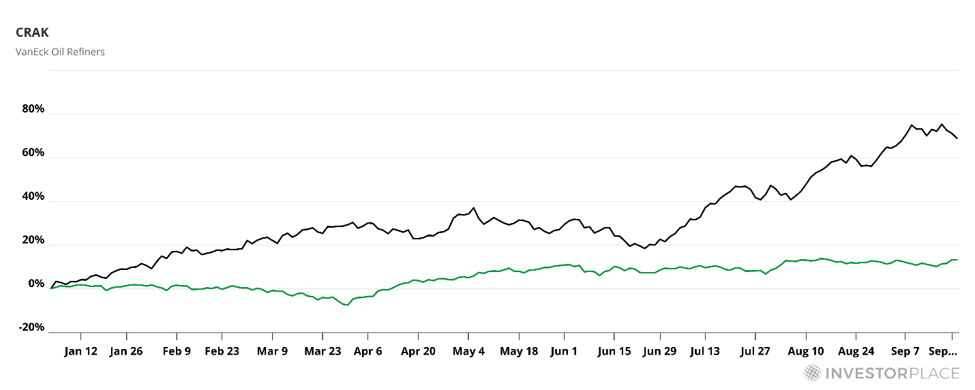
For one-click convenience, check out the VanEck Oil Refiners ETF (CRAK). It holds global refining giants like Marathon Petroleum (MPC), Valero Energy (VLO), and Phillips 66 (PSX).
As you can see below, it’s having a huge year, up more than 70% compared to the S&P’s 13% return.
If you’re looking for a more concentrated bet, one of the names Louis has his Growth Investor readers in is HF Sinclair Corp. (DINO) – a pure-play refiner with no upstream production to muddy the story, so those fat crack spreads flow almost straight to the bottom line.
Louis recommended DINO back on June 23, and his subscribers are already up 65%. But it’s still trading below his Buy Below price of $111.
Stepping back, here’s Louis’ bottom line:
Don’t give up on energy.
I know energy stocks don’t go up when crude oil prices drop, but I do want you to know the refineries are still very, very solid picks for phenomenal sales and earnings.
We’re still going to stick with energy stocks, especially refiners.
Now, the oil patch isn’t the only place Louis is seeing opportunity today. For another stock he likes, let’s dig deeper into his pick we flagged in yesterday’s Digest…
A cheap tech stock hiding in plain sight
Here’s a hot take…
Tech stocks are cheap.
But don’t take it from me. Here’s Louis, once again from yesterday’s Flash Alert podcast:
With technology stocks looking relatively cheap, I think there are some attractive opportunities here.
[Economist Ed] Yardeni’s got one of his QuickTakes reports out there [yesterday] morning showing how cheap tech stocks are.
Let’s look at an example – a stock that Louis’ Growth Investor subscribers are up 50% in since their July 31 entry: Sandisk Corp. (SNDK). It’s a pure-play NAND flash-memory maker, and one of Louis’ “Top Stocks” from last Friday’s issue.
Here’s a wild disconnect for you…
Sandisk is the single best-performing stock in the entire S&P 500 this year, up more than 600%. And yet it trades at roughly seven times forward earnings – less than half the 15 or so times the typical tech stock commands, and among the cheapest AI-exposed names in the market.
If that sounds familiar, it should. It’s the exact same dynamic we laid out using Micron (MU) earlier this month: a memory maker posting record profits, priced as if the floor is about to fall out.
The reason is the same single word – cyclicality. Memory has always been a boom-and-bust business, so Wall Street refuses to pay up for peak earnings it assumes will crater.
But here’s the rebuttal we made for Micron, and it applies just as much for Sandisk. The company has locked in long-term, take-or-pay supply contracts that put a hard floor under its pricing. And according to research shop Bernstein, Sandisk’s floors – around $0.29 per gigabyte – sit meaningfully above Micron’s, offering even sturdier downside protection. Bernstein figures that even in a memory-price collapse worse than 2010, those contracts would blunt the earnings hit.
So, without the fear of a complete earnings wipeout, the single-digit PE multiple makes little sense.
To be clear, it doesn’t erase memory’s cyclicality, and Sandisk has already had a monster run. But it’s clear evidence for Louis’ point: real bargains still exist within AI, even while the headlines are quick to proclaim the mother of all bubbles that’s certain to explode.
If you’re interested in SNDK, Louis’ Buy Below price is $2,238.00. We’ll keep tracking it.
How does Louis find stocks like these?
How does Louis keep finding winners like DINO and SNDK?
The answer isn’t a hunch or a hot tip. It’s data.
Louis is, at his core, a quant – a numbers-first investor who has spent four decades screening for one thing above all: fundamental excellence. Strong earnings, strong sales, fat margins, rising analyst estimates, and real buying pressure. As he put it in yesterday’s podcast:
We have pretty stocks with spectacular sales and earnings.
Years ago, he hard-coded that discipline into a tool he calls Stock Grader. It runs more than 6,000 stocks through eight separate measures of fundamental strength and boils each one down to a simple letter grade, A through F. And the results are hard to argue with – Stock Grader has slapped an “A” on the single best-performing stock in the entire S&P 500 for 12 years running.
Both of today’s names score an “A.” That’s not luck – it’s Louis’ system doing its job.
And this brings us to next week…
Louis is about to make what he’s calling a historic change to Stock Grader – an upgrade he says could add a 2X to 6X boost to his highest-graded names going forward. And he’s unveiling it in a free broadcast on Tuesday, Sept. 29 at 10 a.m. ET.
He won’t be doing it alone. Louis is joining forces with veteran analyst Marc Chaikin, because both men see an unusual market event – an “October Surprise” of sorts – potentially taking shape before the Nov. 3 midterm elections.
Here’s Louis:
I believe an unusual market event could begin before Election Day on November 3. And history gives this event a 92% precedent going back to 1925…
If Marc and I are right, the market could soon begin separating into a very different group of winners and losers.
In fact, we believe this could be the biggest market event of its kind in more than 30 years.
I’ll bring you more details over the coming days, but you can register for the free event today, by clicking here. Beyond learning about this change in the market and what Louis and Marc believe investors should be doing about it, you’ll be walking away with four stocks that you can act on immediately – two to buy, two to avoid.
Wrapping up…
We’ll keep an eye on the diesel crack spread behind the refiners, and whether Wall Street ever comes around to what memory is earning.
In the meantime, put next Tuesday on your calendar. Here’s Louis to take us out:
Several forces that rarely line up at the same time are beginning to converge now.
The historical cycle is shifting, market leadership is changing, and Marc’s and my systems are starting to pick up on the same underlying move.
Have a good evening,
Jeff Remsburg
(Disclaimer: I own MU)


