

Listen to the audio version of this article (generated by AI).
Every year, NFL teams spend months and countless hours of time trying to answer one question.
Who should we draft?
For months, scouts watch countless hours of game film and study the players coming out of college. Coaches meet with the top prospects, while front offices debate who deserves an early pick and millions of dollars in salary.
They were all trying to answer the same question: Who could become the next NFL superstar – and maybe help bring home a Super Bowl?
Of course, even with all that research, they didn’t always get it right. Just look at what happened with the quarterbacks during the 2000 NFL Draft…
In total, 12 quarterbacks were selected that year. Some of them had nice careers. But most of the others faded pretty quickly.
Chad Pennington became a solid starter, but his career was cut short by injuries.
Giovanni Carmazzi never played a regular-season game in the NFL.
Chris Redman spent most of his time as a backup.
Tee Martin didn’t see the field much. He later became a coach.
Marc Bulger made a couple of Pro Bowls.
Spergon Wynn struggled in spurts and only lasted two seasons in the league.
Then there was Tom Brady.
Brady was the 199th overall pick and the seventh quarterback selected.
All of those other guys were picked before him. But Brady… became Tom Brady.
There’s an important lesson there: Sometimes the future superstars are the ones flying under the radar.
It wasn’t that teams hadn’t looked at him. They had watched film, evaluated workouts and analyzed all his statistics. What they didn’t have was a way to recognize a future NFL legend. Brady went on to play in 10 Super Bowls and win seven. He became one of the most accomplished players in NFL history.
The same thing happens on Wall Street.
The next superstar isn’t always immediately visible. You can have all the data and still not pick the right one.
For the past few years, investors have been fixated on the same household-name mega-cap stocks, while smaller companies were largely pushed further down the draft board.
But now, that may be starting to change as small caps are beginning to take the lead.
In today’s Market 360, I’ll show you why small caps are on the move, what’s fueling the move and why I believe some of the biggest opportunities may still be ahead. I’ll also explain why legendary investor Marc and I are paying such close attention to them ahead of our Midterm Mayhem event on September 29. (You can click here to reserve your spot now.)
Small Caps Spent Years on the Bench
For the past few years, it has been easy to understand why investors have focused on the market’s biggest names.
The Magnificent Seven – Apple Inc. (AAPL), Microsoft Corporation (MSFT), Alphabet Inc. (GOOG), Amazon.com, Inc. (AMZN), NVIDIA Corporation (NVDA), Meta Platforms, Inc. (META) and Tesla, Inc. (TSLA) – were putting up tremendous numbers.
In 2023, those seven stocks accounted for more than 62% of the S&P 500’s total return. In 2024, they were still responsible for more than half of the index’s gains.
Small caps simply couldn’t keep up.
The Russell 2000 gained 15.2% in 2023, compared with 24.2% for the S&P 500.
In 2024, the gap widened, with the Russell 2000 climbing 10% versus 23.3% for the S&P 500. And small caps trailed again in 2025.
In other words, they spent years sitting on the bench while Wall Street’s superstars got most of the attention.
But just like Tom Brady, being overlooked isn’t the same thing as lacking potential. There were still some great small-cap companies out there. You just had to know which ones to buy. And that’s exactly what I was doing.
While small caps as a group spent the past few years trailing the market, I continued to find individual companies that were bucking the trend.
And those winners piled up.
In fact, I now have nine small-cap recommendations with gains of 100% or more in one of my premium services – including one with gains of more than 800%.
So, even when small caps weren’t leading the market, I was still finding big winners among them – thanks to my quantitative system, Stock Grader.
Now, the whole group is starting to move.
Small Caps Are Taking the Lead
As of Monday, the Russell 2000 was up 15.9% year to date, compared with a 13.4% gain for the S&P 500.
What’s behind the shift?
It starts with earnings.
The earnings story for small- and mid-cap stocks is incredibly powerful right now. And many smaller companies are expected to grow earnings much faster than their large-cap peers.
The small-cap stocks I’m currently recommending, for example, have average forecasted earnings growth of 189.8% and average forecasted sales growth of 67.5%. Meanwhile, our friends at FactSet estimate 28.9% earnings growth for the S&P 500 in the third quarter.
And as readers may know, I’m evangelical about earnings. I believe nothing is more important to a stock’s long-term potential than its ability to grow earnings.
When earnings are growing, stock prices tend to follow.
But here’s the important part: I don’t think this move is anywhere close to finished.
Why Small Caps Could Have Much Further to Run
Here’s where things get really interesting.
Small caps may already be on a tear, but that doesn’t mean the opportunity has passed. In fact, by a couple of important measures, they still look like they have plenty of catching up to do.
For starters, small-cap valuations are still hovering around a 25-year low.
Investors are paying much less for a dollar of operating earnings from small companies than they typically have in the past.
According to FactSet, the small-cap Russell 2000 index is currently trading at about 85% of the valuation of the Russell 1000 index of larger stocks. Historically, the average is close to 100%.
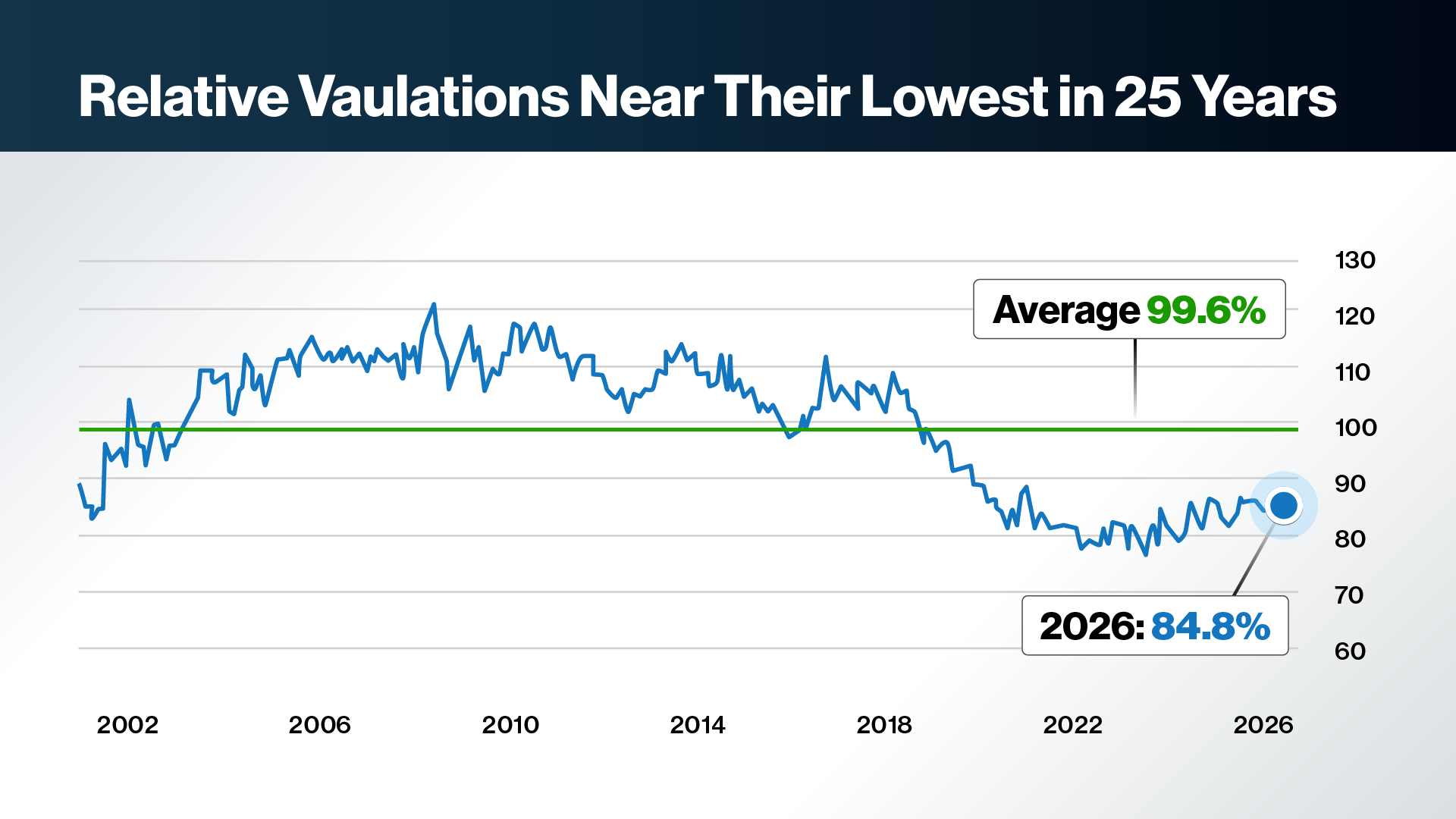
In other words, small caps are still cheap compared with their larger peers.
So, even after the gains we’ve seen, investors still aren’t paying anywhere close to historically high prices for these companies.
Another thing is that small caps only make up about 4% of the total U.S. stock market today. Historically, that figure has been closer to 9%.
That’s a pretty remarkable gap.
And remember, these companies are starting to produce much stronger earnings at the same time.
So, we have a group of stocks that is already outperforming, with accelerating earnings and relatively low valuations.
That’s not what I’d call the end of a move. More like the beginning.
Small-cap bull markets tend to play out over years, not a few weeks. And if this one follows anything close to the historical pattern, there could still be a long runway ahead.
Don’t Wait Until the Winners Are Obvious
That doesn’t mean every small-cap stock is going to be a winner, of course. Just like not every quarterback in the 2000 NFL Draft became Tom Brady, not every overlooked company is destined for greatness.
You still have to know which ones to own.
Remember, by the time everyone knew Tom Brady was a superstar, nobody was overlooking him anymore.
The opportunity to recognize what everyone else had missed came much earlier. And that’s exactly what Marc and I are going to help you with next Tuesday during the 2026 Midterm Mayhem Event.
I don’t want you waiting until Wall Street’s next winners are obvious to everyone else.
So, we’ll show you what we believe is coming next for the market, why small-cap stocks could be some of the biggest winners – and, most importantly, how to prepare.
Click here to save your seat for the 2026 Midterm Mayhem Event now.
Sincerely,

Louis Navellier
Editor, Market 360
The Editor hereby discloses that as of the date of this email, the Editor, directly or indirectly, owns the following securities that are the subject of the commentary, analysis, opinions, advice, or recommendations in, or which are otherwise mentioned in, the essay set forth below:
Apple Inc. (AAPL), Alphabet Inc. (GOOG) and NVIDIA Corporation (NVDA)


