


Listen to the audio version of this article (generated by AI).
Hello, Reader.
In October 2003, the Brian Jonestown Massacre released a song called “A New Low in Getting High.”
The California retro-rock band wasn’t singing about the stock market, of course. But it might as well have been writing the dot-com bubble’s epitaph.
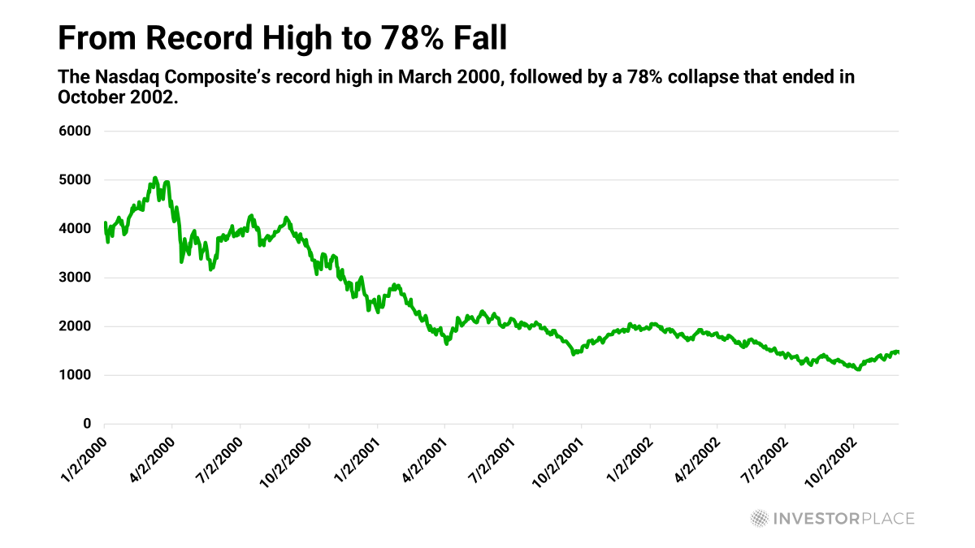
In the months leading up to March 2000, when the Nasdaq Composite reached its dot-com peak, the index kept setting records… even as fewer and fewer stocks participated in the rally.
By the time the Nasdaq hit its high, plenty of stocks were already having a miserable time. Then the bubble burst.
Over the next two and a half years, the Nasdaq Composite plunged 78% from that peak, finally hitting bottom in October 2002.
And now we may be seeing something disturbingly similar.
I like to compare the stock market to a cocktail party. A healthy party has people mingling, laughing, and generally enjoying themselves. The more guests participating, the better the party.
But when a handful of guests are laughing in the corner while most of the room is plotting an escape, the festivities have taken an unpleasant turn.
Lately, that’s been the stock market.
Over the past 18 months, the Nasdaq-100 has closed at record highs 55 times. But during its three most recent record-setting days, an average of just 764 stocks across U.S. exchanges reached new 52-week highs.
A year earlier, that figure was 1,581.
The Nasdaq-100 keeps setting records, but fewer and fewer stocks are joining the celebration … a stat eerily close to the market before the dot-com bubble burst.
It’s worth asking what investors can do about it. After all, knowing that a party is going badly isn’t especially useful unless you know where the exits are, or where else you might want to spend the evening.
Today, I’ll show you why this market deserves caution — and give you the name of an overlooked healthcare stock that I believe offers substantial upside, even if the market’s party keeps shrinking.
The Music’s Still Playing, but Look at the Room
Take a look at the chart below.
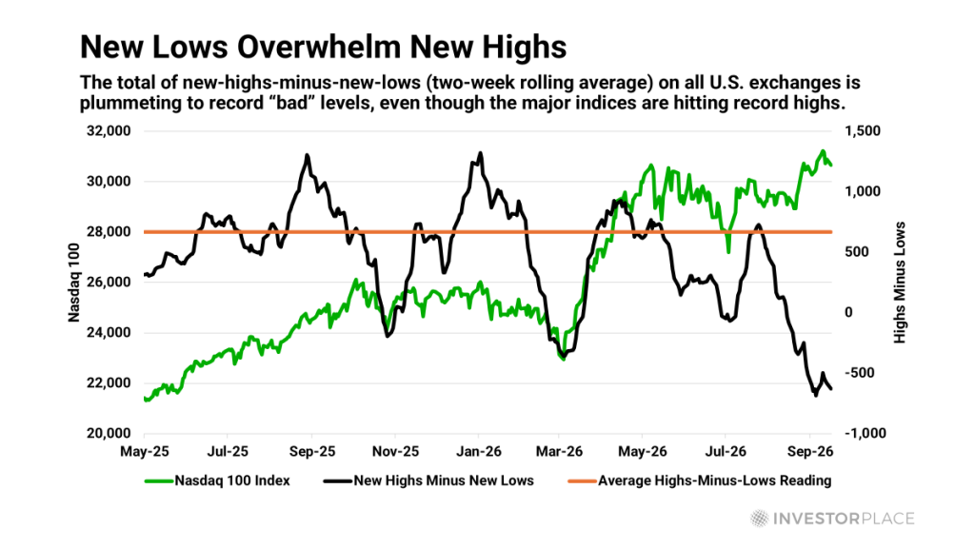
The green line shows the Nasdaq-100, which has been marching steadily higher. Nothing terribly alarming there.
But the black line tells a very different story. It measures the number of stocks across U.S. exchanges hitting new 52-week highs, minus those falling to new 52-week lows, averaged over two weeks. When that line drops below zero, more stocks are hitting new lows than new highs.
And lately, it’s fallen off a cliff.
The Nasdaq-100 is setting records while hundreds more stocks are hitting new lows than new highs. That’s an unhealthy combination.
During the Nasdaq Composite’s final 34 record-high days before the dot-com crash, new lows outnumbered new highs on the New York Stock Exchange on 31 of those days.
I’m not suggesting we’re about to experience another 78% collapse. History rarely repeats itself quite so obligingly.
But I’ve been around long enough to know that when the market’s leaders keep climbing while the rest of the market deteriorates, trouble can follow.
One reason for this growing imbalance is what I call a self-fulfilling buying cycle. The market’s biggest companies attract an enormous amount of investment money. As their stocks rise, index funds and professional investors buy more of them. That additional buying pushes prices higher, which attracts still more money.
Meanwhile, smaller companies and less fashionable industries get left behind.
The popular stocks become more popular because they’re going up. The unpopular stocks become less popular because they aren’t. It’s a remarkably simple process, and one that can continue much longer than common sense might suggest.
Eventually, that concentration makes the entire market more vulnerable. If the handful of companies doing the heavy lifting stumble, there aren’t many others ready to pick up the slack.
My advice is simple: Don’t confuse a market hitting record highs with a market that’s getting stronger. And don’t assume the stocks everybody wants to own are necessarily the best investments available.
In fact, some of the most interesting opportunities may be hiding among the stocks Wall Street has stopped inviting to the party.
Which brings me to a company that’s about as far removed from Silicon Valley’s AI frenzy as you can get.
A Healthcare Giant Wall Street Has Left Off the Guest List
Novo Nordisk A/S (NVO), the Danish pharmaceutical giant behind Ozempic and Wegovy, used to be one of Wall Street’s favorite stocks.
Then its longtime rival, Eli Lilly & Co. (LLY), began winning the battle for the lucrative obesity-drug market. Lilly’s Zepbound delivered better weight-loss results than Novo’s injectable Wegovy in a landmark clinical trial, and investors responded accordingly.
Over the past five years, Lilly’s stock has gained roughly 400%, while Novo’s has lost ground.
Wall Street seems to have decided that Lilly has won the obesity-drug race, collected the trophy, and retired the competition. I think the victory celebration may be premature.
Novo currently trades at roughly 14 times earnings, compared with 34 times for Lilly. Its market capitalization is about one-fifth of Lilly’s, even though their obesity and diabetes businesses generate similar annual sales.
That’s a remarkable valuation gap between two companies competing in the same enormous market.
And here’s what Wall Street may be missing: Lilly may have won the battle of the injections, but Novo has taken an early lead in pills.
In January, Novo launched the first oral GLP-1 treatment for obesity, the Wegovy pill. During its first six months, it racked up approximately 5 million prescriptions, capturing roughly 76% of the U.S. oral obesity-drug market.
Lilly’s competing pill arrived in April but has yet to match that momentum.
The appeal of an effective obesity pill is obvious. Millions of patients would prefer swallowing a tablet to injecting themselves every week. And whichever company captures a meaningful share of that market could enjoy a very profitable future.
Novo also has a promising pipeline of new treatments, including its next-generation obesity drug CagriSema, along with therapies targeting blood disorders and liver disease.
And it’s putting AI to work through partnerships with Microsoft Corp. (MSFT), OpenAI, Amazon.com Inc. (AMZN), and other technology companies to accelerate drug discovery and improve its operations.
That’s what I call an AI Applier: an established business using AI to improve its profitability rather than spending billions building the infrastructure behind it.
Novo doesn’t need to invent the next generation of AI models. It simply needs to use them to develop better medicines, more efficiently.
Of course, Novo isn’t without risks. Lilly remains a formidable competitor, and Novo faces pricing pressure, patent expirations, and uncertain regulatory outcomes.
And cheap stocks have a habit of remaining cheap when the underlying business fails to improve. That’s why I never consider a low valuation, by itself, a compelling reason to buy.
But Novo is still a highly profitable pharmaceutical company with established products, a substantial research pipeline, and a potentially valuable head start in oral obesity treatments. Those are meaningful assets, even if Wall Street has temporarily lost its enthusiasm for them.
At the beginning of this year, I called Novo one of my “Top 7 Stocks for 2026.” At today’s prices, I believe Novo could potentially double and still trade at a discount to Lilly’s valuation. That outcome isn’t guaranteed, of course. But it illustrates just how much pessimism investors have already baked into Novo’s share price.
In a new special report, I explain a strategy that could produce even larger percentage gains if my forecast for Novo proves correct. It also involves greater risk than simply owning the shares. That report is one of the bonuses available to investors who take action after watching my new free presentation.
And Novo is just one of the opportunities I’ve been researching.
I believe an even bigger investment shift could begin around November 4, as the market starts distinguishing between companies spending enormous sums building AI infrastructure and those putting AI to profitable use.
I’ve recorded a free special presentation explaining what I’m seeing. During it, I’ll reveal the name and ticker of my No. 1 AI Applier, another company I believe is positioned to benefit from this shift.
Click here to watch my free presentation and discover my No. 1 AI Applier stock pick.
As for the stock market’s cocktail party, I’m not suggesting you leave just because a few guests have become obnoxiously loud.
But when most of the room is heading for the exits, it pays to notice.
And while the crowd continues to celebrate the same handful of fashionable stocks, I’ll keep looking for opportunities in the quieter corners of the market.
Regards,
Eric Fry
Senior Global Macro Analyst, InvestorPlace


