

Listen to the audio version of this article (generated by AI).
If you’ve ever seen the movie Moneyball, you already understand one of the most important lessons in investing.
In the film, one team couldn’t compete with the biggest spenders in baseball. So, instead of chasing star players, they changed the way they evaluated talent.
They focused on overlooked metrics that actually drove wins – and in doing so, found value where others weren’t looking.
That shift in thinking changed everything.
And we’re seeing that same dynamic play out in the market right now, especially in the race to dominate artificial intelligence.
Right now, most investors are still focused on the obvious names – the ones grabbing headlines and driving the broader AI narrative. But behind the scenes, a different group of companies is quietly delivering the real results.
These are the businesses enabling the AI boom – supplying the infrastructure, power and systems that make it all possible. Unlike the headline-grabbers, their growth is driven by real, measurable demand.
In other words, while investors are still focused on the “flash,” the biggest opportunities are being built on function.
And two companies that reported earnings this week make that contrast crystal clear.
Tesla, Inc. (TSLA) and Vertiv Holdings Co. (VRT) both released results yesterday – and in doing so, revealed exactly where investors are still getting AI wrong.
In today’s Market 360, we’ll break down what they reported, which company is the better opportunity right now… and how to tell the difference between hype and real AI opportunity.
Tesla, Inc.
Tesla doesn’t need much of an introduction. It’s one of the most widely followed companies in the market – and one of the names most closely tied to the AI story.
While best known for its electric vehicles, Tesla has increasingly positioned itself as an AI company, with a long-term vision centered on autonomous driving, robotaxis and robotics.
That vision has kept Tesla at the forefront of investor attention, as reflected in the company’s latest results.
In the first quarter, Tesla reported revenue of $22.39 billion, a 16% increase from a year ago and slightly ahead of expectations.
Adjusted earnings came in at $0.41 per share, also topping analyst estimates.
The results show Tesla’s core business is beginning to stabilize, even as the company shifts more focus toward its AI-driven future.
The company plans to spend roughly $25 billion this year developing autonomous Cybercab vehicles, Optimus humanoid robots and other AI-driven initiatives.
That includes early work on its planned “Terafab” project. This is a projected 100-million-square-foot facility – roughly ten times the size of Tesla’s Gigafactory Texas. It aims to produce 70% of the world’s current chip output by generating one terawatt of computing capacity annually.
The project is a massive joint venture between Tesla, SpaceX, xAI, and Intel. And if the full vision comes to fruition, it could ultimately cost up to $5 trillion.
For Tesla’s part, the facility will be designed to produce next-generation A15 chips and computing infrastructure, which will power both its vehicle and robotics ambitions.
This project is still in its early stages. In the first quarter, Tesla spent less than $2.5 billion toward those efforts. But spending is expected to ramp significantly in the years ahead.
At the same time, the company acknowledged that some of these initiatives will take time to scale. CEO Elon Musk noted that robotaxi revenue is not expected to be “super material” this year, even as the company expands its service. Tesla’s robotaxi platform is already active in cities like Austin, Dallas and Houston, with additional launches planned for Phoenix, Miami, Orlando, Tampa and Las Vegas. Meanwhile, production of its Optimus robot is still ramping gradually.
Looking ahead, management pointed to a stable demand environment while acknowledging growing competition and pricing pressure across the EV market.
Vertiv Holdings Co.
Vertiv Holdings isn’t a household name. But it plays a critical role in the AI boom.
The company is a global leader in digital infrastructure for data centers, communication networks and industrial environments. Its products include power systems, thermal management, racks and monitoring software.
In simple terms, Vertiv helps keep data centers powered, cooled and fully operational.
And that role is becoming more important by the day.
As artificial intelligence workloads expand, they require more computing power. That, in turn, drives higher energy demand and greater heat output. Without the right infrastructure in place, those systems simply don’t work.
That’s where Vertiv comes in.
The company supports more than 750,000 customer sites across over 130 countries, providing the backbone that enables AI systems to run at scale. This isn’t a “nice to have” part of the AI story – it’s essential.
And that demand is now clearly showing up in the company’s results.
In the first quarter, Vertiv’s sales grew 30% year-over-year to $2.65 billion, in line with analysts’ expectations. Adjusted earnings jumped 83.4% to $1.17 per share, easily beating expectations of $1.01 per share.
Looking ahead, the company expects second-quarter sales between $3.25 billion and $3.45 billion, adjusted earnings per share between $1.37 and $1.43. That compares to sales of $2.64 billion and earnings of $0.95 per share in the second quarter of 2025.
For the full year, Vertiv raised its outlook and now expects sales between $13.5 billion and $14 billion, alongside earnings per share of $6.30 to $6.40. That represents 29% to 31% annual sales growth and 50% to 52.4% annual earnings growth.
In other words, this is a company seeing strong demand from one of the most important trends in the market today – and its results are beginning to reflect that.
Which Is the Better Pick?
If you go back to the Moneyball story, you’ll remember the entire edge came down to using the right metrics.
And that’s exactly how we should be evaluating these two companies today.
On the surface, Tesla is the more dominant story. With a market capitalization of roughly $1.2 trillion, it commands enormous attention and sits firmly at the center of the AI conversation.
Vertiv Holdings, by comparison, is far smaller, with a market cap of roughly $115 billion – just a fraction of Tesla’s size. It doesn’t receive the same level of attention, but it plays a critical role in powering the on which that AI depends.
So how do you separate the two?
That’s where my Stock Grader system (subscription required) comes in.
Instead of focusing on headlines or narrative, Stock Grader evaluates companies based on the factors that have historically driven outperformance – things like earnings growth, sales momentum and overall financial strength.
And when you run both companies through that system, the difference becomes clear. Vertiv Holdings earns an “A” rating, meaning “Very Strong,” while Tesla earns a “C” rating or “Neutral.”
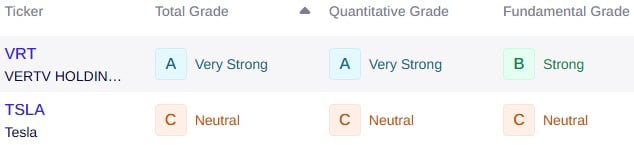
This isn’t about opinions or hype. It’s about what the data is telling us.
Vertiv is delivering strong, accelerating growth tied directly to one of the most important trends in the market today. Its business is benefiting from real, measurable demand.
And this is exactly the kind of opportunity I look for.
In fact, I recommended Vertiv to my Growth Investor subscribers back in 2024, well before the current wave of enthusiasm around AI infrastructure.
Since then, the stock has surged nearly 356%.
Over that same time, Tesla is up about 85%.
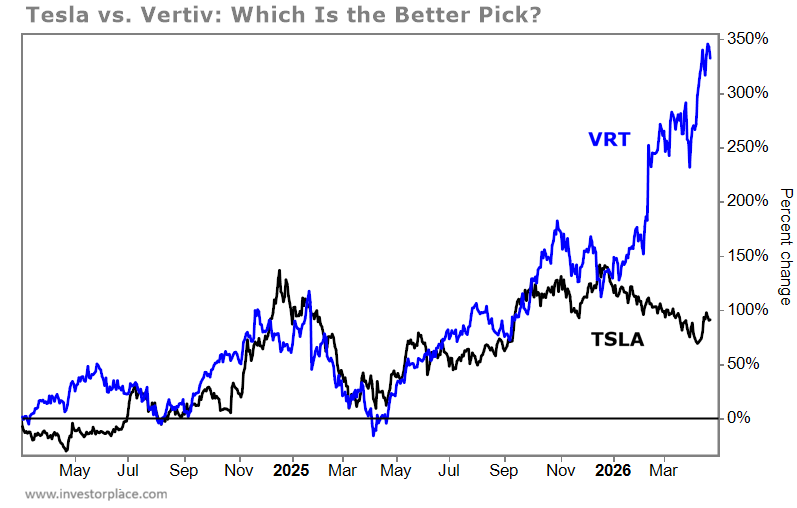
That’s a massive performance gap – especially given how much more attention Tesla continues to receive.
And it highlights exactly what we’ve been talking about.
One company is being driven by what’s happening right now – real demand, real growth and real results.
The other is still largely tied to what investors expect could happen next.
Hype vs. Real AI Opportunity
What we just walked through with Tesla and Vertiv isn’t a one-off situation. It’s a clear example of how the AI story is shifting.
The first wave of AI rewarded visibility. Big ideas and companies with compelling narratives.
And for a while, that was enough.
But that’s beginning to change.
As AI moves from concept to execution, the market is starting to reward something very different – real demand, real growth and the infrastructure that makes it all possible.
That’s the difference between hype and real opportunity.
And it’s exactly what we’re starting to see play out across the market right now.
That raises an important question: If the AI story is evolving… are you positioned for what comes next?
Because, as we just saw, the way investors need to approach AI is already starting to change.
That’s why I recently put together a new presentation on what I’m calling the AI Reset.
In it, I break down where this shift is headed next, which types of companies are best positioned to benefit and how to get ahead of it before the crowd fully catches on.
I strongly encourage you to watch this presentation now while this opportunity is still developing.
Sincerely,

Louis Navellier
Editor, Market 360
The Editor hereby discloses that as of the date of this email, the Editor, directly or indirectly, owns the following securities that are the subject of the commentary, analysis, opinions, advice, or recommendations in, or which are otherwise mentioned in, the essay set forth below:
Vertiv Holding Co. (VRT)


