

Listen to the audio version of this article (generated by AI).
Hello, Reader.
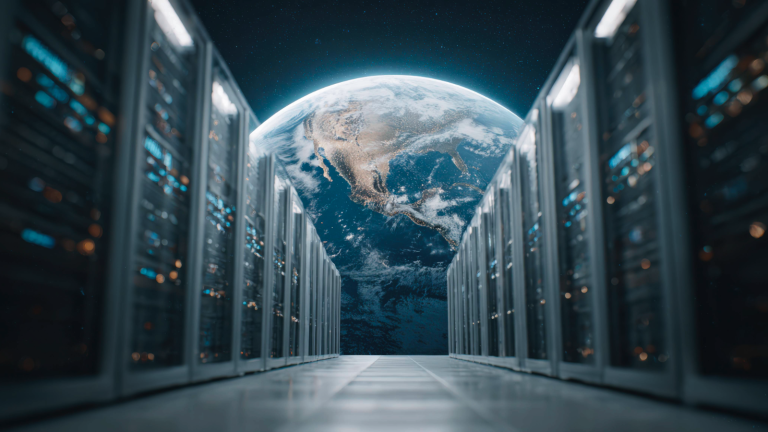
Solar panels can generate up to eight times more power in orbit than on Earth. Last Thursday, October 1, Alphabet Inc. (GOOGL) launched AI hardware on a SpaceX rocket in order to measure that advantage.
Developed with satellite imaging company Planet Labs PBC (PL), Google’s Project Suncatcher is an experiment to see whether AI data centers can operate in space, powered by abundant solar energy.
Over the coming weeks, Project Suncatcher’s prototype satellite will test how well Google’s AI chips can handle radiation and extreme temperatures. It’s the first step in assessing whether solar-powered AI computing can work at scale in space.
Now, it’s worth asking why we’re looking beyond Earth to run AI.
The answer is power.
Earth isn’t running out of energy, but AI demand is growing faster than we can build power plants and grid connections here on this “pale blue dot.”
Research company Gartner expects global data center electricity use to rise 26% this year, reaching 565 terawatt-hours (TWh) – roughly as much electricity as France uses in a year. This surge is driven largely by the servers in AI data centers, whose power consumption is projected to climb more than 80% this year. By 2030, data centers could consume over 1,200 TWh, with Gartner warning that grid supply can’t keep pace.
That’s the real story behind Project Suncatcher. Whether space-based data centers can work at scale or not, Google and the other hyperscalers need to figure out how to power the next generation of AI.
For investors, that matters more than whether one satellite works.
In today’s Smart Money, let’s look at what Google’s Suncatcher project reveals about the AI boom’s growing constraints. Then, I’ll show you where the next AI opportunity is ready for liftoff.
The Bottleneck Even Google Can’t Outspend
Suncatcher offers a glimpse at AI’s future, but the energy problem it’s trying to solve is already here. Today, major tech companies are pouring hundreds of billions of dollars into AI infrastructure – only to find that there isn’t enough power to run it.
Alphabet is on track to spend roughly $175 billion on AI infrastructure this year. Amazon.com Inc. (AMZN), Microsoft Corp. (MSFT), and Meta Platforms Inc. (META) are spending at a similar scale. And the projects are enormous. Meta’s Hyperion campus in Louisiana is expected to consume more electricity than the city of New Orleans.
But money can’t buy time. A new natural gas plant takes three to five years to come online. A nuclear plant takes 10 to 15 years. Even a solar farm takes 18 to 24 months.
The hyperscalers can write a check tomorrow, but they can’t make the power arrive any faster.
Meanwhile, every month a finished data center sits waiting for a grid connection, the expensive chips inside it are aging without earning a dime.
Hence, this latest space race. The final frontier offers something increasingly difficult to secure on Earth – abundant solar power without waiting years for a new grid connection.
Google hasn’t said what Suncatcher costs. But it has been clear about what it would take for the idea to work financially.
Google says launch costs would need to fall below about $200 per kilogram for Suncatcher to compete with data centers on Earth. Even optimistic estimates put a full-scale Suncatcher data center a decade or more away.
In other words, even Google’s own solution to the energy problem runs on a 10-year clock.
And even if Suncatcher eventually works, it won’t unclog the AI infrastructure bottlenecks we’re facing right now. Whether they’re on Earth or in orbit, AI data centers still need chips, memory, copper wiring, solar panels, radiators, and rockets to get there.
Basically, a data center in orbit doesn’t remove the need for physical inputs… it adds new ones.
And that creates an opportunity much closer to home.
Who Gets Paid Whether Suncatcher Works or Not
If space computing works, someone has to supply the chips, metals, and power hardware to build it.
If it stalls, the pressure stays right here on Earth – on the power plants and grid connections that keep data centers running… the mines that produce the copper wiring every facility depends on… and the “fabs” that make the memory chips AI systems need to process data.
Either way, the companies that supply AI’s scarcest inputs are in a position of strength. When demand outruns supply and buyers can’t wait, the suppliers set the price.
I see three areas where that’s playing out right now.
The first, of course, is energy. Over the long run, meeting AI’s demand will take every source of energy we can generate, from the ground below us to the space above us.
The second is raw materials. Every data center, transformer, and transmission line runs on copper, and a new copper mine can take seven to 10 years to bring online. That’s yet another decade-long clock.
The third is memory. Nvidia Corp. (NVDA) CEO Jensen Huang has called the memory bottleneck “severe,” and the supply of the memory chips that AI systems depend on hasn’t kept pace with the data centers being built.
Here’s the common thread: AI investing is shifting toward what I like to call “things you can kick.” The businesses that mine, generate, and manufacture the physical things AI can’t run without.
A Google satellite has gone into orbit carrying AI chips. And while it may be years before we know whether AI can run in space at scale, the experiment is telling us now that the biggest limits on AI today are physical, not digital.
And that’s exactly where the money can be found. You can learn more about these three critical bottlenecks – and the companies helping to solve them – in my latest special presentation.
Those bottlenecks won’t be solved overnight. That’s exactly what makes those companies worth owning.
Click here for all the information.
Regards,
Eric Fry


