
Tom Yeung here with your Sunday Digest.
What year would you have wanted to be born in?
The 2023 International Booker Prize-winning book, Time Shelter, explores this with a dash of black humor. In it, Bulgarian author Georgi Gospodinov writes about a psychiatrist who creates a clinic for Alzheimer’s patients where each floor re-creates a decade in intricate detail. Healthy people then come to the clinic, seeking to relive past eras.
The concept eventually becomes so popular that entire countries hold referendums allowing citizens to vote on when to move back to. Bulgaria rewinds to the 1970s, while France picks the 1980s. It is a masterwork in examining nostalgia, collective memory, and the seduction of the past.
But what if you added a second constraint to those national referendums: that you would have to be born into a family at the bottom 25% of wealth?
In America, the best period to have been born poor was not the 1960s… the 1970s… or even the tech-driven world of the 2000s.
It would have been the 1940s.
If you’re paying attention, you likely suspected that. Just think of the massive wealth you see in Mar-a-Lago… the lush golf courses dotting The Villages and other retirement communities… the multimillion-dollar family offices that line Wall Street…
According to studies by the National Bureau of Economics, 90% of children born in the 1940s eventually outearned their parents in real terms. Those who came from the bottom-25% of wealth ended up in the mid-40th percentile.
In fact, those who were lucky enough to be born in 1945 saw the best return in the stock market during their prime savings years.
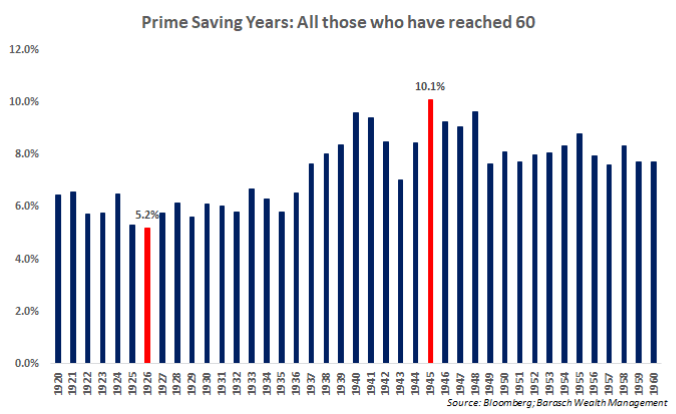
They lived through the era of the American Dream.
However, the American Dream is in decline. Just 50% of those born in the 1980s now outearn their parents in real terms (down from 90% in the 1940s). Upward mobility for families has reverted to 1910s levels… and we’re quickly turning into a society of “haves” and “have-nots” where a party at Mar-a-Lago might as well be a scene out of The Great Gatsby.
It’s no wonder that 76% of millennials and 75% of Gen-X’ers now experience historical nostalgia, compared to just 35% of the Silent Generation and 59% of baby boomers.
That’s why Washington has been so laser-focused on rebuilding an earlier era. Their vision is where well-paying manufacturing jobs are brought back, investment is directed into America, and the American Dream is reborn.
Some of this started with the $2.2 trillion Build Back Better Act and the $280 billion CHIPS Act. These were the largest industrial policy packages the U.S. government had created to date.
But our three senior analysts, Louis Navellier, Eric Fry, and Luke Lango, believe this is just the start.
In their brand-new free presentation, The American Dream 2.0 Summit, they outline how we’re now at the start of an $11.3 trillion investment bonanza aimed at turning America back into a global powerhouse. These enormous sums have been wrangled out of multinational firms and sovereign nations alike and will be spent on AI data centers… research… manufacturing… and more.
Even better, they will discuss their Power Portfolio 2026, a list of their “best-of-the-best” companies that are riding on this new investment wave.
In last week’s Sunday Digest, I revealed three companies that were considered for their portfolio, but didn’t quite make the cut. This week, I’d like to suggest two more promising firms that illustrate how high a bar the Power Portfolio has set…
Top Stock for 2026 No. 4: The Chemistry Behind American Manufacturing
Chemical maker Celanese Corp. (CE) is a sped-up version of the American Dream. The world’s largest producer of acetic acid performed marvelously through the 2010s, thanks to its access to low-cost U.S. natural gas feedstocks and a solid execution strategy.
The company used this cost advantage to dominate the acetyl-chain industry, which supplies the automotive sector, construction industry, and more. Celanese also acquired DuPont’s (DD) mobility and materials portfolio in 2022, turning the combined entity into one of the world’s largest engineered material producers as well.
However, a global slowdown in chemicals demand since then has turned Celanese into a deep-value play. Shares plummeted from the $150 range down to the $40 range, and its carefully planned DuPont acquisition now looks like a millstone. The company slashed its dividend by 95% in 2025 to prioritize repaying the debts it accrued from the purchase.
That’s why the American Dream 2.0 is so crucial to Celanese’s recovery.
Over the coming 12 months, analysts expect the crucial automotive business to stabilize. Edmunds calls it a “sustainable pace supported by real demand.”
Meanwhile, the construction industry is expected to see “a decade of demand arriving all at once” in the energy and utilities sector, as global consulting firm West Monroe puts it. Data centers and electrification are driving enormous amounts of load growth, creating demand from the construction industry for the adhesives, paints, and solvents that Celanese helps create.
That’s why analysts expect revenues at Celanese to rise in 2026 for the first time since 2023. This is despite management’s decision to sell its noncore Micromax business (electronic inks) to repay debt.
Profits are also expected to surge. Gross income is expected to jump 17% to $2.1 billion, helping flip reported net income positive after two years of negative numbers.
That’s a historically excellent sign for firms like Celanese. Conservative investors typically favor stocks only after companies have turned profitable. Buying Celanese today gets investors in before the rush.
It’s also essential to note that Celanese trades at a significant discount to its justified value, which sits closer to $100 per share. The company continues to have the same access to low-cost natural gas feedstocks, and a return to normal industry pricing gives CE stock an upside of 140%.
Top Stock for 2026 No. 5: The Hidden Compute Leader
It’s becoming a challenge to find promising AI plays at the right price. Shares of Nvidia Corp. (NVDA) have now risen 950% since ChatGPT was released on November 30, 2022. Data center infrastructure firm Vertiv Holdings Co. (VRT) has jumped 1,050% over the same period, while AI darling Palantir Technologies Inc. (PLTR) has surged 2,300%.
Power producers… chipmakers… AI software firms: Most now trade at their highest valuations in recent history.
Akamai Technologies Inc. (AKAM) is one notable outlier.
This cybersecurity and cloud computing firm has traded flat since ChatGPT was launched, and now sits at just 12 times forward earnings.
The reason is straightforward: Akamai was once the leader in content delivery networks (CDN), the global mesh of servers that allow websites to load at lightning speeds. An internet user in Japan, for instance, would access an American website like Delta.com through a Japanese server, rather than one based in the United States. This can shave significant amounts of waiting time, especially when data makes multiple round trips.
The CDN industry no longer has a leader. Most media firms have now built their own CDNs, and many hyperscale data centers and cloud computing firms now offer competing services. CDNs now make up just 30% of Akamai’s business, down from 80% in 2017.
However, Akamai has quietly repurposed its CDN servers to support enhanced cybersecurity and cloud computing.
In 2022, the firm acquired Linode, a developer of cloud infrastructure that specialized in virtual machines. The following year, Akamai launched its Connected Cloud, a platform focused on edge computing. Then in 2024, the firm acquired Noname Security (not a typo) to build out its cybersecurity offerings.
Together, this has turned Akamai from a CDN provider into the most distributed cloud in the world. The firm’s cloud has 4,400 points of presence, dwarfing the 750 that Amazon Web Services has through CloudFront.
This network will become invaluable as America builds out its network of robots, self-driving cars, and other connected AI devices. These “edge” devices require ultrafast, ultra-safe connections to data centers.
And so, analysts forecast revenue growth at Akamai to reaccelerate through 2027 as a result. This lucrative business should raise reported earnings per share 18% annually over the same period, making its current valuations a steal.
The Rebirth of the American Dream
In a recent Market 360 update, Louis Navellier noted the extravagance of a recent Gatsby-themed celebration at the Mar-a-Lago Club.
The chandeliers were glowing, the band was roaring, and President Trump was still greeting guests close to midnight.
But what stood out to him was the contrast.
Outside those walls, Americans are facing higher prices, shrinking opportunities, and an economy that feels stacked against them. Many people tell me it feels harder than ever to get ahead. For countless families, the American Dream that shaped generations now feels out of reach.
You see, Louis was part of this earlier American Dream “1.0.” His father was a bricklayer, and as a boy, Louis would pick up caddying shifts at the local golf course. He would go on to score in the top 1% in math on the SATs, finish college in three years, earn an MBA, and launch a career on Wall Street.
But now he’s worrying about what life will be like for his children and grandchildren. Which side of the “Mar-a-Lago wall” will they find themselves on? What kind of America will they inherit? Because clearly, the American Dream 1.0 isn’t working anymore.
That’s why the American Dream 2.0 is so crucial. It’s a make-or-break for this next generation. And it’s why so many trillions of dollars are getting funneled into accelerating American infrastructure.
It might not all work out, however… so I urge you to watch Louis team up with Eric and Luke in their American Dream 2.0 Summit.
See you back here next Sunday.
Regards,
Thomas Yeung, CFA
Market Analyst, InvestorPlace


