
Our old warning about Adobe… Luke Lango and “the flip side”… why price is all that matters in today’s AI world… the power of stage analysis… which stocks Luke classifies as winners and losers going forward
In our August 26, 2024, Digest, we warned investors about the risks that AI posed to software giant Adobe (ADBE):
For some part of the foreseeable future, AI advancements should help Adobe make jaw-dropping products for its designer clients that we would expect to boost earnings.
But what happens when AI grows so advanced that we no longer need digital designers?
Instead, you’ll just tell an AI Digital Design Bot what you want.
Well, in that case, without a drastic pivot, Adobe’s entire business model goes “poof.”
If that Digest scared you out of ADBE, congratulations – you sidestepped a 52% “poof.”
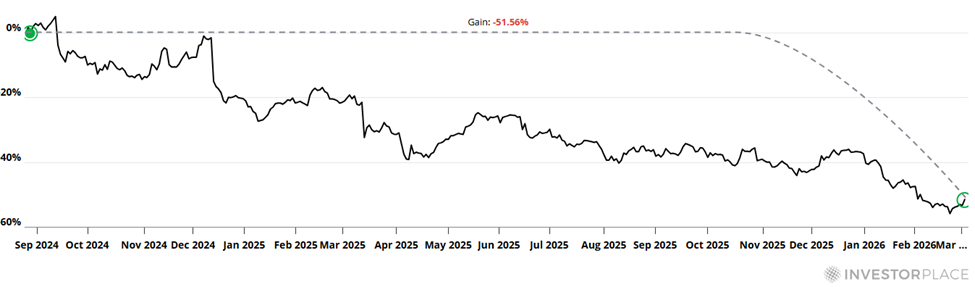
Let’s jump to our technology expert Luke Lango for more on the recent carnage in the software sector:
The tech industry spent years telling a beautiful story about AI.
“AI will make everything faster and smarter and better, and the companies building it will be the most profitable in history.”
But there was a flip side to that pitch: If AI can do everything its champions claim, it can replace everything its customers currently pay for.
That flip side has arrived.
In recent days, I’ve highlighted Luke’s analysis explaining the best way to invest in this “flip side.”
In short, investors need to be wary of companies that offer only digital products, while considering companies that facilitate the physical layer of AI.
Back to Luke:
What separates the winners from the losers?
Physical versus digital; atoms versus bits.
The companies being demolished are pure-play digital – software, platforms, marketplaces, fintech apps.
The companies soaring are manufacturers, hardware producers, and energy providers.
For the first time in about 15 years, having a physical business is a competitive advantage rather than a drag on margins.
Now, at the end of today’s Digest, I’ll name-drop a handful of potential winners and losers that Luke just highlighted. But before we get there, let me do you one better…
Let’s walk through a market approach you can use today to navigate this AI “sifting machine” on your own. It will help you sidestep the next AI destruction…and help you uncover the next soaring trade.
In fact, circling back to Adobe, even if you missed our August 2024 Digest… even if you had no awareness of how destructive AI would be for software stocks… this simple-yet-highly-effective market approach could have helped you sidestep the worst of this stock collapse.
Let’s talk about how, then get into the best ways to apply it today.
Price is truth
AI is rewiring our global economy.
No one knows exactly where this takes us, much less which stocks will be 100% higher or 50% lower by this time next year.
Circling back to software, here’s Luke making this point:
When investors look at a high-multiple Software-as-a-Service (SaaS) company and ask, “will this business still be here in five years?”, the honest answer is increasingly:
I genuinely don’t know.
The way around this is to focus on what we do know – price.
At the end of the day, our best analysis is irrelevant if it contradicts the core axiom of the stock market…
Price is truth.
It doesn’t matter if your spreadsheets, research, and discounted cash flow models conclude that a $50 stock should climb to $100. If it falls to $27, that’s “truth.”
Traders who fight that truth lose. Traders who respect it – and swim with the current, whether they agree with it or not – grow their wealth.
How “stage analysis” finds the market’s truth
As I noted yesterday, every stock is always in one of four unique stages: 1) going sideways at a bottom, 2) going up, 3) going sideways at a top, or 4) going down.
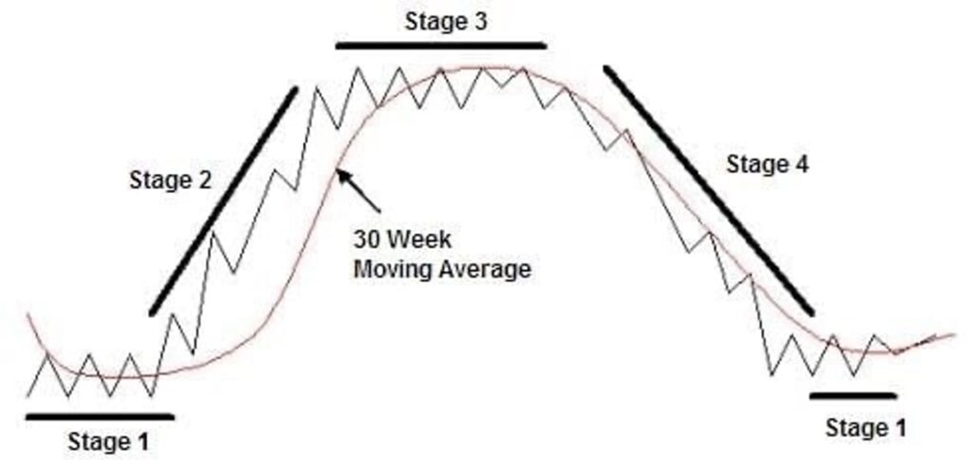
Stage analysis is the process of determining which stage a stock is currently in, and then investing only when it’s on the cusp of entering, or already surging, in Stage 2.
This puts all the emphasis on price, which is the North Star variable that directly impacts your wealth.
Here’s Luke highlighting its preeminence:
The only thing that will make a difference to your portfolio is whether the stocks you own rise in value while you own them.
Let’s say you found a truly atrocious company hemorrhaging cash, with awful management, in a dying industry.
But what if its stock price had just broken out and, hypothetically, was on its way to doubling from $5 to $10? Would any of those negative characteristics matter to you?
If what you care about is your personal wealth, they shouldn’t. Why would they?
All that would matter is that the stock is doubling while you’re invested…
When it comes to wealth-building, the only thing that truly matters is whether the share price moves in the direction you want during the period you own the stock.
Let’s apply this to Adobe
Below, we look at ADBE since the fall of 2022.
Here’s how it looks with a stage-analysis overlay.
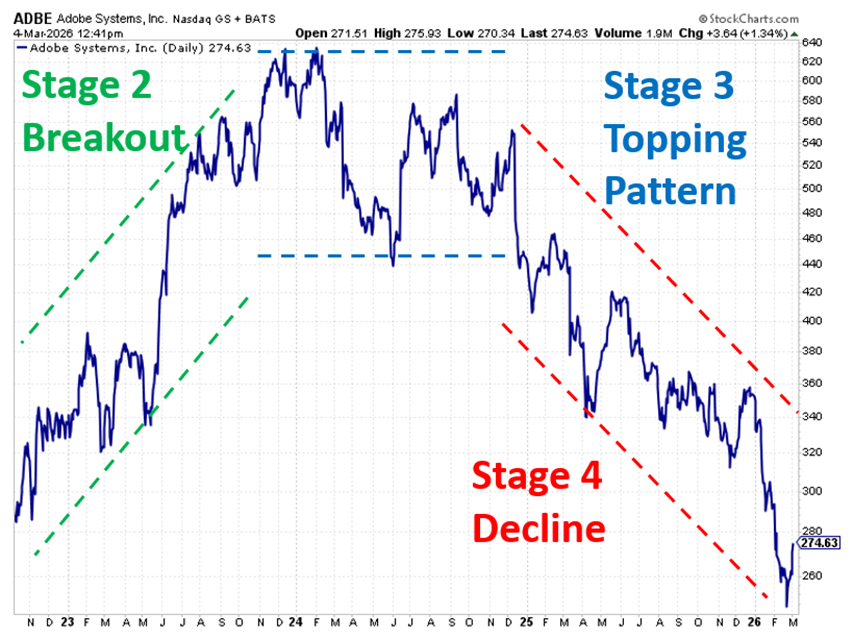
Even if you missed our August 2024 Adobe call, following a stage analysis framework would have led you to sell the stock about four months later – around $445 – when ADBE fell below the support line of its Stage-3 topping pattern.
Adobe shareholders would have avoided a nearly 40% collapse to current prices.
How to play offense with stage analysis
This framework isn’t just about playing defense – its primary benefit is as an offensive weapon.
Below, we look at one of the hottest stocks of the last year, drone maker Kratos Defense & Security Solutions (KTOS).
Stage analysis led Luke to recommend KTOS in May 2023 – very early in its Stage-2 breakout…
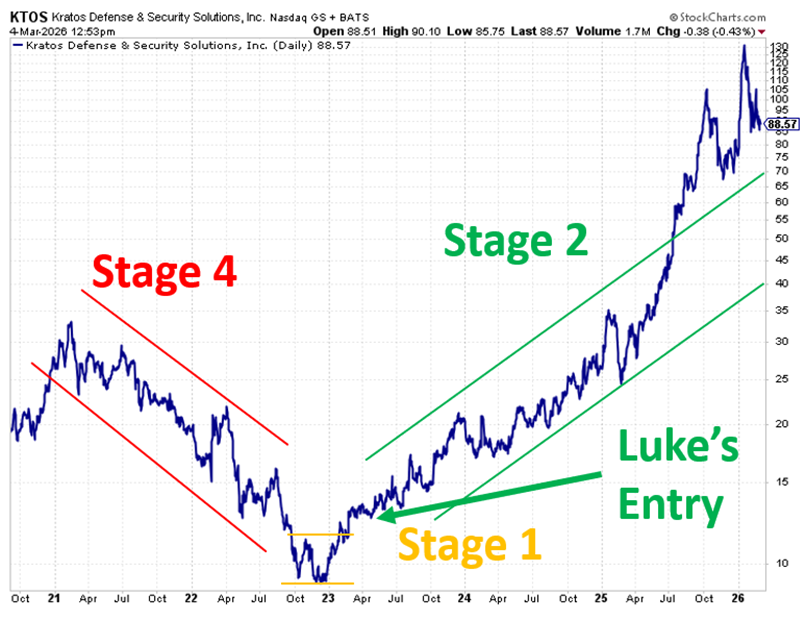
Luke and his subscribers are still in this position, currently up 455% as I write.
Now, let me point out one important aspect of this trade…
Back in May 2023, when Luke recommended this drone maker, he had no way of knowing that the drone sector would soar as it has in recent years…or that the Russian/Ukraine war would still be relying heavily on drones today…or that they’d be used extensively in our current conflict with Iran…
In fact, forward-looking fundamental and macro analysis played no role whatsoever in Luke’s recommendation.
He simply followed price and volume through this stage analysis framework – that’s it.
Price is truth.
Applying this to AI stocks going forward…
The key point is that we don’t actually need to know in advance which companies will ultimately win or lose.
Think back to the examples we just walked through. Adobe looked like a dominant software franchise for years. Kratos was a relatively obscure defense contractor that most investors barely discussed. Yet price ultimately revealed their respective truths long before the broader narrative caught up.
And that’s the beauty of this framework.
You don’t have to correctly predict the future of AI.
You don’t have to perfectly forecast which business models will be disrupted and which will thrive.
The market will begin revealing those answers through price long before they appear in headlines or earnings reports.
If you’re anchored to your own predictions and biases, you’ll likely miss those shifts. But if you’re anchored to price, you simply adapt.
Bottom line: With this market approach, price becomes your compass, and stage analysis becomes your map. Together, they allow you to stay nimble as this AI revolution sorts out its winners and losers.
How to apply it today
At a very basic level, the process is simple.
First, look for stocks that have spent weeks or months moving sideways in a tight range. That’s often the hallmark of a Stage-1 consolidation.
Second, watch for a decisive breakout above that range on strong volume – roughly two to three times normal trading volume. When institutions begin accumulating shares, those breakouts can launch the kind of sustained Stage-2 advances that drive the biggest gains.
Also, be aware of a stock’s inherent volatility so that you aren’t shaken out of a trade prematurely. You don’t want to mistake normal volatility for a breakdown.
That’s the basic blueprint. And you can begin using it today.
However, the challenge is scale.
There are thousands of publicly traded stocks. At any given moment, only a small fraction are transitioning from consolidation into breakout mode. And spotting them early requires scanning hundreds – sometimes thousands – of charts.
That’s why Luke built a systematic breakout screener with his team.
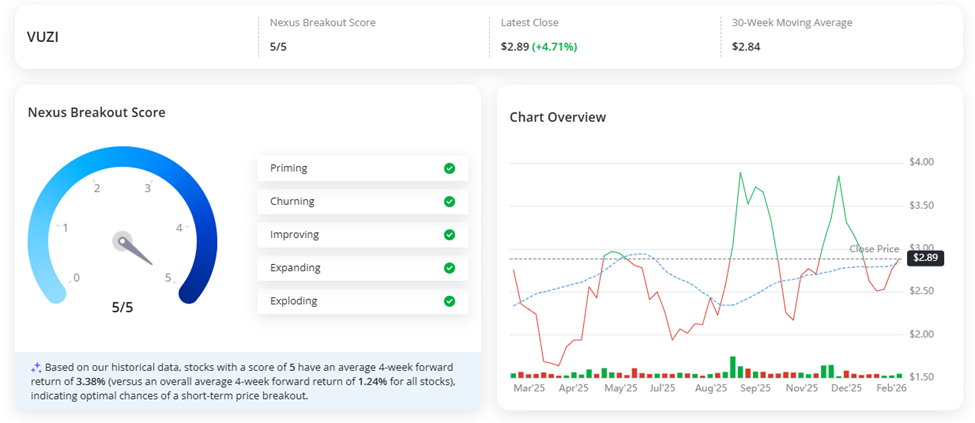
Instead of manually combing through the market, the tool scans more than 3,000 stocks and assigns each one a breakout score from 1 to 5 based on momentum strength and stage positioning.
The highest-scoring stocks are the ones most likely to be on the verge of entering a powerful Stage-2 move.
Here’s the example we provided in yesterday’s Digest from augmented reality smart glasses company Vuzix (VUZI). It gets a “5” today, meaning it is highly primed for a breakout.
For a deeper dive into this trading framework, Luke just released a free presentation where he walks through how it works, what Stage 2 looks like on a chart, and which stocks are scoring highest right now.
And if you join him, you’ll get unlimited access to this new breakout stock screener. You can use it to find your own Stage 2 stocks.
Circling back to the prospective winners and losers from AI
The market is already beginning to separate AI’s winners from its casualties.
As we look at both groups, let’s begin with the stocks Luke just flagged as casualties caught up in the carnage of the rotation out of “digital” AI.
From Luke:
Atlassian (TEAM), Flutter (FLUT), HubSpot (HUBS), Intuit (INTU), Workday (WDAY), Reddit (RDDT), Zillow (Z), DraftKings (DKNG), Robinhood (HOOD), TheTradeDesk (TTD), ZScaler (ZS), Pinterest (PINS), ServiceNow (NOW), Figma (FIG), Expedia (EXPE), Salesforce (CRM), SoFi (SOFI), Adobe (ADBE).
Every single one of these stocks is down more than 30% in 2026. We’re barely into March.
That’s not a correction. That’s a repricing.
On the other hand, here are a handful of the recent winners of this rotation that Luke flags:
- SanDisk (SNDK)
- BloomEnergy (BE)
- Moderna (MRNA)
- Generac (GNRC)
- Modine (MOD)
- WesternDigital (WDC)
- Entegris (ENTG)
- MKS (MKSI)
- ComfortSystems (FIX)
But these are stocks that have already made big moves. We want to focus on what happens going forward.
Back to Luke for a few more ideas:
Look at:
- Taiwan Semiconductor (TSM), whose fabrication plants represent decades of accumulated manufacturing knowledge that no competitor can replicate in under a decade.
- Constellation Energy (CEG), whose fleet of nuclear reactors is now signing 20-year power purchase agreements directly with Microsoft (MSFT) and Meta (META) because hyperscalers need 24/7 carbon-free baseload power and there are simply not enough nuclear plants on the planet.
- Eaton (ETN), GE Vernova (GEV), Arista Networks (ANET), Micron (MU), Cameco (CCJ): These companies don’t just have physical moats – they have direct revenue tailwinds from AI spending.
To be clear, the goal isn’t to blindly buy any stock on Luke’s list
Instead, think of these names as a watchlist – companies sitting directly in the path of AI spending.
From there, stage analysis can help determine when heavy buying pressure is moving them.
If one of these stocks breaks out of a consolidation with strong volume, that could signal the start of a Stage-2 advance. If it breaks down, price will tell you that story just as clearly.
That’s why combining Luke’s research with a stage-analysis framework can be so powerful…
The right stocks…at the right time.
Bottom line: AI’s pathway of destruction – and opportunity – rolls on. Make sure you’re prepared.
Have a good evening,
Jeff Remsburg
(Disclaimer: I own MSFT.)


