
Listen to the audio version of this article (generated by AI).
Small caps hit a wall… is Ray Dalio right about the AI bubble?… Luke Lango’s 6.5% stress test… why Louis Navellier sees a “stunning finish” to 2026…
Last Wednesday, one day after the S&P 500 and the Nasdaq set fresh all-time highs, another index was on the verge of a correction…
The small-cap Russell 2000 – down almost 10% from its August peak – slumped to test its 200-day moving average, a widely watched gauge of an asset’s long-term trend. It remains close to that key support level as I write on Monday, down 9% from its August high, just shy of official correction territory.
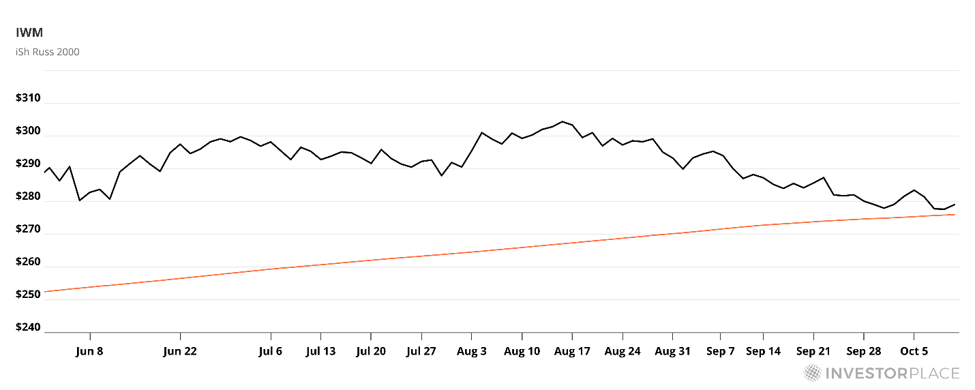
What accounts for the difference between the large-cap all-time highs and the small-cap slump?
In a word – rates.
Why small caps could get hit “really, really hard”
Small caps’ big run this year was fueled largely by the Fed’s rate cuts in late 2025.
As a reminder, the Fed cut in December of last year, lowering the target range to 3.50%–3.75%.
This was rocket fuel for many small caps because smaller companies borrow differently than big ones. According to estimates from Goldman Sachs and Bank of America, roughly a third of Russell 2000 debt is floating-rate, compared with only about 6%-8% for the S&P 500.
So, when rates fall, small-cap interest bills shrink almost immediately – great for their bottom lines. But when rates rise, the process runs in reverse, squeezing margins – and rates are rising.
As you know, in September, the Federal Reserve hiked interest rates for the first time since 2023. And last week’s minutes from the latest FOMC meeting showed that most officials expect another increase before year-end. In the wake of this, the 10-year Treasury yield touched its highest level since 2002 last week.
Our trading expert Jonathan Rose, editor of Advanced Notice, flagged this bond risk – and the potential pain in small caps – when I interviewed him for Investing Insider last week. Jonathan – who traded bonds for eight years – has seen how all these pieces affect asset prices. And here’s what he told me in our interview:
Any kind of news that the Fed is going to raise rates – and right now, the front end of the bond market is pricing in a raise – is going to hit those small caps really, really hard.
His takeaway was simple: steer clear of the broad small-cap index until rates soften.
A quick clarification…
Jonathan was careful to distinguish between “small caps” and “smaller companies.”
Avoiding the broad small-cap index doesn’t mean avoiding everything below mega-cap. Jonathan still likes some smaller, profitable names in sectors where demand doesn’t hinge on cheap credit, like cybersecurity and copper.
Also, a wider context is helpful. Over the past three decades, the Russell 2000 has performed slightly better in years the Fed raised rates than in years it cut them, if the economy held up. Plus, October and November of midterm years have also historically been strong for stocks.
So, the overall play here is more about patience and selectivity: let yields stabilize, then buy quality small caps once there’s evidence the trend is turning bullish again.
In the meantime, Jonathan isn’t forcing any trades – instead, he’s simply watching the market, letting real money flows guide him into new positions. Specifically, he’s looking for unusually large bets being made on lesser-known companies. This is how Jonathan spotted a trade in the oil services company SLB NV (SLB) in August. Over the following week, his recommended position gained 219%.
MP Materials Corp. (MP) brought another example of this system in action. Jonathan’s recommended trade returned 534% in three days – all thanks to watching money flows.
Jonathan will walk through his entire process this Wednesday at 8 p.m. Eastern during his free $10K to $100K Challenge. You’ll learn how to spot these big-money bets yourself, so you’re not finding out about a stock’s move after it’s already happened. That way, the next time a large bet lands on an under-the-radar stock, you could be among the first to see it – and ride it.
You can reserve your seat right here.
Is the AI bubble about to burst? Ray Dalio thinks we’re getting close
The same rising rates squeezing small caps have caught the attention of one of the world’s most famous investors.
Last Wednesday, Bridgewater Associates founder Ray Dalio told the Forbes Global CEO Conference in Singapore that AI is a “classic bubble.” More importantly, he believes rising interest rates are pushing it toward a breaking point.
Dalio’s argument is that enormous amounts of debt are being taken on to fund the AI buildout. As rates climb, that debt gets more expensive to carry. Eventually, investors who are rich on paper (and the companies that borrowed expensive money) need actual cash, and getting it means selling. What happens at that point is the problem.
Here’s Dalio, as reported by Bloomberg:
We’re in the part of the cycle that is before that but approaching that. I think we’re close to that.
Everybody says “I’m worth a billion dollars” but OK, try to spend that. In order to spend that you have to sell wealth in order to get money — and so the bubble usually pricks at that.
The debt piece isn’t hypothetical. In the first half of this year alone, Amazon (AMZN), Microsoft (MSFT), Alphabet (GOOG), Meta (META), and Oracle (ORCL) sold roughly $200 billion in investment-grade bonds. That’s nearly double what the five issued in all of 2025.
So, should investors head for the exits?
Our technology expert, Luke Lango, editor of Innovation Investor, takes this issue seriously, but doesn’t think the alarm bell has rung yet. Here he is to explain:
It’s a legitimate risk — but identifying how a bubble could burst doesn’t establish that the breaking point is imminent.
To measure how much pressure the market can absorb, Luke highlights a stress test.
The idea is that fast-growing earnings can offset a shrinking valuation, which is exactly what rising rates tend to cause. If S&P 500 earnings grow about 30% over the next two years, the market’s price-to-earnings ratio could fall from around 20 to roughly 15.4, and stock prices would still be about flat.
Luke’s 30% assumption isn’t pie in the sky. According to FactSet, Wall Street analysts expect S&P 500 earnings to grow 32.4% this year and another 15.8% in 2027. Luke’s scenario works out to roughly 14% a year, which is slightly below what analysts already expect for 2027.
So, how high would rates have to climb to force that compression from 20 to 15.4? To answer that, Luke uses the market’s “earnings yield,” which is simply the market’s P/E ratio inverted.
Back to Luke:
Using a simplified framework that compares the market’s earnings yield to the 10-year Treasury, a 15.4x multiple corresponds to a Treasury yield near 6.5%. Today, we’re at 5.35%.
That’s a conditional stress test, not a precise forecast or a guaranteed breaking point…
We remain a long way from a 6.5% 10-year Treasury yield, and we’d expect stocks to keep grinding higher as long as earnings deliver and yields stay well below that level.
One clarification – Luke’s analysis is from last week; the 10-year has since eased to about 5.24% as I write on Monday morning.
So, what should investors do with Dalio’s warning?
Luke’s answer echoes what we heard from Jonathan about the small-cap world – be choosy:
Dalio’s warning therefore strengthens the case for selectivity: favor strong balance sheets, credible customer economics, and earnings growth that can support valuations.
In the end, Dalio and Luke are watching the same variable – rates. Dalio thinks we’re nearing the tipping point. Luke’s math suggests there’s more cushion than the headlines imply, as long as earnings keep delivering.
Speaking of earnings…
Dalio may see a bubble forming, but he’s also known for warning against making overconfident predictions. And in a funny twist, legendary investor Louis Navellier, editor of Growth Investor, noted last week that Dalio likes to repeat an old Wall Street saying:
He who lives by the crystal ball will eat shattered glass.
After this year, that’s hard to argue with. Few investors in January would have predicted oil above $100 a barrel, central banks raising rates again, and Treasury yields above 5%. Fewer still would have predicted that the S&P 500 and the Nasdaq would set new all-time highs anyway.
This is why Louis prefers to let the data – particularly earnings – do the talking.
And here he is with what that data is saying:
Right now, the fundamentals are pointing to a strong finish to 2026, especially when it comes to corporate earnings.
Third-quarter earnings season kicks off this week, and the numbers behind Louis’ optimism are striking. According to FactSet, analysts expect S&P 500 earnings to grow 29.5% compared with a year ago, up from an estimate of 26.7% at the end of June. If that holds, it would be the third straight quarter of earnings growth above 25%.
What stands out to Louis is the direction of the estimates. Analysts usually lower their numbers as a quarter goes along. Over the past five years, they’ve cut them by an average of 2.2% during each quarter. This time, they raised them by 1.4%. As Louis put it, “That’s unusual, folks.”
Corporate executives are feeling confident, too. A record 72 S&P 500 companies have issued positive guidance for the third quarter, the most since FactSet began tracking the figure in 2006.
Tech is leading the way. Forty-four of those 72 companies are in the Information Technology sector, which is expected to grow earnings 65% this quarter.
There’s another detail in FactSet’s report that supports Louis’ case…
From June 30 through the end of September, the S&P 500 climbed 2%, while forward earnings estimates jumped more than 9%. As a result, the index’s forward price-to-earnings ratio fell from 20.4 to 19.0.
So, even though stocks are at record highs, by this measure, they’re cheaper than they were three months ago.
What Louis sees as we push toward the holiday season
Here’s Louis with what he expects from here:
Remember what positive earnings surprises did for stocks during the second-quarter earnings season?
From mid-July, when earnings season started, through NVIDIA Corporation’s (NVDA) earnings report in late August, the S&P 500 soared 3.7%. Wave after wave of positive earnings surprises helped push stocks higher.
I suspect we’ll see more of the same in October and November.
Better still, Louis sees two more tailwinds contributing to this bullishness.
First, midterm uncertainty is about to fade. Since 1970, stocks have historically started rallying about 22 trading days before a midterm Election Day, and they’ve averaged a 14.1% gain in the six months after.
Second, consumers are still spending. Retail sales rose 1.2% in August, beating estimates, and Deloitte expects holiday sales to grow 4% to 4.8% this season.
Here’s Louis’ overall take:
Add it all up, and I believe these three reasons could set the stock market up for a stunning finish to 2026.
Wrapping up
So, Dalio warns that rising rates could pop the AI bubble, while Luke and Louis both see more upside. Their shared advice is to be selective, because not every stock will rise with the market (just look at small caps slipping as the Nasdaq hits records).
That’s where Jonathan comes in. He expects bumps heading into the midterms, but if stocks dip, as he told me in our interview, he plans to “back up the truck” on his favorite names – which he finds by following where big money is flowing.
And that brings us back to this Wednesday at 8 p.m. Eastern when Jonathan will show you how to do this yourself during his free $10K to $100K Challenge. Here’s that registration link again.
We’ll keep you updated on all this here in the Digest.
Have a good evening,
Jeff Remsburg
(Disclosure: I own AMZN, MSFT, GOOGL)


