
Last Friday night, most investors went to bed believing they understood the global landscape. They knew the picture.
By Sunday morning, one of the biggest geopolitical question marks in the Western Hemisphere had been resolved, and the picture looked completely different.
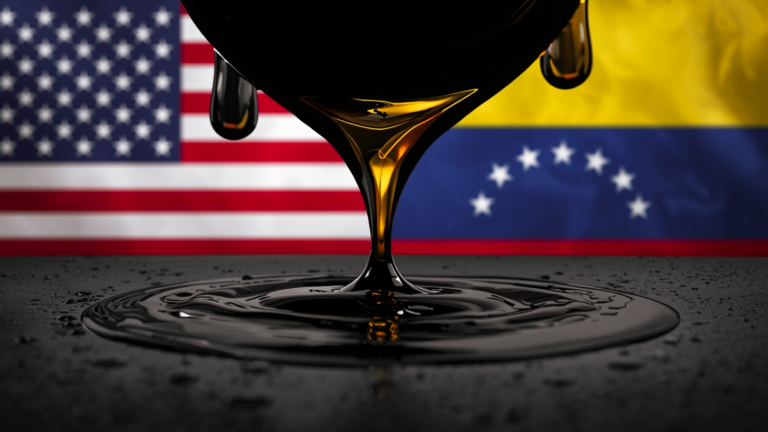
It looked like this.

As you know, the United States military carried out a surprise operation in Venezuela that resulted in the capture of Venezuelan President Nicolás Maduro over the weekend.
The image that circulated after the operation told the story more clearly than any official statement.
Not because of the drama – but because it removes uncertainty. Power had clearly shifted. The outcome was no longer in doubt. And when uncertainty disappears, capital doesn’t hesitate. It reprices.
That’s exactly what we’ve been watching over the past few days.
So in today’s Market 360, I want to walk through what actually happened in Venezuela, why it happened and what the market’s reaction really signals. Because this wasn’t just a geopolitical event. It was a live demonstration of how quickly markets adjust when the picture becomes clear.
It also ties directly into a risk I’ve been warning about – a “hidden crash” that doesn’t arrive with panic or headlines, but quietly leaves unprepared investors stuck in dead money while capital moves elsewhere.
Let’s start with what happened.
What Happened in Venezuela
Over the weekend, the United States military carried out a surprise operation in Venezuela that resulted in the capture of Maduro and his wife, Cilia Flores. Both were taken into U.S. custody and transported to New York to face federal charges related to narco-terrorism.
With Maduro removed, Venezuela’s vice president, Delcy Rodríguez, is now serving as acting president. While there was initial condemnation of the U.S. action, the new leadership has since indicated it will seek balanced and respectful international relations with the United States.
Secretary of State Marco Rubio has been a central figure in the U.S. response, working with Maduro’s former lieutenants – including the current president – to manage the handoff and maintain stability.
The stated objective is straightforward: reduce corruption, revive the oil industry and restore economic stability. For years, Venezuela’s sanctioned energy exports were funneled toward U.S. adversaries like Cuba, China and Russia. That alignment is now being reshuffled.
The Trump administration has made it clear it wants the Venezuelan economy rebuilt – and that U.S. companies should play a central role in that process.
The Immediate Implications
One of the clearest implications of the shift in Venezuela is in energy.
The country sits on the world’s largest proven oil reserves. But years of sanctions, mismanagement and political isolation left production stagnant and infrastructure in disrepair. The country’s role in global energy markets steadily deteriorated.
That is now changing.
As the transition unfolds, the focus has shifted toward restoring output and expanding production. That has direct implications for global supply – and for the companies positioned to move first.
Chevron Corp. (CVX) stands out as the most immediate beneficiary. Unlike many U.S. energy companies, Chevron maintained a presence in Venezuela and already has operations on the ground. Other major energy companies such as Exxon Mobil Corp. (XOM) and ConocoPhillips (COP) were pushed out when Venezuela nationalized its oil fields. That gives Chevron a clear first-mover advantage as infrastructure is repaired and production ramps up.
I should also add the major refiners also stand to benefit. Companies like Valero (VLO), Phillips 66 (PSX) and Marathon Petroleum (MPC) operate massive refining complexes along the Texas Gulf Coast that were built decades ago to process heavy, sour crude – exactly the kind Venezuela produces.
That detail matters.
U.S. shale fields in places like West Texas primarily produce light, sweet crude. And when Venezuelan supply was cut off by sanctions, the refiners were forced into costly workarounds. They imported heavy crude from Canada, which requires expensive pipeline capacity, or from the Middle East, which adds shipping costs.
The result was lower efficiency and tighter margins. Refineries couldn’t run at peak capacity, feedstock costs rose and the system became more expensive than it needed to be – even as the U.S. sat on an energy surplus it couldn’t fully refine.
As of Sunday morning, that dynamic appears to have shifted.
Over the longer term, the goal is for corporate America to help rebuild Venezuela’s energy sector, bringing capital, expertise and stability back into a system that has been dysfunctional for years. If that effort gains traction, it could reshape Venezuela’s role in global energy markets.
If Venezuelan production ramps up alongside existing U.S. output, it adds incremental supply to global markets. More supply puts downward pressure on oil prices over time – a tailwind for lower inflation.
What’s more, lower energy costs filter through everything from transportation to manufacturing to consumer prices and more – in other words, lower energy prices are good for growth.
The Bigger Picture
Now, all of this international intrigue is very interesting. But the takeaway here is that once the uncertainty around Venezuela disappeared, capital adjusted quickly.
Chevron is up about 4% on the week as I write this. Valero is up over 12%. Phillips 66 is up over 9%. Marathon is up 7%.
That’s how markets work.
And here’s the thing… Venezuela may not be the final chapter. Countries like Cuba, which relied heavily on Venezuelan oil, now face mounting pressure. These shifts rarely happen in isolation. They tend to cascade, producing second- and third-order effects as capital and power realign.
Oil also isn’t the only long-term opportunity, either. Venezuela was once among the most prosperous countries in Latin America, with resources extending well beyond energy.
Aluminum production powered by hydroelectric capacity was once a major industry.
Even more interesting is the fact that Venezuela also holds deposits of rare earth elements and other critical materials used in AI infrastructure, advanced electronics and modern weapons systems.
Until recently, much of that material flowed through Chinese-controlled supply chains. That, too, is now in flux.
How We Should Respond
When you step back and look at what just happened in Venezuela, a clear pattern emerges.
Once direction changed, markets didn’t hesitate. Capital began moving immediately toward the companies best positioned to benefit and away from those that weren’t. The separation was fast and obvious.
What’s harder to see is that the same process is already playing out beneath the surface of the broader market.
Some stocks are continuing to attract capital, build momentum and compound higher. Others may still look fine on the surface, but their earnings momentum is fading, institutional support is drying up and capital is quietly moving on.
That’s how stocks turn into dead money.
Not with a crash. Not with a headline. But through long stretches of stagnation, where portfolios go nowhere even as select stocks surge ahead.
This is exactly why I rely on my Stock Grader system (subscription required).
Stock Grader zeroes in on what matters most in markets like this – accelerating earnings, strong momentum and sustained institutional buying. It shows you, in near real time, which stocks the market is rewarding and which ones are already being left behind.
Most investors don’t see this split until it’s obvious, and by then, the opportunity has passed. That’s why I put together a brand-new special briefing about the“Hidden Crash” that’s beginning to emerge.
In it, I break down:
- Where this hidden separation is already forming
- Why simply owning the market may no longer be enough
- How institutional money is rotating right now
- And how I’m using Stock Grader to stay aligned with the market’s true leaders
I strongly encourage you to watch the briefing now to see how I’m positioning for this next phase – and how you can avoid getting stuck on the wrong side of a market that’s becoming increasingly selective.
Sincerely,

Louis Navellier
Editor, Market 360
The Editor hereby discloses that as of the date of this email, the Editor, directly or indirectly, owns the following securities that are the subject of the commentary, analysis, opinions, advice, or recommendations in, or which are otherwise mentioned in, the essay set forth below:


