


If you’re fundamentally pessimistic about the future, stocks are probably not for you.
Investing in stocks is fundamentally an optimistic act.
You invest your hard-earned money in a stock you believe will experience growth.
Pessimism often feels smart – and during uncertain times, it feels comfortable.
But in markets, pessimism is frequently just poor timing wearing a sensible disguise.
Optimism, by contrast, is harder work. It requires separating signal from noise. It requires acknowledging risks without becoming paralyzed by them. And it requires the discipline to recognize when conditions are quietly improving – even when headlines say otherwise.
That’s the kind of optimism successful investors rely on. Not blind faith. Not rose-colored glasses. But evidence-based confidence rooted in fundamentals.
When I look at the early days of 2026, I see several important things going right – in the economy, in corporate earnings, and in the parts of the market that tend to lead during periods of sustained growth.
Of course, that doesn’t mean everything is perfect. It never is. In fact, I see some real dislocations ahead in this market, and ignoring them would be a mistake. I’ll briefly talk about those risks in just a moment before I elaborate on them in a future piece.
But before focusing on what could go wrong, in today’s Market 360, we’ll do the harder work first – identifying what’s already going right… and understanding why that matters to your investing success in the rest of the year.
What’s Going Right: Economic Growth Is Accelerating
If you want proof that this optimism isn’t theoretical, start with economic growth.
The U.S. economy may not be firing on every cylinder yet. Housing and manufacturing are still lagging. But taken as a whole, growth is clearly accelerating.
The Commerce Department recently revised its third-quarter GDP estimate higher, to a 4.4% annual pace. That followed 3.8% growth in the second quarter. Taken together, the U.S. economy just posted its strongest back-to-back quarters of growth since 2021.
That didn’t happen by accident.
Consumer spending grew at a 3.5% annual rate. Corporate activity remained resilient even as interest rates stayed elevated. In other words, the economy absorbed tighter financial conditions and kept moving forward.
The trade deficit surged in November. Exports declined, imports jumped, and the monthly trade gap widened sharply. As a result, the Atlanta Fed revised its fourth-quarter GDP estimate lower, though it still expects growth north of 4%.
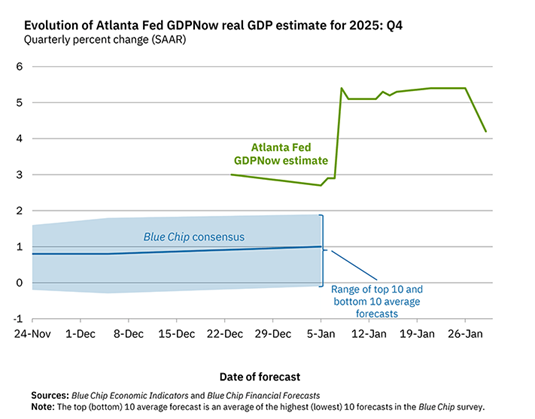
Now, trade data has been distorted by shifting tariff policies, and there are still some structural problems in the economy that need to be addressed.
But make no mistake, folks, the broader growth trend remains intact.
Tax cuts, strong consumer demand, the ongoing AI data-center buildout, improving existing home sales, and an estimated $20 trillion of onshoring activity underway in the U.S. are powerful tailwinds. Together, they form the foundation for faster, more durable growth than most investors are prepared for.
My (Revised) GDP Prediction
Back in late 2024, I told my followers that the U.S. economy could reach a 4% annual growth pace in 2025 and accelerate further to hit 5% – at least temporarily – in 2026. (I reiterated that prediction in early January 2025, here.)
That may have sounded aggressive at the time. But based on current momentum, my earlier forecast may prove conservative.
In fact, I think we could hit 6% annualized GDP growth at some point in 2026 – possibly in the second half of the year.
That doesn’t mean there won’t be volatility. And the market is always full of distractions.
But the bottom line is that the U.S. economy is growing faster than most of the developed world. Corporate earnings are responding accordingly. And historically, that combination has favored investors who stay focused on fundamentals instead of headlines.
Small Caps Are Emerging as the Next Leaders
When markets transition from one phase of growth to the next, leadership also changes.
Large, well-known stocks tend to dominate early in a cycle. But as confidence builds and earnings momentum broadens, leadership often rotates toward smaller, faster-growing companies that are more directly exposed to economic acceleration.
That rotation appears to be underway.
In January, small-cap stocks moved decisively higher. The Russell 2000 surged 7% for the month, far outpacing the S&P 500’s 1.4% gain and the Dow Jones Industrial Average’s 1.6% rise.
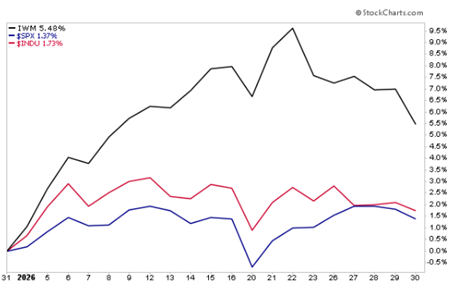
Small caps tend to be more domestic in nature, which means they benefit directly from U.S. economic growth. They also tend to move first when investors begin looking beyond yesterday’s winners and toward where the next phase of growth is likely to emerge.
Now, I’m not saying “buy small caps” indiscriminately. But market leadership is changing, and companies positioned on the right side of this change are beginning to be rewarded.
That’s where my prediction of an AI Dislocation comes into play.
The AI Dislocation Is Coming
The first phase of the AI boom rewarded a narrow group of mega-cap leaders.
Those gains were powerful, but obvious. Everyone knew the names. Everyone crowded into the same trades. And expectations rose accordingly.
That was Stage 1.
What’s happening now is different.
As scrutiny increases and capital spending intensifies, the market is beginning to look deeper into the AI ecosystem – toward the smaller companies building the power systems, networking infrastructure, and enabling technologies that make AI scalable and profitable.
That’s Stage 2 – where the next wave of opportunity is taking shape.
This AI Dislocation isn’t the end of the AI boom. It’s a changing of the guard.
How to Position Yourself for What’s Next
Now, I understand that talk of an AI Dislocation may make some people nervous.
But optimism is addictive, folks. And we should be bullish about America and what’s going to happen next in the AI boom. Take it from me, it’s the best path toward prosperity.
In fact, using my proven system, I’m already finding stocks positioned to benefit from this transition.
To be very clear, these are not obvious names.
You won’t find NVIDIA Corp. (NVDA) or Microsoft Corp. (MSFT) on this list.
Instead, you’ll find smaller companies – companies most investors have never heard of – that my system says are positioned not only to survive a potential shakeout around February 25, but to thrive in the aftermath.
These are the kinds of setups that historically produce the biggest gains – not because the companies are flashy, but because expectations are still low while fundamentals are improving rapidly.
That’s why I recorded a special briefing to walk through this opportunity in detail.
In it, I explain why I believe the coming AI Dislocation could mark the transition from the market’s first phase of easy AI gains to a far more selective phase – one that rewards investors who know where to look.
I’ll also show you how I’m positioning ahead of that shift, using my system to focus on fundamentally superior companies with the potential to deliver outsized gains as this next phase unfolds.
If you want a clearer roadmap for where the next AI-driven opportunities could come from – and how to avoid being anchored to yesterday’s winners – go here now for more details.
Sincerely,

Louis Navellier
Editor, Market 360
The Editor hereby discloses that as of the date of this email, the Editor, directly or indirectly, owns the following securities that are the subject of the commentary, analysis, opinions, advice, or recommendations in, or which are otherwise mentioned in, the essay set forth below:
NVIDIA Corporation (NVDA)


