


Hello, Reader.
As a contrarian investor, I find myself drawn to these words from Mark Twain…
Whenever you find yourself on the side of the majority, it is time to pause and reflect.
Twain warns against blind conformity. The majority may rule, but they aren’t always correct. History is full of moments when most people believed something that turned out to be wrong.
I believe worthwhile agreement should come from reasoning, not crowd behavior.
Today, I’d like to pause and reflect… especially before my FutureProof 2026 event, which I’m holding tomorrow, March 18, 2026, at 1:00 pm ET (you can reserve your spot for that free broadcast here).
As I was prepping for this specialbroadcast, I came across a piece of high-end research not available to the public. It’s from one of the leading market foresight and strategy firms.
This type of research isn’t even sold online. Access typically requires direct inquiry.
You get the idea.
But I was able to review it — and it confirmed something important…
I thought I was one of only a few contrarian voices speaking about AI’s emerging bottlenecks. But I’m actually joined by a growing chorus of voices behind Wall Street’s closed doors.
And when agreement starts forming behind closed doors, it’s often a signal something bigger is already underway…
The Most Crowded Trade in the Market
It may be the most contrarian view at the moment: to rotate capital away from Big Tech and into a new class of smaller “asset-heavy” companies.
That’s because Big Tech is the market.
Companies like Nvidia Corp. (NVDA), Microsoft Corp. (MSFT), Apple Inc. (AAPL), Amazon.com Inc. (AMZN), and Alphabet Inc. (GOOGL) make up a large portion of the S&P 500 and the tech-heavy Nasdaq Composite.
AI is the dominant narrative right now. Capital continues to flow into these names because investors see them as the core beneficiaries of the AI boom.
So, most investors stay long – even if these hyperscalers’ valuations look stretched.
But when everyone agrees Big Tech is the place to be… that’s exactly when a contrarian pauses and reflects.
For more than two decades, markets have rewarded “asset-light” digital companies focused on software, social media, and the internet.
These companies scaled quickly, required little capital, and generated enormous margins. But AI is changing that dynamic.
Artificial intelligence is forcing Big Tech to become capital-intensive.
These so-called hyperscalers are having to spend enormous amounts on AI data centers and other infrastructure. As a result, their capital expenditures are rising rapidly while free cash flow is coming under pressure.
The AI capital expenditures by the five major hyperscalers now consume more than half of their pre-CapEx cash flow.
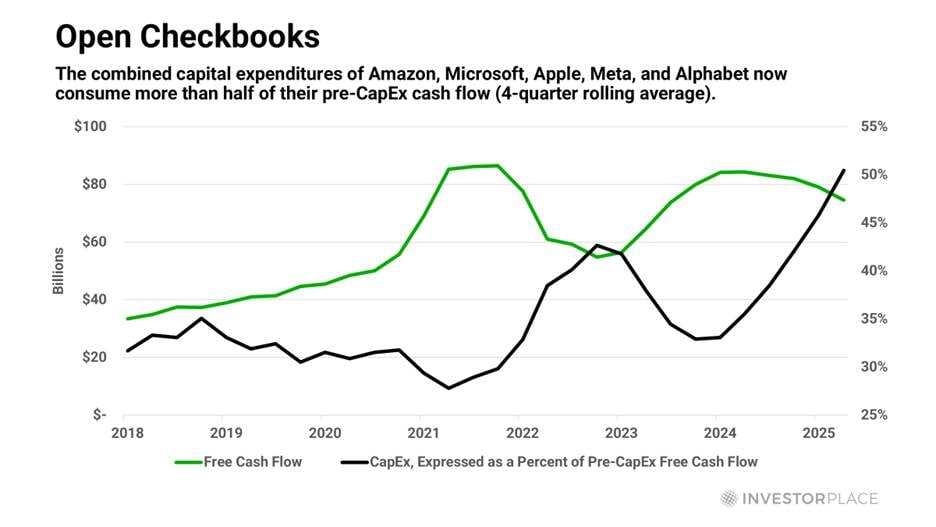
Just yesterday, Meta Platforms Inc. (META) said it plans to spend up to $135 billion in AI-related costs in 2026.
The research notes that free cash flow at the Big 5 hyperscalers could be cut in half between the end of 2025 and the end of this year due to AI spending:
But now, we see that capex as a percentage of operating cash flow for hyperscalers is likely to be more than double what it was three years ago. And as a result, their trailing-4Q free cash flow is likely to be cut in half between 4Q 2025 and 4Q 2026. Note that these five stocks account for nearly one-fifth of the S&P 500’s total market cap.
So far, however, investors are turning a blind eye to this troubling trend. The popular storyline seems to be that these titanic investments, while onerous over the short term, will reap major benefits over the long term.
Pause. Reflect.
I have been warning against the high valuation of Big Tech companies for months. In the beginning of this year, I wrote to my subscribers…
In 2026, the most crowded trade in the market does not need a collapse, a recession, or a crisis to lose money. It merely needs valuations to adjust to a world where the Mag 7 stocks do not produce robust cash flow and fat profit margins as reliably as they did in the past.
That world has arrived.
From a Demand Economy to a Supply Economy
The global economy is shifting: We’re moving from a demand-constrained economy to one constrained by supply. The research I got access to highlights bottlenecks in key areas, including:
- Processing capacity
- Energy
- Metals
- Minerals
I’ve been sounding the alarm on a few of those over the past several days. There is a raw materials bottleneck forming, for example, and those behind Wall Street’s curtain agree.
It’s simple: You cannot build AI infrastructure without massive amounts of physical materials.
And compared to relative global wealth, the metals and raw materials sector is tiny. This means even small capital flows into mining companies could cause huge share-price increases.
Geopolitics plays a part in the equation here…
China controls around 70% of global processing for many critical minerals. The country dominates the smelting, refining, and mineral processing stages.
China can influence global prices by restricting exports, adjusting smelting capacity, and manipulating supply chains.
And while China expands refining capacity, Western smelters are shutting down. The result is a structural shortage in metals processing.
That pushes prices higher.
For my FutureProof 2026 event, I’ve identified several raw materials companies positioned to benefit as this bottleneck grows in the years ahead, all while Big Tech stands at the ready, checkbooks in hand.
And it’s not just raw materials.
I’ll lay out the real impact of these constraints… the stocks I believe you should sell… and the names and tickers I think stand to benefit as this shock plays out.
A Narrow Window to Act
This is not a general market outlook.
This is a specific, time-sensitive call – and I built my FutureProof 2026 event around it because I believe the window to act is narrow.
Right now, that contrarian view is starting to spread.
That means getting ahead of the curve before this contrarian view bursts into the mainstream.
I’m already starting to feel the tremors – just like I did prior to the dot-com bust when I protected my readers from huge losses and guided them into stocks that soared while tech stocks were crashing.
That’s why I believe investors need to act before this shift moves into the mainstream… and likely before the end of April. That’s when I believe $10 trillion in wealth concentrated in Big Tech stocks will rotate into the companies that supply the physical goods needed for the continued AI buildout.
I believe the earnings announcements from several of the Magnificent Seven companies between April 24 and May 1 – specifically their language around “pacing” and “supply constraints” – will trigger the smart money to do the math.
In fact, we’re already hearing early hints.
Just a few days ago, Nvidia’s head of AI infrastructure expressed the “exciting opportunity” central processing units (CPUs) present. They are “becoming the bottleneck in terms of growing out this AI and agentic workflow.”
But I believe the investment opportunity is even more granular – and profitable – than that.
I’ll discuss all of this in detail tomorrow morning at my free FutureProof 2026 event.
That’s less than 24 hours away.
So if you’d like to get ahead of this shift, now is the time to reserve your spot.
I look forward to seeing you there.
Regards,
Eric Fry
Editor, Smart Money


