
Welcome to Smart Money! My name is Eric Fry, and I’m glad you’re here.
Wall Street has sold investors on the idea that they should start with “micro” analysis – the idea that they should make investment decisions by comparing things like price/earnings ratios, income statements, or other company details.
But I do the opposite. I start with “macro” analysis.
I look for big-picture trends that drive huge, multiyear moves in entire sectors of the market.
I’m talking about trends that can spin off dozens of triple- and even quadruple-digit gains in just a few years.
Catching just one of these trends – at the right time – can help anyone accumulate enough capital to finance their dreams and an enviable retirement…
When investors use a global macro strategy, they identify investment opportunities from a broad, global, top-down perspective, rather than by examining stocks one by one (a micro, bottom-up perspective).
And today, I want to highlight my Top 7 Stocks for 2026, each of which capitalizes on a powerful megatrend.
Let’s get started…
Top 2026 Stock No. 1: Match Group
Match Group Inc. (MTCH) is in the business of making online love connections, but the company hasn’t been able to make a love connection with investors for several years. Most of them have been “swiping left” — i.e., saying “no thanks” — on the shares of this online dating leader. But the company’s new management is engineering an AI-powered overhaul that could produce a new era of robust earnings growth.

During the last few years, the company has resembled the kind of match that goes up in flames, rather than the one that sparks romantic flames. From the peak levels of 2019, the company’s annual revenues and operating margins have both tumbled more than 20%. As a result of this grim performance, the stock price has plummeted 80%.
But the green shoots of a turnaround are starting to sprout, and I expect them to blossom over the coming months. In essence, Match’s current situation is a classic turnaround setup: a market leader with entrenched competitive advantages, temporarily out of favor due to stagnant growth, but with a clear and credible revitalization plan.
Match is the undisputed titan of online dating websites and apps, with roughly 82 million monthly active users – about 15 million of whom pay for subscriptions – and an estimated 30–40% global market share. Its portfolio includes Tinder, the world’s No. 1 dating app, along with more than a dozen other online dating brands like Hinge, OkCupid, Plenty of Fish, and Match.com.
However, despite the company’s formidable competitive moat, it has struggled in recent years to convert market leadership into profit growth. This disconnect enticed a couple of activist investors to take large positions in the company last year and begin agitating for an overhaul.
In early 2024, Elliott Investment Management, one of the world’s biggest and most prominent activist investors, revealed a $1 billion investment in Match. The company named two new directors to the board several weeks later. Shortly thereafter, Starboard Value established a 6.6% stake in the foundering online dating company.
After a lot of back-and-forth, Elliot managed to replace the company’s CEO with a hand-picked successor named Spencer Rascoff, formerly a co-founder of Zillow. Since taking over the helm seven months ago, Rascoff has wasted no time implementing a comprehensive, AI-focused overhaul. Under his leadership, the company has embraced a long-term vision where AI is not just an enhancement, but the foundational infrastructure for every aspect of the business.
Rascoff is pursuing a three-phase strategy he calls, “Reset, Revitalize, Resurgence.” The initial “Reset” phase focused on rebuilding culture, flattening management layers, and accelerating product velocity. That phase is now complete and the “Revitalize” phase is underway. That’s the interlude when products start reflecting a renewed focus on “speed, accountability, and relentless product execution.” If all goes well, the “Resurgence” phase will flower in 2026 and 2027.
AI is central to this entire strategy.
Match’s AI Upgrade
On the consumer side, Rascoff is deploying AI to reshape Match’s most important brands, Tinder and Hinge. At Hinge, for example, a new AI-powered recommendation algorithm launched in March 2025 has increased matches and contact exchanges by 15%. This meaningful improvement translates into more real-world dates and higher rates of payer conversion.
Additionally, the “onboarding” process at Hinge now offers generative AI tools to help users create their profiles. These tools provide real-time feedback on profile prompts to reduce generic answers and encourage more authentic, high-quality responses.
On the Tinder app, which is facing sharp user declines, Match is introducing an even broader suite of AI tools. This AI-enabled upgrade is prioritizing deeper compatibility and better user outcomes, rather than optimizing for superficial swiping or other short-term engagement metrics.
AI is also improving trust and safety on Tinder – a major Achilles heel. New detection models can identify bots and scammers with higher accuracy. Match has also introduced AI-powered facial verification tools that increase authenticity and trust. The company is even testing ad campaigns that highlight these safety features, with plans to measure and improve public perception.
By embedding AI at multiple touchpoints – from onboarding and match recommendations to internal product development – Match is building a unified ecosystem where data, technology, and human creativity reinforce each other. This dual focus on consumer experience and operational efficiency is not simply an experiment; it is the strategic foundation for the company’s revitalization plan.
Assuming the new AI-led initiatives can stabilize and then grow Tinder’s user base, while Hinge continues its strong growth trajectory and international expansion, Match shares could mount a substantial rally.
For investors willing to take a chance on the prospective “resurgence” Rascoff anticipates, Match offers a unique and compelling opportunity: exposure to a dominant consumer internet franchise at a time when it is fundamentally reinventing itself to align with the next wave of technology-driven user experiences.
Top 2026 Stock No. 2: Novo
Novo Nordisk A/S (NVO) hasn’t spent a penny building the AI stage, but it is learning how to dance upon it.
Over the past three years, Novo has choreographed several promising AI alliances. It partnered with Valo Health back in 2023 – well before AI dominated every earnings call – paying $190 million in upfront and milestone payments to hunt for new diabetes, cardiovascular, and obesity treatments.
It’s also running a working AI alliance with Microsoft Research on Azure – more on that shortly. And in 2026 alone, Novo signed strategic partnerships with both OpenAI and AWS, opening an AI co-innovation hub in London to compress the timeline between identifying a drug target and dosing the first patient.
None of these AI credentials automatically make Novo a great investment. But they do make Novo a great example of an AI Applier. The investment case, though, doesn’t hinge entirely on AI credentials. It hinges on a century-old rivalry that just entered a new phase.
Novo Nordisk and Eli Lilly & Co. (LLY) have been battling each other across the Atlantic since 1923, when both companies started selling the first commercial insulin. A century later, they’re fighting it out again – this time over obesity – but the market has already declared Lilly the winner. That victory celebration looks premature, and the price you’d pay to bet against it has never been this cheap.
The Denmark-based healthcare company is currently trading for 14 times earnings, while Eli Lilly is trading for about 34 times. That’s a massive valuation gap between two companies chasing the same therapies, the same patients, and by some estimates, the same eventual market size.
Novo’s market cap sits near $200 billion; Lilly’s is above $1 trillion. In other words, Novo is only one-fifth the size of its American rival, even though the two companies’ obesity and diabetes franchises generate similar annual sales.
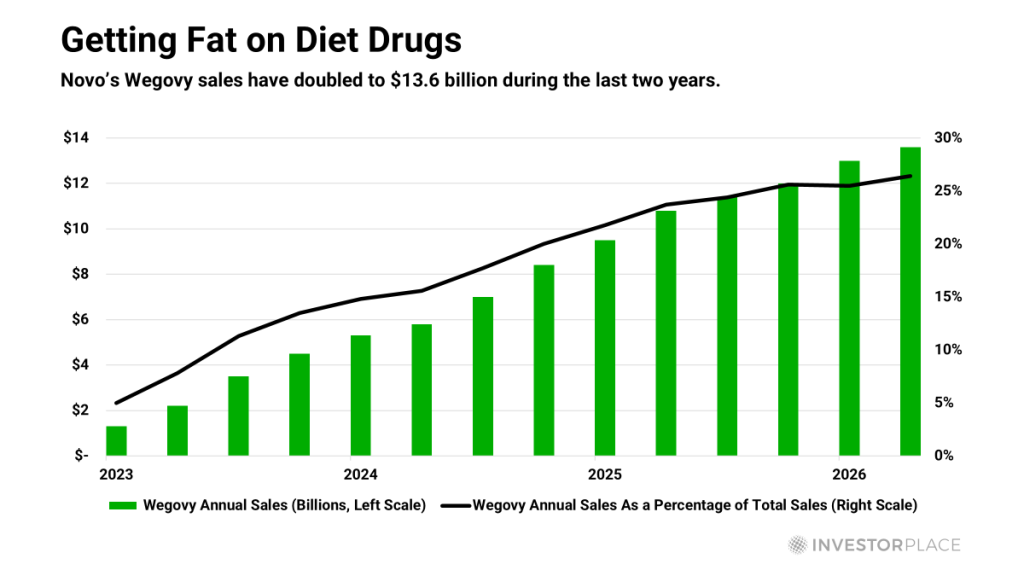
This isn’t a case of one company being profitable and the other not. Novo’s operating margin hovers near 40% – essentially matching Lilly’s on a comparable basis. Its leverage is the more conservative of the two, and its dividend yield, near 4%, dwarfs Lilly’s token 0.5%. Novo, in other words, is hardly a “value trap.” It’s a highly profitable market leader trading like a company whose best days are over.
Applying AI, Not Building It
Novo’s AI push deserves more than a passing mention, because it’s the exact mechanism driving the whole AI Appliers thesis — just running inside one company’s pipeline instead of across an entire sector.
The oldest and least publicized of Novo’s AI partnerships is also its most telling. In 2023, Novo expanded a collaboration with Valo Health, paying $190 million in upfront and milestone payments plus an equity stake, to apply Valo’s AI models and proprietary datasets against Type 2 diabetes, cardiovascular disease, and obesity – three of Novo’s core franchises. That deal predates the current AI infrastructure boom by two years. Novo wasn’t chasing a hot theme; it was already using AI to hunt for its next generation of drugs while Wall Street was still arguing about GPU shortages.
Novo’s work with Microsoft Research on Azure has already produced something concrete. Doctors have long used standard risk calculators to estimate a patient’s odds of a heart attack or stroke – tools built on broad population averages that often miss the mark for any one individual. Novo’s team built an AI model that reads a patient’s own data more precisely, and it’s already outperforming those standard calculators at identifying who’s actually at risk. That’s a rare thing in pharma-AI coverage generally – an actual, specific, working result, not just a partnership announcement.
This year brought two much larger deals. In April, Novo partnered with OpenAI to integrate AI end-to-end across drug discovery, manufacturing, supply chain, and commercial operations, aiming for full integration by the end of 2026. In August, Novo named AWS its preferred cloud provider and strategic AI partner, opening a co-innovation hub in London where AWS engineers work directly alongside Novo’s own scientists – using tools like Amazon Bio Discovery to identify drug targets and rank candidates before they ever reach a lab bench. Novo says its existing AWS relationship has already cut clinical documentation time and lifted productivity for more than 25,000 employees.
Most recently, Novo signed with H1 to speed up an unglamorous but expensive bottleneck: selecting clinical trial sites and designing studies. Small potatoes next to drug-discovery headlines, but exactly the kind of efficiency gain that compounds across dozens of trials running at once.
To be clear-eyed about it: No AI-discovered drug, from any drugmaker, has yet won full FDA approval. Eli Lilly is racing down a similar path, with its own AI ties to Chai Discovery and a $2.75 billion partnership with Insilico Medicine.
Novo’s AI edge isn’t exclusive, but it doesn’t need to be. The AI Appliers thesis was never about finding the one company nobody else has thought of. It’s about recognizing that a company applying cheap, borrowed AI compute to an already-profitable, already-growing business captures real value, while the companies building and financing the underlying AI infrastructure absorb the risk. Novo already sits on the right side of that line.
Top 2026 Stock No. 3: Savers Value Village
Thrifting is “all the rage” among Generation Z. Two out of five items in the average zoomer’s closet are secondhand.
That’s the first reason to consider investing in Savers Value Village Inc. (SVV), but far from the only one. As the largest “for-profit” thrift store operator in North America, the company is perfectly positioned to capitalize on the Gen Z thrifting phenomenon.
Savers Value Village didn’t simply bolt a thrift operation onto a traditional retail model. It has specialized in thrifting since 1954, when founder William Ellison opened the first Savers store in San Francisco. The idea was radical for the time: partner with local nonprofits to collect donations, pay them for the goods, and then sell those goods in a clean, organized retail environment.
For decades, the company quietly grew under private ownership – expanding across the U.S., into Canada, and eventually into Australia – while perfecting the operational model. The stores never looked like the musty thrift shops of old. They looked like real retailers: wide aisles, sorted racks, organized departments.
By the 1990s and 2000s, Savers had become the largest for-profit thrift chain in North America, with a business model that turned donations into both community funding and shareholder returns.
Today, Savers Value Village runs 300-plus stores across the U.S., Canada, and Australia, is staffed by over 22,000 team members, and processes billions of pounds of donated goods annually. What looks simple on the sales floor is the product of 70 years of supply-chain engineering.
To support its business, Savers has built one of the most creative and durable sourcing models in retail. For example, the company pairs nearly every Savers store with a Community Donation Center (CDC).The company’s nonprofit suppliers use these on-site donation centers to drop off used clothes, shoes, books, and household goods.
Unlike charities that simply accept items, Savers pays its suppliers by the pound for these donations. As a result, local charities get steady funding without the overhead of running stores, while Savers secures a consistent stream of inventory.
In select markets, Savers supplements CDCs with GreenDrop donation stations. These freestanding pods or trailers extend the network and make donating easier.
After Savers collects these donations, its employees sort, price, and rack the sellable items. Merchandise hits the floor fast and cycles through quickly. Products that don’t sell at retail are bundled and resold into the global wholesale reuse market. That “multi-exit” monetization process converts “waste” into incremental revenue.
This model means Savers doesn’t rely on closeouts or liquidation deals. It owns its supply chain, from the donation bin to the cash register. That’s why it can keep prices dramatically below discount retail – 40% to 70% lower, according to management’s checks.
The Moat: Industrial-Scale Treasure Hunting
Thrifting has always been about the “hunt.” What Savers Value Village has done is industrialize the hunt without killing the fun.
- Frequency and freshness. Savers cycles through its inventory about 15 times a year, which is an extraordinarily rapid rate. That’s nearly double Walmart Inc.’s (WMT) inventory turn and about five times faster than Lululemon Athletica Inc.’s (LULU). Effectively, Savers offers entirely new merchandise every three weeks.
- Scale married to local tailoring. With hundreds of stores, the company can apply data through its 6-million-member loyalty program to optimize assortment, flow, and seasonality at the local level. It can backstock off-season goods, drip them out at the right time, and flex floor space to match neighborhood demand.
- Multi-monetization. Unsold inventory isn’t a liability. The company exports, recycles, or wholesales it to create an incremental revenue stream, while also keeping landfill diversion part of its brand story.
- Brand halo. Because Savers funds local nonprofits, the firm operates with a built-in community goodwill advantage compared to traditional clothing retailers. Every drop-off becomes a story about supporting charity and sustainability – soft power that purely commercial resale apps don’t have.
- Capital efficiency. New stores are highly accretive. Each new store generates 15% to 20% profit margins, on a stand-alone basis.
Taken together, these elements create a moat that few competitors can cross. Traditional retailers can bolt on “resale corners,” but they can’t replicate Savers’ 70-year infrastructure of donations, partners, and processing know-how.
Given Savers’ business model, there’s plenty of room for the company’s growth to accelerate. In its most recent quarter, for example, U.S. same-store sales soared 6%, which is double or triple the growth rate of most clothing retailers.
Looking ahead, the company should benefit from several factors.
- Because Savers operates fewer than 400 stores in North America, it has massive expansion potential across the U.S. and Canada. Many mall landlords court them as anchor tenants.
- The thrift supply chain is tariff-free, which means Savers does not need to waste precious resources absorbing tariff expenses or trying to rejigger its supply chain.
- Savers finds itself in the right place at the right time. Gen Z has embraced thrifting because it is affordable, unique, and sustainable. Capital One Shopping reports that 83% of zoomers have purchased or are interested in purchasing secondhand.
Not surprisingly, the secondhand clothing market is growing five times faster than the overall apparel industry. According to ThredUp, the U.S. secondhand market grew 14% in 2024, compared to just 3% for the broader apparel market. Online resale was even stronger – up 23%. Analysts expect the U.S. resale market to nearly double by 2029, reaching roughly $40 billion.
That’s not a niche. That’s an empire in the making.
Savers is on track to earn about $0.50 per share this year and $0.65 per share in 2027. That steady growth rate would give the stock a valuation of 25 times 2026 earnings and 20 times the 2027 result.
Although this valuation is not the “deep discount” variety you might find on the racks of a Savers store, it is below the sector average. Further, if the company accelerates its expansion plans and/or boosts its profit margins as much as I anticipate, earnings could surprise on the upside.
Top 2026 Stock No. 4: Primo Brands
Water is the ultimate circular economy product – although Mother Nature does most of the heavy lifting. Her complex process of evaporation, precipitation, and decades-long subterranean filtration cycles water through planet Earth to sustain both flora and fauna.
The bottled water industry is a small drop in that planetary bucket, but it too operates within Mother Nature’s hydration cycle. This trait gives it a circular economy identity. Its core product is essentially limitless. And it can source and distribute that product without relying on a foreign supply chain. In other words, the bottled water industry can thrive as a purely domestic business.
Enter Primo Brands Corp. (PRMB), one of the largest branded water companies in North America.
In a market obsessed with AI-everything, Primo Brands seems defiantly analog. It manages springs, bottles water, delivers water, restocks coolers, and operates a vast logistics network. The company delivers drinking water through three primary sales channels.
First, it sells branded bottled water at retail. This division, which accounts for about 60% of total company sales, includes national powerhouses like Poland Spring and Pure Life, regional spring-water labels like Arrowhead, Deer Park, and Ice Mountain, as well as premium brands like Saratoga and The Mountain Valley. The company distributes these brands into more than 200,000 retail outlets across the United States and Canada. That footprint gives Primo negotiating leverage on shelf space, feature frequency, cold placement, and in-store displays.
Second, Primo operates a large direct-delivery network that supplies five-gallon water bottles directly to homes and businesses. This segment, which accounts for about 35% of company sales, resembles a subscription utility. Customers place recurring orders, Primo loads routes from local branches, and trucks deliver water on a scheduled cadence. That recurring model produces predictable revenue and strong lifetime customer value when service runs smoothly.
Third, Primo runs exchange and refill businesses, which account for about 5% of total sales. Consumers can exchange empty multi-use bottles at approximately 26,500 retail locations or refill bottles at over 23,500 self-service stations. That reusable packaging system reduces plastic waste while creating recurring, traffic-driving transactions.
Behind these customer-facing activities sits a vertically integrated network of more than 80 springs, bottling plants, distribution centers, warehouses, and delivery fleets. Primo employs over 12,000 associates and manages logistics coast-to-coast. This is not a marketing shell over outsourced production. It is an industrial hydration platform.
Primo Is Both an AI Survivor and Applier
Importantly, Primo is one of those rare enterprises that operates a relatively future-proof business. That quality puts it squarely into the AI Survivors framework. Artificial intelligence cannot replace hydration. It cannot digitize a spring. It cannot virtualize a truck route. The demand for clean water persists, regardless of technological shifts.
At the same time, Primo also fits in the AI Appliers category. The company already invests in warehouse management systems, forecasting tools, and digital customer interfaces. AI-driven route optimization can reduce miles driven. Predictive analytics can cut inventory imbalances. Call-center automation can shorten resolution time and increase retention. Revenue management systems can optimize price-pack architecture and SKU mix.
AI will not eliminate Primo’s network. It will increase its return on invested capital.
This water company does not promise moonshot growth. It offers something rarer – a recovering industrial consumer platform trading at a distressed multiple while generating nearly $800 million in annual free cash flow. That combination can reward patient capital far more reliably than the next AI wannabe.
Top 2026 Stock No. 5: Carter’s
There is one type of consumer who does not respond to financial uncertainty the way economics textbooks say they should. These consumers do not defer their purchases. They do not trade down to a cheaper brand. They do not wait for a sale or consult a spreadsheet to reconsider their priorities. They do not care about the price of gasoline or the direction of interest rates.
They simply buy the onesie because the baby needs the onesie.
Those consumers — the parents of a child between zero and ten — represent the core customer base of Carter’s Inc. (CRI), North America’s dominant baby and children’s apparel company. The company possesses a 25% market share in its category and operates over 1,000 stores across the U.S., Canada, and Mexico.
Despite these strengths, however, investors have spent most of the past three years punishing the stock for a “sin” that was beyond its control: a tariff regime that crushed its profit margins. The stock collapsed from above $75 to a 52-week low of $23 before recovering to around $40 today.
But a recovery is clearly underway, as recent results indicate. In the first quarter of this year, revenue rose 8.1% to $681 million, exceeding analyst expectations by $20 million. Earnings per share of $0.39, while down from $0.43 the prior year, came in $0.29 ahead of what the Street had modeled.
The star of the quarter was the direct-to-consumer business. Total U.S. retail net sales grew nearly 13%, with comparable sales up more than 10% versus the same quarter of the prior year. It was the fourth consecutive quarter of positive comp growth, and the company is seeing improvement in its two-year comp trend as well.
The international business is adding to the picture. Total international net sales rose 14% over the prior year, driven by Canada and Mexico. The Mexico business posted a plus-21% comparable sales result in the first quarter, and the company plans to open 12 new stores there this year.
The only major negative in the quarter has become an odd sort of positive: tariff expense.
Because tariffs added more than $30 million to the company’s cost structure in the quarter, operating margins plummeted more than 50%. That’s the bad news. The good news is that the Supreme Court’s ruling against the IEEPA tariffs will provide major benefits to Carter’s.
First, management expects the combined effect of lower tariff rates and the elimination of the India-specific tariff to boost margins toward normalized levels. Second, Carter’s should soon receive a windfall from the tariff reversal earlier this year.
The company has filed for a refund of approximately $130 million in IEEPA tariffs paid between last year and early 2026. Although the company has not booked this “gain,” it expects to receive the funds later this year.
Since Carter’s net debt totals just $94 million, a $130 million tariff rebate would eliminate all its liabilities and leave $36 million leftover. The company has signaled that it will use this “excess” money to fund growth investments, including $20 million in new marketing efforts.
Despite the improving prospects for Carter’s, the stock is still languishing at low valuations. It is trading for just 11 times estimated earnings and pays a 2.6% dividend yield.That valuation does not seem overly demanding for North America’s dominant baby and children’s apparel company — with over 25% market share, more than 1,000 stores, and a maturing e-commerce platform.
As margins normalize into next year, and revenue growth continues to gain momentum, the stock could appreciate significantly over the next year or two.
Top 2026 Stock No. 6: Birkenstock
Even though Birkenstock Holding plc (BIRK) sandals are more popular than ever, the company’s stock has fallen out of fashion. Slightly disappointing earnings results in December 2025 knocked the stock for an 11% one-day loss – increasing its drop over the preceding 12 months to 25%.
But this steep price decline is creating a great opportunity to buy a premier global brand off the discount rack. You don’t often get the chance to buy a 250-year-old cult brand at a what’s-wrong-with-it valuation, especially right after it reports the best year in its history.
Birkenstock’s fiscal 2025 results not only set a record, but did so by a wide margin. What’s more, the company’s annual revenues and net profit are now more than double what they were four years ago. For the year, revenue reached approximately €2.1 billion, up 18% – with all regions contributing double-digit growth. The Americas grew roughly 18%, Europe, the Middle East, and Africa (EMEA) grew mid-teens, and Asia-Pacific (APAC) grew 34%. Those growth rates place Birkenstock near the top of the global footwear category.
Volume growth, rather than price increases, powered most of these strong results. Unit pairs sold grew approximately 12%, while average selling price (ASP) increased 5%, supported by targeted price actions and the mix shift toward premium executions. The company continues to produce double-digit growth on both unit and ASP lines, which is a rare achievement for any clothing company in the current environment.
Clearly, the company is not “broken.” It simply disappointed investors, mostly because of short-term factors like foreign exchange headwinds, tariff impacts, and capacity constraints. On last month’s earnings call, Birkenstock management reduced revenue growth guidance for 2026 to a range of 13% to 15%, versus the 17% number Wall Street had penciled in. Management also trimmed the gross margin forecast from 59% to 57% — a casualty of foreign exchange impacts and tariffs.
Importantly, short-term headwinds are causing most of this downward growth revision. The core, long-term engine of the business is still roaring ahead: strong top-line growth, a brand with real moat, and a long runway of organic growth in both product and distribution.
Management emphasized that demand is not the factor constraining its growth; it’s the company’s limited production capacity. As CEO Oliver Reichert put it, “Our growth is only limited by our production capacity and disciplined distribution.” In other words, product scarcity is mostly intentional, not accidental. Birkenstock is pacing supply deliberately to preserve premium positioning and full-price realization.
A Classic “AI Survivor”
In early 2025, I introduced the concept of “AI Survivors” — enterprises whose value proposition becomes stronger in an AI-saturated world. These are businesses that produce value by providing physical experiences, sensory appeal, scarcity, and/or identity. The more digital and automated the world becomes, the more humans look for grounding in the uniquely human or material aspects of life.
Birkenstock fits that profile perfectly.
It monetizes physical comfort and iconic fashion – something an AI model cannot simulate or replace. Birkenstock sells physical products that serve an essential human desire to “walk the way nature intended,” while promoting a feel-good fashion ethos. That brand equity should strengthen as “screen fatigue” accelerates.
Birkenstock’s journey from a fringe “hippie sandal” to a universally recognized fashion staple is one of the most unusual brand evolutions in modern consumer culture. For decades, Birkenstocks were the footwear of the “flower power” counterculture – embraced in the United States in the 1960s and ’70s by the hippie movement as a symbol of comfort, natural living, and rebellion against “the Establishment.”
If you strip the story to its essentials, you find a simple narrative: The worst of the bad news – tariffs, FX drag, and the guidance reset – is reflected in the share price. The business itself just delivered the strongest year in its history and continues to invest in future capacity, distribution, and premium mix expansion.
Demand is booming, while disciplined production growth prevents product saturation and discounted pricing. The consumer continues shifting toward structured, comfort-first closed-toe silhouettes, and Birkenstock is capturing a growing share of that market. The brand continues to extend into new, fast-growing geographies, especially APAC. The direct-to-consumer channel is robust and growing.
Lastly, the more digital our world becomes, the more we humans will crave non-digital products and experiences. Birkenstock answers that craving.
Top 2026 Stock No. 7: Devon Energy
Not all natural gas is created equal. Its location greatly affects its value.
For example, the Delaware Basin’s natural gas, much like a long-distance sweetheart, is geographically undesirable.
Today, natural gas prices in the Delaware Basin, in far west Texas and southeast New Mexico, are depressed for one obvious reason: Gas has nowhere to go. The pipelines that run from the upper Permian Basin to hubs near the Gulf of Mexico do not have enough “offtake capacity” to transport all the gas the region produces.
In the parlance of the oil & gas industry, this excess production is called “stranded gas,” and it is so worthless that producers must find ways to dispose of it. The producers who have permits to burn off the gas simply “flare” it at drilling sites. Otherwise, they must pay companies to truck it away, like dumpsters full of old mattresses.
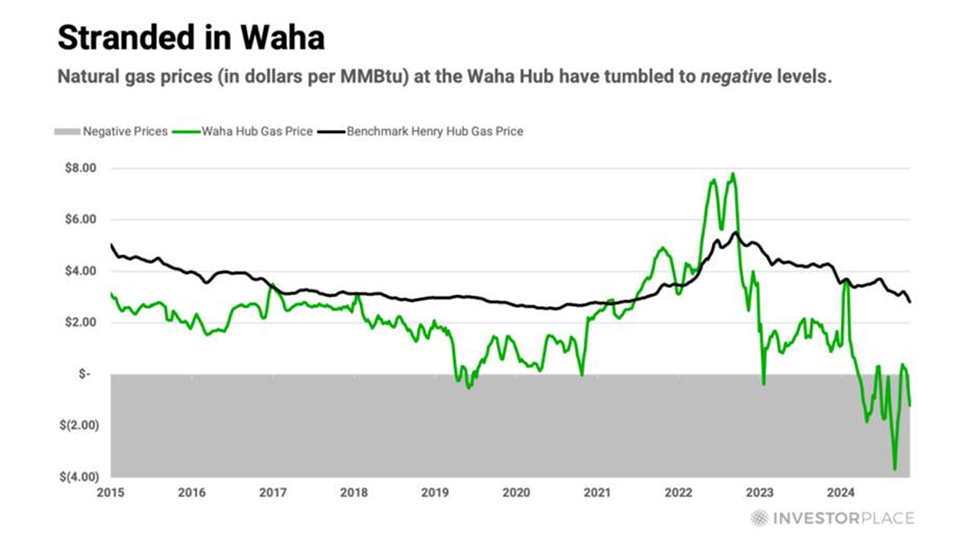
But the economics of producing natural gas in the Delaware Basin may be on the verge of a major transformation – one that will flip today’s negative gas pricing into solidly positive pricing.
A company called Devon Energy Corp. (DVN) is ideally positioned to benefit from that prospective transformation. It is the fourth-largest natural gas producer in the Delaware Basin, and it has been investing heavily in natural gas transport and processing facilities.
One of those facilities is the 580-mile Matterhorn Express Pipeline, which opened for business in 2024. This new pipeline, in which Devon holds a 12.5% stake, transports up to 2.5 billion cubic feet per day of natural gas from the Waha Hub to the Katy area near Houston.
Following close on the heels of the Matterhorn, Devon’s new 365-mile Blackcomb Pipeline is in operation and aims to be in service in the second half of 2026. It will transport gas from West Texas to the Agua Dulce Hub in South Texas, near Corpus Christi.
Importantly, Devon has contracted for significant offtake capacity on both pipelines, which is why the company is planning to ramp up its natural gas production from the Delaware Basin over the next few years.
Devon might also benefit from a new “wildcard” source of natural gas demand: data centers.
As the big tech companies build ever-larger and ever-more-numerous data centers, they are struggling to secure the dedicated power supplies these centers require.
For example, Dominion Energy Inc. (D), the utility that serves Northern Virginia’s “data center alley,” announced in October 2024 that it “expects the time it takes to connect large data centers to the electric grid to increase by one to three years, amid a surge of requests, bringing the total wait time to as long as seven years.”
Because of power bottlenecks like these – both current and prospective – the big tech companies are turning to every and any possible power source to satisfy their needs.
But over the near term, natural gas will take the lead in supplying the additional power. According to Goldman Sachs, natural gas will satisfy 60% of the power demand growth from AI and data centers, while renewables will provide the remaining 40%.
As a result of this growth, data centers could boost the demand for natural gas to fuel U.S. power plants by 20% to 45% over the next three years, according to Wells Fargo research. The midpoint of that estimate would be equivalent to doubling the current production from the Delaware Basin.
The natural gas market offers three major advantages over competing technologies…
- It is abundant.
- It is cheap, especially in the Delaware Basin.
- It is a proven technology with relatively rapid permitting processes.
Data center demand for natural gas could become especially acute in the Delaware Basin, with a new “Data Center Alley” potentially blossoming in that region.
To be clear, data centers will not immediately impact the economics of natural gas production in the Delaware Basin. However, this wildcard source of demand, combined with the two new pipelines coming onstream, could produce significantly higher and sustainable natural gas pricing throughout West Texas.
This likelihood is not lost on the heavy hitters of the U.S. oil & gas industry. They have been falling all over each other to acquire drilling acreage in and around the Delaware Basin. Because this region, which extends from West Texas into southeastern New Mexico, is less developed than the eastern Permian, it contains vast, untapped reserves.
Devon Energy was ahead of the game. Way back in January 2021, Devon kicked off this land-grab in the Delaware Basin by launching a $5.75 billion takeover of WPX Energy. After completing the deal, Devon possessed a massive 400,000-acre land position in the Delaware, along with significant production.
Five years later, Devon is attempting to cash in. The company is devoting about 60% of its capital investment budget to drilling projects in the Delaware.
Devon Energy’s share price does not reflect any upside potential from these new activities… nor much upside potential from any of its other activities.
But as Delaware gas prices trend higher, in the context of stable-to-rising energy prices, Devon’s share price could soar from current levels.
Moving Forward
I’m so glad that you decided to further your journey to wealth by joining Smart Money.
While these seven stocks are sure to fortify your portfolio in 2026 and beyond, those aren’t the only benefits of this free e-letter…
Nearly every Monday, Wednesday, Thursday, Saturday, and Sunday, you’ll receive an email from me wherein I’ll share insights on the latest market megatrends, how to hedge against inflation, which stocks you should avoid, and more.
Get started by visiting your Smart Money website here.
Regards,
Eric Fry
Editor, Smart Money