The ground just shifted around Nvidia… why Luke Lango says there are now two camps within AI… what does all this mean for Nvidia?… getting on the right side of this split with the American Dream 2.0
Last week, Google fractured the AI landscape.
Yesterday, Amazon deepened the split.
For the last three years, “AI” has moved as a single block. If you owned the major players, you captured the trend. The rising tide lifted everything.
This is changing – and it has major implications for your portfolio.
As our technology expert, Luke Lango of Innovation Investor, just wrote:
For the first time, a massive split in the AI world has emerged.
AI has reached an inflection point – and getting our portfolios correctly aligned now will be critical to the next 18–24 months of performance.
The sudden shift that’s driving this new sector division
Last week, I covered a key development in the tech/AI world: Meta (META) exploring the purchase of billions of dollars’ worth of Google’s (GOOGL) custom TPU chips rather than Nvidia’s (NVDA) GPUs.
It’s hard to overstate how central Nvidia has been to the AI build-out. Its GPUs have been the standard equipment for training large models, powering the cloud, and enabling the arms race that defined the last three years.
But Google’s TPUs – which are specialized for inference work and potentially cheaper to operate at scale – suddenly have momentum. That matters because AI compute has become the primary cost center for both hyperscalers and model developers.
So, if TPUs prove to offer a lower cost per unit of compute, the incentive to shift workloads toward Google becomes clear.
Now, none of this means it’s time to abandon Nvidia. In yesterday’s Digest, I highlighted Luke’s analysis. Here was his quick takeaway:
Nvidia’s growth story isn’t broken … just the market’s assumption of monopoly-level domination…
These chips don’t kill Nvidia. They simply take slices of the market Nvidia was never going to own forever.
But this doesn’t mean some portfolio changes aren’t appropriate.
“A massive split has emerged”
As Luke explains, Wall Street spent the last few years treating the Google compute complex and the Nvidia/OpenAI compute complex as essentially interchangeable. Basically, “AI is AI.”
But this new TPU/GPU divide is fracturing that idea – fast.
Here’s Luke:
For the first time, a massive split has emerged. The Google compute complex, including AVGO, CLS, and TTMI, has soared.
The OpenAI compute complex, including ORCL, AMD, CRWV, MSFT, and NVDA, has crashed.
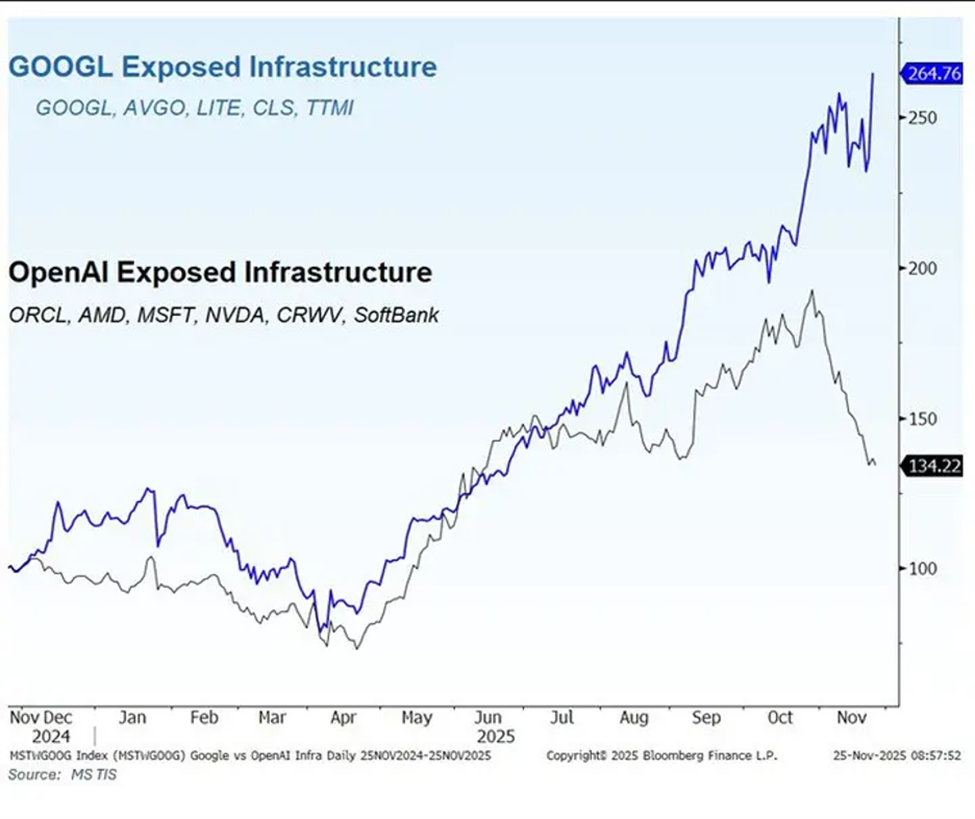
Luke says this divergence is driven by four main forces:
- The rising popularity of Google’s TPUs for AI compute
- Growing concern about Nvidia’s long-term GPU market share
- Uncertainty surrounding some of the circular financing dynamics within the OpenAI/Nvidia relationship
- Google’s progress with Gemini 3.0.
Alone, any one of these would warrant a fresh look at AI positioning. Taken together, they are beginning to reshape leadership within the sector. And this leads to Luke’s first big takeaway:
We have entered a new investing paradigm in the AI Boom.
Goodbye rising tide, hello “every stock for itself”
One of the most striking things Luke notes is how uniform AI returns had been until very recently.
For nearly three years, you could buy almost anything tied to AI and have a reasonable chance of outperforming – the enthusiasm was that powerful.
No longer.
As Luke puts it:
Selectivity is now crucial. You are seeing divergences within the AI megatrend.
Winners are separating themselves from losers.
To be clear, this isn’t the end of the AI boom – far from it – but it’s the next phase, where the market becomes more discerning about which companies have structural advantages, and which may struggle to keep pace.
Luke describes this as the shift from a “shotgun” environment, where broad exposure worked, to a “sniper” environment, where targeted exposure will matter much more.
He and his team are beginning to selectively trim portfolios to reflect this new reality, focusing more on the companies positioned to benefit.
Here’s Luke with some specific moves:
Takeaway: Trim excess Nvidia concentration. Boost exposure to custom silicon winners like Broadcom (AVGO) and Marvell Technologies (MRVL).
But do not reduce AI exposure overall…
Money shifting from NVDA to GOOG does not equal money leaving AI. It just moves within the AI ecosystem.
He’s also moved CoreWeave (CRWV) from a “buy” to a “hold.”
A new competitor just joined the fight
The pressure on Nvidia isn’t coming from just Google. Yesterday brought fresh evidence that the landscape is evolving in multiple directions.
Amazon (AMZN) announced the release of its next-generation AI chip, the Trainium series.
It represents a clear attempt to give cloud customers – and Amazon’s own infrastructure – a lower-cost alternative to GPU-heavy compute.
From Yahoo! Finance:
Amazon’s chips are much cheaper than Nvidia’s: AI developers using Amazon’s chips can see cost savings of 30% to 40%, according to [AWS vice president of compute and machine learning Dave Brown].
If Google’s TPUs already threatened to nibble at Nvidia’s dominance from one front, Amazon’s chips could threaten from another.
Now, Nvidia still has enormous advantages: scale, ecosystem, software depth, and existing relationships. Those don’t evaporate overnight.
But the incremental growth story becomes less straightforward. As more companies develop viable alternatives, the pool of new GPU demand doesn’t grow at the same pace. And if the sector gravitates toward custom chips for cost and control, Nvidia’s long-standing default status becomes less automatic.
Bottom line: NVDA is not a “sell” – but if it has ballooned into an outsized position in your portfolio, this may be an opportunity to take some profits and rebalance.
The broader point for investors…
While Nvidia remains a pillar of the AI economy, the ground around it is shifting in ways that many investors won’t fully appreciate until it impacts their portfolios.
The key issue isn’t whether Nvidia is weakening – it’s that the competitive and cost dynamics surrounding AI compute are changing faster than Wall Street expected.
Between Google’s TPUs, Amazon’s custom chips, and hyperscalers racing to develop their own silicon, the AI market is no longer marching in lockstep. Instead, it’s beginning to split into two distinct paths, each with its own beneficiaries.
The question now is whether your portfolio is positioned on the right side of that divide.
That’s precisely why I want to put Monday, December 8, at 10 a.m. Eastern on your radar.
Getting your portfolio on the right side of the American Dream 2.0
This coming Monday, we’ll be holding a closed-door strategy session with Luke, Louis Navellier, Eric Fry, and several special guests to walk through what they’re calling the American Dream 2.0 shift.
This is an $11.3 trillion wave of domestic reinvestment, reshoring, AI infrastructure build-out, and government-backed industrial modernization that begins in earnest on January 2.
The new AI divide we’re seeing fits directly into this broader transformation.
For three years, AI spending flowed broadly and indiscriminately across the entire ecosystem. But as we’ve seen from Luke today, those days are ending.
Trillions of dollars are still coming – but the results will be uneven. They will concentrate. They will bottleneck. And those bottlenecks will determine the next generation of market leadership.
Here’s Luke:
When you pour $11.3 trillion into rebuilding the real economy, the money doesn’t flow evenly. It bottlenecks in a handful of choke points — key nodes where tiny suppliers become indispensable.
We’ve spent months mapping those bottlenecks.
At the same time, another structural force is converging with this capital wave – the transition from a human labor pool to a robotic/AI workforce. I’ve been detailing this in the Digest, and together, these two influences are about to alter both the economic and investment landscapes at a foundational level.
Here’s how Luke puts it:
American Dream 1.0 created the U.S. middle class.
American Dream 2.0 will create a new investor class.
That’s why this Summit matters so much. Louis, Eric, and I aren’t going to sugarcoat it. We’ll walk you through why:
- AI is accelerating a historic labor reset…
- Major firms are openly betting they can grow profits without growing headcount…
- And why even conservative voices in finance now warn that waiting on the sidelines could devastate long-term returns.
Luke, Louis, and Eric have been strategizing how to position portfolios for this shift, and the result is a new collection of hand-selected stocks designed for the emerging AI landscape.
The last time these three collaborated on a “power portfolio” was in late 2024 – and it returned 32%, nearly triple the Dow and more than double the S&P 500 over the same period.
This year, our experts have zeroed in on a new batch of under-the-radar players sitting at the economic “bottlenecks,” as Luke just put it.
Here’s Luke to take us out:
If you’re not on the ownership side of this transition – if you’re not positioned in the companies powering it – you’re on the wrong side of history.
But get on the right side, and you’re on track for American Dream 2.0.
Have a good evening,
Jeff Remsburg
Disclaimer: I own GOOGL, MSFT, AMZN, and AMD.


