
What is OpenClaw and why does it matter?… CPUs: what’s old is new again… more examples of supply/demand imbalances… how to invest today
Suddenly, OpenClaw is everywhere.
Here are just three of the myriad headlines from the last two days:
- Nvidia CEO Jensen Huang says OpenClaw is ‘definitely the next ChatGPT’ – CNBC
- China Is Embracing OpenClaw, a New A.I. Agent, and the Government Is Wary – The New York Times
- Nvidia’s version of OpenClaw could solve its biggest problem: security – TechCrunch
What is OpenClaw, and why is it such a big deal?
At its core, it’s a platform for building autonomous AI “agents” – software that can complete tasks on your behalf without constant instruction.
It’s less “chatbot,” and more “digital assistant that actually does things.”
Think: scheduling meetings… sending emails… moving money… coordinating workflows… and as we’ll talk more about shortly, managing other AI agents.
Now, to understand why this matters for your wallet and portfolio, let’s zoom out.
Here’s veteran investor Brian Hunt from a recent issue of his free newsletter Money & Megatrends, explaining the significance of this coming “Agent Supernova”:
The Agent Supernova is set to transform how our lives and economies function. It will break and reform many businesses, industries, and societal norms.
[It’s] about to introduce billions of “AI workers” into our economy to perform all kinds of roles… with very little day-to-day human oversight.
To be clear, this isn’t a software upgrade…
It’s a before/after shift toward AI systems that actively run parts of the economy – coordinating tasks, making decisions, and operating continuously in the background.
Now, we could take this conversation in a few directions:
- The added convenience for our day-to-day lives…
- The potential disruption to jobs and entire industries…
- What this surge in AI activity means for the physical systems powering it – and the investment opportunities that could emerge as those systems come under strain…
Let’s focus on that last piece.
Because while most investors will look for the next OpenClaw-powered multibagger, the real opportunity will be in owning the infrastructure that every one of those winners – and losers – will rely on.
Let’s unpack this.
The next shift in the AI buildout
Up to this point, the AI boom has been defined by one thing…
Graphics processing units, or GPUs.
These specialized chips handle massive workloads all at once – powering everything from ChatGPT to enterprise AI systems – and they’ve been at the center of the AI explosion.
But as AI evolves with advances like OpenClaw, the demands on the system are starting to change.
Here’s our macro investing expert Eric Fry connecting that shift:
Technology companies are now building agentic AI systems – networks of AI agents that collaborate to complete complex tasks.
Instead of answering one question, they manage entire workflows.
That shift dramatically changes the computing demands inside data centers.
How are these computing needs changing?
Well, it’s no longer just about raw computing power – it’s now also about coordination.
When multiple AI agents work together – moving data, making decisions, and interacting in real time – something has to manage the entire system. And that’s where a much older, far less flashy piece of technology suddenly becomes critical again…
The central processing unit, or CPU.
If GPUs are the engines doing the heavy lifting, CPUs are the conductors – directing traffic, coordinating tasks, and keeping everything running in the right order.
Back to Eric:
The GPUs run the AI models…
But the CPUs increasingly run the system that manages the AI.
In other words, OpenClaw may be signaling the start of a new phase in the AI boom…
And a new bottleneck.
Where investors should be looking today
We’ve been tracking AI bottlenecks in the Digest all week – in critical industrial metals, memory, and energy.
They’re different parts of the AI buildout, but the same underlying story…
The system is struggling to keep pace with rising demand. And that tension is beginning to reveal where the next opportunities are forming.
Today, that pressure is showing up in CPUs.
Back to Eric:
The semiconductor industry is already seeing early signs of tightening supply for server CPUs.
Delivery times for some processors have stretched toward six months.
Prices have risen more than 10% in certain markets.
The problem is straightforward…
Semiconductor capacity doesn’t expand overnight. New fabs take years to build. Production takes time to scale. And yet demand is accelerating now.
This imbalance is setting up a massive tailwind for leading CPU players.
Here’s Eric with the numbers:
Some analysts now expect the global CPU market to more than double in size – rising from roughly $27 billion today to about $60 billion by 2030.
If you’re looking for ideas for your portfolio, Intel (INTC) is worth a close look.
While the company has struggled to keep pace in GPUs, it remains deeply embedded in the CPU market.
It’s also positioning itself for this next phase, optimizing its latest processors to support agent-based systems like OpenClaw through local, “hybrid AI” computing.
If Eric is right about the growing importance of this layer, Intel could benefit from a shift in where demand is flowing.
You can also go with Nvidia (NVDA). It’s leaning into this transition through its Grace CPU platform – a signal that even the biggest winner of the GPU era sees what’s coming next.
But the story doesn’t stop at chips
The CPU bottleneck is just one layer.
A moment ago, we mentioned critical industrial metals. We’ve highlighted this bottleneck with copper many times here in the Digest, but let’s look at a different example today…
Aluminum.
It’s a metal that sits quietly at the center of the AI buildout – used in server racks, cooling systems, power infrastructure, and even components tied to chip manufacturing.
As AI infrastructure expands, so does demand for aluminum.
Here’s Yahoo! Finance:
[Aluminum] prices are booming.
Part of that is because inside every data center are cooling units, server racks, radiators, and a litany of other pieces and parts made out of aluminum.
No wonder demand is high.
But supply isn’t keeping up.
Producing aluminum is extremely energy-intensive – and as AI data centers consume more power, they’re competing with aluminum producers for the same resources.
That’s creating a classic bottleneck. And it’s exactly the kind of setup Eric has been highlighting:
Every high-voltage line that feeds an AI data hub consumes 1 to 2 tons of aluminum per megawatt of delivered power. Each new stretch of long-distance transmission deepens the world’s appetite for this versatile metal.
From 104 million tons of demand in 2024 to an estimated 120 million by 2030, global aluminum consumption is set to grow relentlessly.
This is why we’ve put aluminum – and Alcoa (AA) – on your radar, citing Eric’s research above.
In our November 5, 2025 Digest, we highlighted AA as a strong pick for the metals/AI boom, quoting Eric, who said the aluminum maker had not yet “had its play.”
Since then, the stock has jumped 54%.
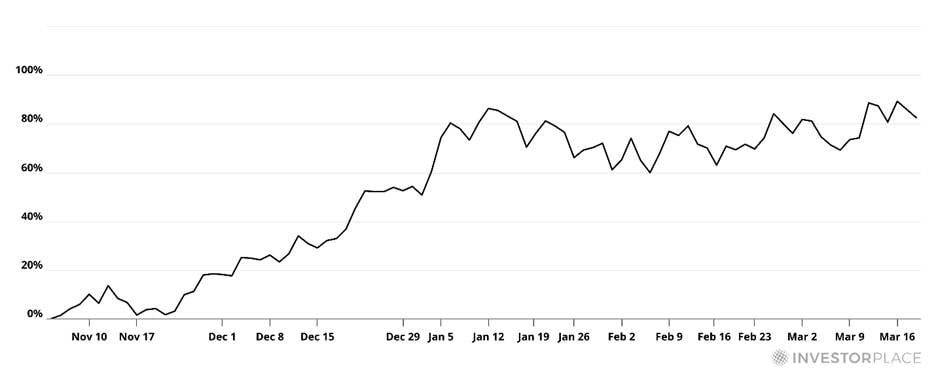
But if this bottleneck continues to tighten, the bigger move still lies ahead.
Meanwhile, last night brought another illustration of bottlenecks in action when Micron (MU) reported earnings.
Micron is the poster child for the memory trade, and yesterday, after the closing bell, it delivered a blowout quarter, tripling revenues.
But the bigger story is the lack of memory supply relative to ravenous demand.
From CEO Sanjay Mehrotra:
We are only able to supply, for our key customers in the mid-term, about 50% to two-thirds of their requirements.
Recognize the broader pattern here
Every major technological boom runs into constraints.
And when it does, capital doesn’t stay where it is, it moves toward whatever solves the problem.
And this is where investors can take advantage, as Eric explains:
But tech revolutions rarely unfold in a straight line. They run into bottlenecks.
And those bottlenecks often become the most profitable investment opportunities of all.
This is what Eric laid out in detail during his FutureProof 2026 event earlier this week.
In that presentation, Eric walked through the specific constraints forming across the AI economy – from chips to energy to materials – and explained how they could reshape where capital flows next.
He also highlights a group of companies already positioned to benefit from these emerging pressure points.
If you haven’t seen it yet, it’s well worth your time. You can watch the full replay right here.
Coming full circle
OpenClaw isn’t just another AI headline. It’s a signal that AI is moving beyond chat – and into real-world execution.
As this shift picks up steam, there will be some OpenClaw-enabled winners, but the more powerful trades will come from companies sitting at the infrastructure bottlenecks that make it all possible.
We’ll keep tracking this for you here in the Digest.
Have a good evening,
Jeff Remsburg
(Disclaimer: I own MU.)


