Listen to the audio version of this article (generated by AI).
May CPI is hot – but we dodged a bullet… the labor market handbrake is releasing… what a hike would mean for AI stocks… an edge for a bifurcated stock market
The May Consumer Price Index (CPI) report came out this morning, and the initial read is about as good as investors could have hoped for given the circumstances.
Headline inflation came in at 4.2% year-over-year, matching expectations. Yes, that’s the highest print since April 2023, and yes, it crossed the 4% threshold for the first time in three years. But the monthly pace actually slowed – 0.5% in May versus 0.6% in April.
Meanwhile, the number that matters most to the Fed – core CPI, which strips out volatile food and energy – came in at just 0.2% month-over-month, cooler than both the 0.3% forecast and April’s 0.4% reading.
Gasoline accounted for the bulk of the headline monthly move, while shelter costs, food, and core goods were all well-behaved. Economists are increasingly calling May the peak – assuming Iran hostilities don’t reignite and push oil higher again.
The takeaway: so far, this is an energy-driven inflation surge, not a broad-based one – which makes it a moment of relatively good news in what has been a difficult inflation stretch. Had core inflation come in hot, it would have rattled a market that’s already looking fragile. So, bullet dodged.
That said, the CPI print tells us where we’ve been. What’s changed underneath the surface tells us where we’re going – and what’s changed is already significant enough that even a well-behaved core reading doesn’t alter the trajectory.
In other words, the inflation risk hasn’t gone away. And the fragile balance that’s been keeping the Fed from responding to it is starting to crack.
The handbrake is being released
For the better part of six months, the Federal Reserve has been frozen between two competing fires.
On one side: inflation running well above the 2% target…
The Iran conflict has added an energy shock, pushing headline CPI to 4.2% – a three-year high, as of this morning’s print. Cutting rates into that environment would mean pouring fuel on the fire.
On the other side: a labor market showing real signs of weakness…
It spent most of 2025 softening – slow hirings, job openings down, unemployment drifting toward 4.5% at its peak last November. Not in freefall, but fragile enough that hiking into it carried real risk.
But that two-handed weakness created a delicate balance. Inflation made it too hot to cut rates, yet the labor market was too fragile for hikes.
The result was paralysis: rates locked at 3.50% to 3.75% through three straight meetings, which was fine for Wall Street.
But that calculus may now be changing – and the evidence comes from an unlikely place.
One of the loudest arguments for labor market fragility has been the fear that AI was quietly hollowing out hiring. If that were true, it would give the Fed even more reason to stay put. But the data are telling a different story.
As regular Digest readers know, I’ve been questioning the “AI will take all jobs” narrative. I haven’t abandoned it, but a growing body of data is making me hold it with less conviction.
Yesterday, Torsten Slok, chief economist at Apollo Global Management, flagged the latest relevant data point.
Instead of snowballing job losses related to AI, Slok reports that the number of job openings per unemployed worker has started rising again and is now back above 1.0 – meaning there are more jobs available than workers to fill them. The May jobs report from last Friday reinforced this, with nonfarm payrolls jumping 172,000.
Here’s Slok:
If AI were triggering a jobs crisis, we would expect job openings to collapse and unemployment to climb, yet the opposite is happening.
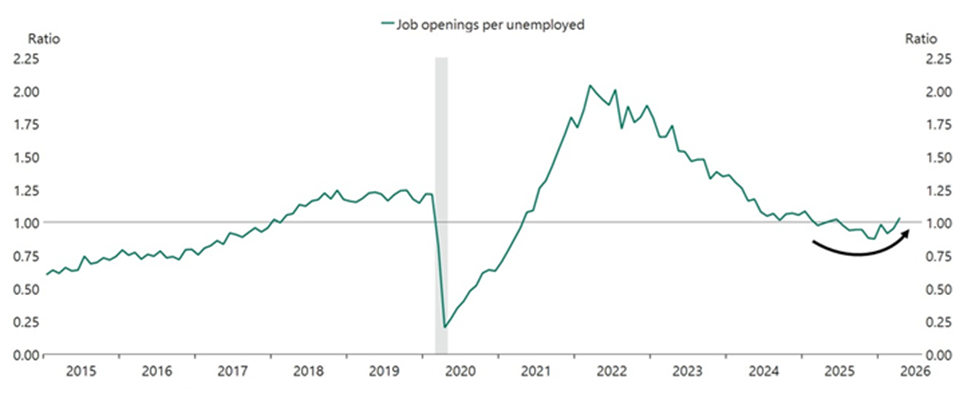
Source: Torsten Slok / Apollo
This is big.
The labor market weakness that gave the Fed its excuse to stay put is fading. Which means one of the two constraints supporting the Fed’s delicate equilibrium is being removed.
What it means for Warsh’s first meeting
Kevin Warsh was sworn in as the 17th Fed chair on May 22, inheriting a central bank holding rates at 3.50% to 3.75%, a deeply divided FOMC – four dissents at the most recent meeting – and inflation that’s been above the 2% target for five straight years.
Three of those four dissenters weren’t opposed to pausing. They were opposed to the Fed’s easing bias – the language signaling that cuts, not hikes, remain the next move.
Why lean toward easing when inflation has been running hot this long?
At the June FOMC meeting – one week from today – it’s widely expected that Warsh will drop that easing bias entirely.
Now, that alone would be a meaningful hawkish signal. But the deeper question, with the labor market handbrake releasing, is whether a bias shift is enough – or whether the data are supportive of an overt head-nod toward a hike.
Markets are starting to price that possibility.
Below, we look at the CME Group’s FedWatch Tool, which shows the probability traders assign to different interest rate ranges in the future.
As you can see, the odds of at least one quarter-point hike by the December 2026 FOMC meeting now clock in at roughly 66%.
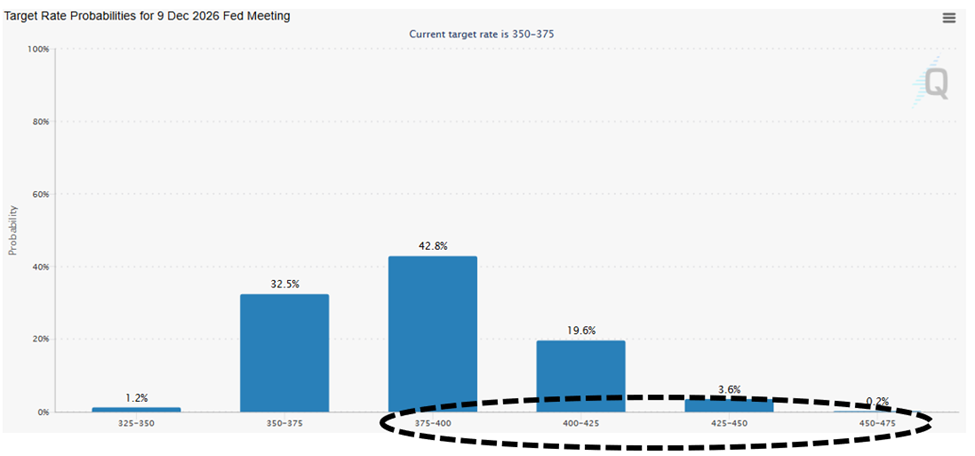
In other words, the question is now not so much “when do we cut?” but rather “when do we hike – and by how much?”
Two markets inside one – and where the AI trade fits
Let’s say that sometime in the coming months, Warsh hikes.
What happens then?
First, there’s a broad selloff. That’s a near-certainty based on how markets behave.
High-multiple growth stocks get nailed because higher rates mean higher discount rates, which compress valuations on companies whose earnings are weighted toward the future.
So, AI darlings like Nvidia (NVDA), ARM (ARM), and Marvell (MRVL) all suffer in the immediate aftermath of a hike announcement.
But as wise investors, we need to look beyond this. After all, the first move and the lasting move are entirely different issues.
While the knee-jerk selloff would treat all rate-sensitive assets roughly the same, the recovery wouldn’t.
To understand the difference, we must ask one key question…
What’s fueling today’s AI bull?
The answer: the hyperscalers. Microsoft (MSFT), Alphabet (GOOG), Amazon (AMZN), and Meta (META).
But while these companies are using some debt in their AI capex buildout, the majority of that funding comes from operating cash flows and new equity issuance, totaling tens of billions of dollars per quarter.
A 25- or 50-basis-point rate hike doesn’t change that math. These companies don’t need cheap debt to build data centers. Their AI infrastructure spending is, in a meaningful sense, insulated from the Fed in a way that most of the market simply isn’t.
Compare that to what a genuine tightening cycle does to the rest of the market: leveraged real estate, small-cap companies running on thin credit lines, consumer discretionary names dependent on households that borrowed cheaply…
That pain is structural, not temporary – and it doesn’t bounce back the same way.
This will accelerate the “tale of two markets”
Regular Digest readers will recognize this dynamic. It’s the Technochasm we’ve written about for years at this point – the widening gap between the companies and investors positioned on the right side of transformative technology, and everyone else.
What’s worth understanding now is that a rising-rate environment doesn’t pause the Technochasm – rather, it likely accelerates it.
If monetary tightening hits rate-sensitive sectors hard while leaving hyperscaler AI capex largely intact, the performance gap between AI infrastructure and the rest of the market widens.
That’s a harder story to tell than “rates go up, growth stocks go down.” But it’s the more accurate one – and it’s the distinction that matters for how you think about positioning.
Which is exactly where legendary investor Louis Navellier comes in
Louis has spent 47 years identifying the fundamentally strongest stocks in the market. But in a bifurcating market – where the right names recover and the wrong ones don’t – finding quality is only half the equation.
The other half is timing: knowing when a stock’s short-term momentum supports taking action on a long-term thesis, and when it doesn’t.
This morning, Louis and TradeSmith CEO Keith Kaplan held a live event unveiling a new system that combines Louis’ fundamental stock-selection framework with TradeSmith’s market-timing technology. The goal is precisely the kind of edge this environment demands – not just what to own through a volatile, rate-sensitive stretch, but when to pull the trigger or step aside.
If you missed this morning’s event, you can catch a free replay right here.
Coming full circle
Today’s CPI print was relatively good news. But the real news is how the handbrake is now releasing.
One week from today, Warsh chairs his first FOMC meeting with inflation at a three-year high, a labor market that’s no longer fragile enough to justify inaction, and markets pricing a 66% chance of a hike before year-end.
The regime is shifting, and the Technochasm will be widening.
The investors who come out ahead will be the ones who recognize what this means, where it takes us, and how to position for it.
Have a good evening,
Jeff Remsburg
(Disclaimer: I own MSFT, GOOGL, and AMZN)


