
Listen to the audio version of this article (generated by AI).
Luke Lango highlights AI’s toll roads… Brian Hunt flags Brazil’s overlooked AI angle… Louis Navellier’s refiner play amid Mideast turmoil…
As I write on Thursday morning, the biggest headline is that President Trump says Iran called “a little while ago” wanting to make a deal “so badly” – just hours after a second night of U.S. strikes.
But there are plenty of other stories…
South Korean memory-chip maker SK Hynix – one of the world’s most recently minted trillion-dollar companies – is preparing for its $28 billion American IPO tomorrow. Demand is running roughly seven times the available shares, a loud signal for the AI memory trade.
Meanwhile, on the economic front, this morning’s initial jobless claims came in at a seasonally adjusted 215,000, beating forecasts and down from the prior week. It’s another sign the labor market is holding steady – and a data point that Fed Chair Kevin Warsh will factor in.
We could spend this Digest chasing any one of those threads. Instead, we’re letting them take a backseat for a different purpose…
Putting some money in your pocket.
Today, let’s look at three investment ideas – straight from three of our sharpest analysts.
The first is a straightforward AI play from Luke Lango – built for when the AI trade’s current multiweek drawdown eventually gives way to its next leg higher.
The second is a more conservative way to ride that same AI wave, courtesy of Brian Hunt – and it comes from a corner of the market most investors aren’t watching.
And the third is for AI-weary investors who just need a break from all-things-tech and its recent volatility. It’s a trade from legendary investor Louis Navellier, built around one of the more overlooked side effects of the conflict in the Middle East.
Let’s get into it.
Luke Lango: “AI just joined the payroll”
Luke, our tech and innovation expert and editor of Innovation Investor, is flagging a shift he thinks most investors are underestimating. AI is turning from a tool people use into labor companies deploy.
This is the shift to “agentic” AI that we’ve been tracking here in the Digest for months.
To illustrate, Luke highlights Kalshi, the prediction-market platform. It has an internal AI agent named “Harrison” doing work that looks like analyst labor – tracking news, monitoring competitors, drafting contract language, and helping resolve markets.
Tying into the investment opportunities, here’s Luke to explain why that matters for the compute build-out:
An AI agent is different.
Give it an objective, and it goes to work — planning, executing, checking its own output, calling tools, querying databases, revising, and iterating until the task is complete.
That continuous loop consumes inference compute on a vastly larger scale.
This reference to “inference compute” is where we find opportunity.
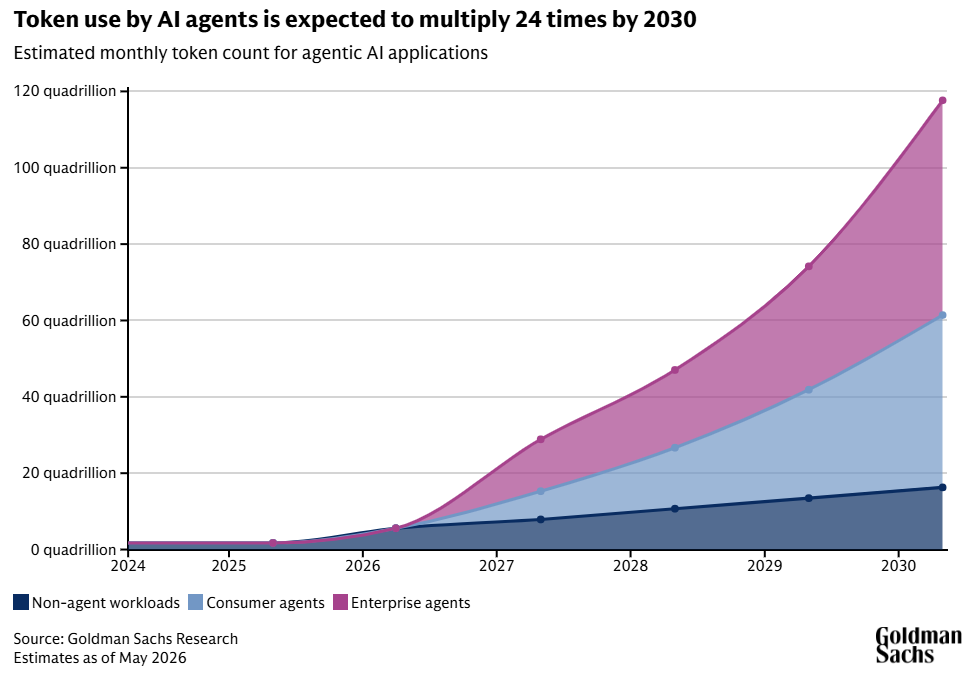
Luke points to estimates from Gartner that agentic AI workflows consume 5X to 30X more tokens per task than single-shot generative AI queries. Meanwhile, Goldman Sachs projects that monthly token counts for agentic AI could reach roughly 120 quadrillion by 2030.
Luke’s takeaway for investors:
Follow the compute, and you’ll find the trade.
It doesn’t matter which app wins, which enterprise deploys the most agents, or which model — GPT, Claude, Gemini, Llama — powers them.
What matters is that every agent is sending traffic through the same physical infrastructure stack. And that stack is finite, expensive to build, and currently being stretched to its limits.
Each layer collects a different kind of toll.
Luke breaks the “toll roads” into several categories – accelerators like Nvidia (NVDA), networking and custom silicon such as Credo (CRDO), memory like SanDisk (SNDK), servers and power such as Dell (DELL), optical connectivity like Coherent (COHR), and storage.
For our purpose today, I’ll highlight one of Luke’s “storage” stocks: Everpure (P).
AI agents need fast retrieval from massive datasets, and Luke says storage is where that need shows up first. Here he is with more:
Everpure in particular has been gaining strength beneath the surface.
In Q1 of FY2027, product revenue surged 55%, while subscription services accounted for 45% of total revenue.
Operating profit jumped over 90% year-over-year to $159 million.
His broader point is that as agentic workloads scale, storage isn’t a side character in the AI story; it’s a structural beneficiary. It quietly compounds while the market’s attention stays fixed on chips.
Luke’s closing thought is interesting. While we’ve written many Digests about the economic incentive for companies to shift from a human workforce to an agentic workforce to benefit from lower labor costs, Luke spots a parallel:
Once AI joins the payroll, compute becomes the new labor cost.
The companies supplying the accelerators, networking, memory, servers, storage, power, cooling, and connectivity behind that shift are not side bets on AI. They are the trade.
It’ll be interesting to watch how pricy this new compute “labor cost” becomes – and how that shapes the agentic AI trade.
In the meantime, for the specific AI stocks that Luke officially recommends in Innovation Investor, click here to learn more.
Brian Hunt: Brazil is the AI trade nobody’s talking about
Following Luke’s look at the infrastructure layer behind AI agents, our next opportunity comes from Brian, editor of the free daily newsletter Money & Megatrends – and it takes the AI infrastructure story somewhere unexpected…
Brazil.
In Tuesday’s issue of Money & Megatrends, Brian argues the iShares MSCI Brazil ETF (EWZ) is set up to keep climbing, and that AI’s global infrastructure boom is part of the reason why.
Brazil, he notes, is a commodity superpower – and commodities are the backbone of the AI buildout that most investors overlook.
Here he is to explain:
Brazil is a beneficiary of the historic AI infrastructure spending boom…
Brazil’s huge network of rivers also makes it a giant producer of hydroelectric power. This makes it an attractive destination for power-hungry AI data centers.
Brazil also has large reserves of rare earth elements. Demand for these raw materials is soaring thanks to growing demand in AI infrastructure, robotics, and defense tech.
Brian’s been tracking the price action for months. He first flagged Brazilian stocks back in September, and here’s how that call played out:
Soon after my September note, Brazilian stocks – in the form of the iShares Brazil ETF (EWZ) – surged 38% in less than seven months.
It then experienced a natural, healthy bull market correction from mid-April to mid-June.
Now, he says, that correction is over as EWZ looks poised to continue its uptrend.
It’s a reminder that the AI trade isn’t confined to chips and data centers. Somewhere down the supply chain, it runs through rare earths, hydropower, and the raw materials that make the whole buildout physically possible – and Brian thinks Brazil sits right in the middle of that chain.
If you like EWZ, Brian writes Money & Megatrends every day the market is open, highlighting these kinds of opportunities before they become front-page news – and it’s 100% free.
His issues are loaded with trend analysis, actionable advice, and loads of specific tickers. You can sign up right here.
Louis Navellier: A trade that has nothing to do with AI
To round out today’s lineup, let’s turn to Louis, editor of Growth Investor. Two weeks ago, he recommended a trade that’s aging quite well – U.S. oil refiners.
Louis made this call while the ceasefire was still holding. Now that it’s collapsing, the shortages and refining-margin tailwind he flagged look even more likely to persist.
Backing up, volatile crude prices usually squeeze energy companies from both directions…
Rising crude hits refiners’ feedstock costs – the price they pay for the crude oil they’re about to turn into diesel and jet fuel – before they can pass the increase along. Falling crude does the opposite damage – it marks down the value of the crude oil they’re already holding in storage and pipelines.
But right now, refiners are catching a powerful offset: some of the strongest refining margins in years.
Here’s Louis to explain why:
The conflict in the Middle East has created shortages and increased demand for U.S. energy products.
That has pushed refiners to ramp up production of diesel, jet fuel and other petroleum products – and helped drive some of the strongest refining margins in years.
The numbers back him up. In the first quarter, the industry benchmark 3-2-1 crack spread – essentially a snapshot of refiner profitability – jumped 73% on average.
One of the companies riding that tailwind – Louis’ pick – is Phillips 66 (PSX), a diversified energy giant that touches nearly every part of the fuel supply chain. It boasts 12 U.S. refineries, more than 70,000 miles of pipeline, thousands of branded and joint-venture fuel outlets, and a growing renewable fuels business.
That diversification showed up directly in the company’s first-quarter results. Louis highlights how Phillips 66 posted adjusted earnings of $200 million, or $0.49 per share – crushing Wall Street’s estimate for a loss of $0.39 per share.
Analysts have since revised their consensus estimate 60% higher over the past three months, and they now expect second-quarter earnings to soar 179% year-over-year, to $6.64 per share, compared with $2.38 per share in the same quarter a year ago.
Now, Louis made this recommendation on June 26, and his Growth Investor subscribers are already up 11%. That’s pushed PSX above his buy-up-to price of $180 – the stock trades around $189 as I write.
But keep watching here. Any genuine de-escalation in the Middle East would likely ease the shortages driving refining margins higher, which could pull PSX back down – potentially back into Louis’ buy range.
Either way, PSX is a reminder that AI isn’t the only game in town right now. Sometimes the more interesting opportunity is old-fashioned energy infrastructure, catching a tailwind from an entirely different story.
If you want more from Louis, he’s got his eyes on July 23 – exactly two weeks from today – when Q2 earnings kick in.
In his latest presentation, he dives into what his Precursor Intelligence system – or P.I. for short – is digging up right now. Louis designed it to help him identify where institutional money moves next, before the rest of Wall Street catches on. That’s the lens through which he’ll be positioning himself for Q2 earnings.
You can get more details right here – as well as several stocks his system says could be next in line as institutional money makes its next move.
Wrapping up
No big headline analysis today – just three ideas to consider from some of our sharpest analysts…
- An AI infrastructure trade built for the rebound,
- A conservative AI angle running through Brazil,
- And an energy play riding a tailwind that has nothing to do with AI at all.
Given our analysts’ respective track records, each is worth a good look if you’re thinking about putting money to work today.
Have a good evening,
Jeff Remsburg
(Disclaimer: I own COHR)


