
Listen to the audio version of this article (generated by AI).
Alphabet fails Wall Street’s new AI test… why Microsoft held up… the “peak AI spend” question… hot inflation, hotter GDP… Eric Fry on Brazil’s shock election
In yesterday’s Digest, we said last night’s earnings from Microsoft Corp. (MSFT) and Alphabet Inc. (GOOGL) would show us how hard the hyperscalers are still pressing the AI “gas pedal.”
The answer: very hard.
But Wall Street is now grading them on a new question – can they afford it? And judging by this morning’s trading, Alphabet failed badly.
As I write on Thursday, Alphabet is down about 12%, on pace for its worst day since March 2020. Microsoft opened higher before slipping about 1% as the Nasdaq dropped 1.5%. That’s hardly a victory lap. But an 11-point gap between the two tells you how differently Wall Street graded them.
To dig into the different reactions, let’s start with Microsoft…
Revenue rose 19% to $92.3 billion, and adjusted earnings of $4.89 per share beat estimates. Azure, Microsoft’s cloud platform, grew 48%, and management guided for 49% to 50% growth next quarter. Meanwhile, Microsoft’s contracted backlog of future business jumped 73% to $677 billion.
Most importantly, it did all this while still generating cash. Here’s CNBC:
The software giant has been rapidly building out data center infrastructure to meet artificial intelligence demand, while also maintaining positive free cash flow unlike its fellow hyperscalers.
Free cash flow – the cash left over after a company pays for its operations and investments – came in at $18.6 billion, and management expects it to stay positive for the full fiscal year.
Alphabet’s story is more complicated
The AI side is booming. Google Cloud revenue soared 103% to $30.7 billion, and the Gemini app just reached 1 billion users, making it the fastest-growing product in Google’s history.
The problem is what AI is doing to Google’s core business…
Search revenue came in at $63.4 billion, missing estimates. Google said its fast-growing AI Mode search earns less per query than traditional search ads. CEO Sundar Pichai framed that as a deliberate trade-off:
Just like our shift to mobile over a decade ago, we are focused on building the best Search user experience, followed by monetization.
In other words, Google is prioritizing winning users with AI first and figuring out how to profit from them later. Wall Street doesn’t want to wait.
Then there’s the bill…
Alphabet’s free cash flow swung to negative $9.1 billion. That comes one week after Meta Platforms Inc. (META) reported negative cash flow for the first time since 2012. Alphabet has also paused stock buybacks and is now selling new shares and bonds to help fund the build-out.
How did last night’s results influence fears of “peak AI spend”?
Both earnings reports included a detail that could have kneecapped the AI infrastructure trade: both companies spent less on capex than Wall Street expected last quarter.
However, both management teams quickly put fears of “peak AI spend” to rest.
Microsoft’s spending last quarter came in about $5 billion below its own forecast of “over $50 billion.” But management says that’s a matter of timing, not a pullback.
It expects more than $50 billion again this quarter, about $170 billion for the fiscal year, and faster spending in the second half as chip deliveries and data center capacity catch up.
As for Alphabet, it held its 2026 guidance at $195 billion to $205 billion – which implies a big fourth-quarter jump – and said it expects capex to increase significantly in 2027.
In fact, Alphabet said demand is so strong that it has started renting third-party computing capacity because it can’t build fast enough.
What does this mean for the wider AI trade?
Last night didn’t call AI demand into question. Nor did it signal a spending slowdown. Both companies are capacity-constrained and still pressing the gas.
But Wall Street is questioning how the hyperscalers will pay for it – and whether AI cannibalizes the businesses that fund it. Microsoft is paying from its profits. Alphabet is now leaning on stock and bond sales as AI nibbles at its search ads.
For the companies supplying the build-out – on the receiving end of all these hyperscaler dollars – last night’s spending outlook is good news. But as the response to Meta’s earnings last week showed, infrastructure stocks can still sell off when investors start to doubt whether that spending can last. We’re seeing a version of that this morning, with many chip stocks lower alongside Alphabet.
Our next test comes tonight, when Amazon.com Inc. (AMZN) reports after the close. We’ll report back.
The other big news today – hot prices, and an even hotter economy
In yesterday’s Digest, we noted that this morning’s PCE inflation report could shift expectations for the Fed’s next move. Here’s what we got…
The personal consumption expenditures (PCE) price index – the Fed’s preferred inflation gauge – rose 0.5% in September, its biggest monthly jump since March. That put annual inflation at 3.6%. The biggest culprit was energy, with gasoline and other energy goods jumping 9.2% in the month.
Core PCE, which strips out food and energy, rose 0.3% for the month and 3.1% for the year, up from 3.0% in August.
While hot, at least the numbers were roughly in line with forecasts.
Speaking of hot, third-quarter GDP grew at a 3.4% annualized pace, beating the 3.1% estimate and marking the fastest growth in a year.
And what accounts for the acceleration? You guessed it – AI. Business investment soared 19.4%, led by a 20.9% surge in equipment spending – much of it tied to the AI build-out.
That’s the same hyperscaler spending we just covered. And it ties back to yesterday’s Digest, where we looked at how AI is adding to inflation now while its productivity payoff comes later. This morning’s data showed both sides of that coin: the build-out is powering growth, but Main Street is getting the bill first.
Real disposable income – what households have left after taxes and inflation – fell for the first time since April. And the savings rate dropped to 3.8%, its lowest level since the end of 2022.
Here’s Bloomberg Economics:
September’s personal income and outlays report paints a troubling picture of the US consumer: Inflation came in hotter, while income growth failed to keep pace.
Squeezed by higher prices, consumers held real spending flat even as the saving rate declined.
As for the Fed, strong growth plus inflation stuck well above its 2% target makes it hard for the Fed to justify holding off on another hike. On that note, the CME Group’s FedWatch Tool puts the odds of at least one quarter-point hike in December at 80%.
Finally, let’s circle back to Brazil, where a shock election earlier this week could be setting up a very profitable trade.
Brazil’s shock election: why Eric Fry is calling it an overreaction
On Monday, Brazil’s stock market suffered one of its worst days in decades. We waited to cover it until we had analysis from one of our own experts. Now we do.
First, a quick recap…
On Sunday, Brazilian voters gave President Luiz Inácio Lula da Silva a fourth term, beating Flávio Bolsonaro in the runoff roughly 51.8% to 48.2%. Bolsonaro had won the first round, and on Sunday morning, prediction markets gave him about an 80% chance of victory.
So, on Monday, investors who had bet on a Bolsonaro presidency ran for the exits.
Brazil’s Ibovespa index plunged as much as 17%, triggering the country’s first circuit-breaker halt since March 2020, before closing down 14%. Here at home, the iShares MSCI Brazil ETF (EWZ) closed down 20%.
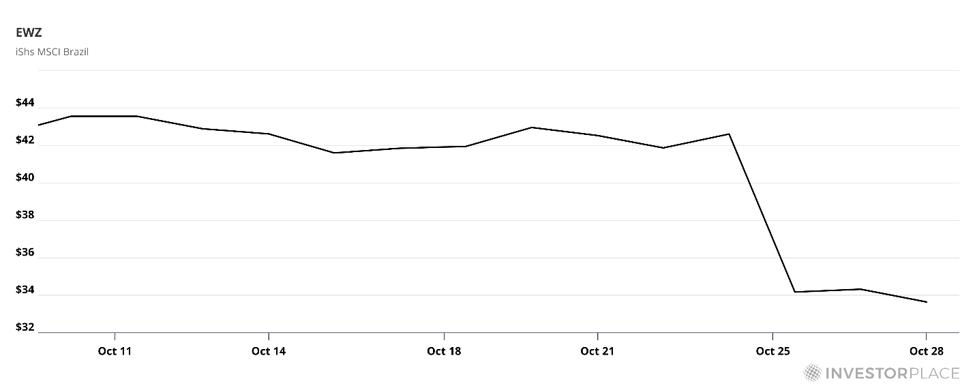
In the fund’s 26-year history, only one day was worse: March 16, 2020.
That EWZ number could sting for some of our readers
Last Tuesday, we highlighted senior analyst Brian Hunt’s bullish call on EWZ, which was up 21% since his July note. We’ll pass along Brian’s take when it crosses our desk. In the meantime, our global macro expert Eric Fry, editor of Fry’s Investment Report, has plenty to say, since he’s recommended a handful of positions with exposure to Brazil in his newsletters.
Eric explains that the market’s worry is fiscal. Brazil’s public debt tops 82% of GDP, and investors fear Lula will keep spending high, keeping interest rates elevated.
Meanwhile, critics call Lula a “socialist” and a “populist.” But Eric believes the market’s fear rests more on those labels than on Lula’s record:
Lula’s critics apply both labels to him, and they have a point. But when it counts, Lula has also chosen pragmatism over ideology…
In October 2002, Brazilian markets collapsed on fears that Lula would win his first presidential election, and the real sank to record lows. Then Lula installed an orthodox finance team, and investors spent the next several years unwinding their “Lula discount.”
Eric also points out that the Ibovespa Index soared by nearly 1,200% in U.S. dollar terms during Lula’s first two terms, from 2003 through 2010.
But investors aren’t convinced yet. The Ibovespa slipped Tuesday and Wednesday and is down again as I write on Thursday. And with Bolsonaro refusing to concede, more volatility could be ahead.
So, where does this leave investors with Brazilian exposure?
First, what you own matters.
For example, old-line Brazilian banks Itaú Unibanco (ITUB) and Banco Bradesco (BBD) finished Monday down roughly 24% and 29%, respectively, on fears of tax increases and tighter regulation. Meanwhile, e-commerce leader MercadoLibre Inc. (MELI) fell a more modest 8%, and has since bounced almost 5% off its Monday low.
Overall, Eric sees a buying opportunity:
Markets often fixate on narratives over substance. I believe [Monday’s] selloff is an overreaction and a buying opportunity…
I expect to see a lot more of the pragmatic Lula over the next four years than the populist one.
Maintain your position [in Eric’s recommended plays].
To find out which Brazil-exposed stocks Eric holds, plus the rest of his international picks, click here to learn about joining him in Fry’s Investment Report.
Summing it all up…
The hyperscalers are still pressing hard on the AI gas pedal, but Wall Street now wants proof they can pay for the fuel. On that note, all eyes turn to Amazon after the closing bell.
Meanwhile, hot inflation keeps the Fed’s foot hovering over the brake. And in Brazil, Eric sees a selloff driven more by fear than fundamentals – which is often where the best opportunities begin.
Have a good evening,
Jeff Remsburg
(Disclosure: I own GOOGL, MSFT, AMZN)


