


Editor’s Note: Thank you to everyone who joined Louis Navellier, Luke Lango, and me earlier today for The American Dream 2.0 Summit. It was an energizing session, and I’m grateful so many of you showed up ready to think differently about the $11.3 trillion transformation now unfolding across America. If you missed any part of the broadcast — or want to watch it again — we’ve posted a full rebroadcast. Click here to view it.
With that in mind, I want to share something directly connected to the themes we covered — a major shift happening inside U.S. manufacturing, and the trade I believe investors should be focusing on now.
Hello, Reader.
“In the dark” is not typically a great place to be.
If you’ve ever been the unsuspecting victim of surprise news, or caught unaware of a change of plans, then you know the feeling. Nobody wants to be kept in the dark.
That is, unless you are a “dark factory.”
These manufacturing plants operate, as their name suggests, totally in the dark.
Also called “lights-out” or “smart” factories, they function without lights… because they don’t need humans. They are instead designed for total robotic efficiency.
Xiaomi, a Chinese tech company located in Beijing, operates what may be the most advanced smart factory in the world. Powered by AI and robotics, it produces one smartphone every second – in total darkness – with a total annual capacity of up to 10 million devices.
In the United Kingdom, the warehouses of online grocer Ocado are almost entirely robotic. Grocery orders fly across the grid and then get sorted and packed by machines.
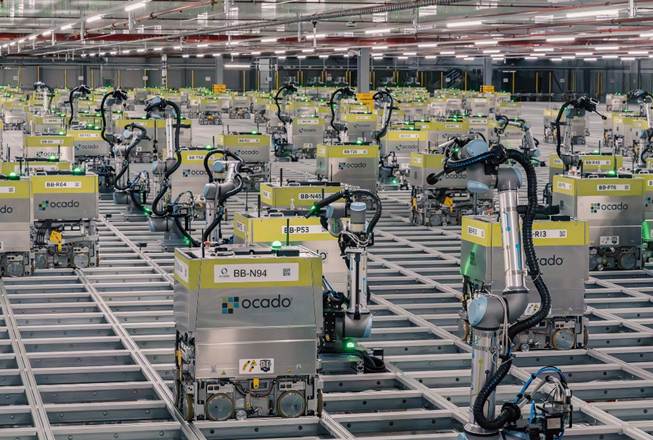
Source: Ocado
Back here in the States, Amazon.com Inc.’s (AMZN) newest fulfillment centers are designed from the ground up for total automation.
These plants showcase a supply chain that runs end-to-end without human hands. And while an incredible technological feat, more “lights out” factories means it’s “lights out” for human manufacturing jobs.
Smart manufacturing has already affected the U.S. labor market. The ADP National Employment Report released last week showed a loss of 32,000 private-sector jobs in November.
Last month’s hiring was particularly weak in manufacturing, with a loss of 18,000 jobs.
So, in today’s Smart Money, let’s take a closer look at how AI, robotics, and automation are disrupting the payroll…
And the profit opportunity hiding “in the dark” itself.
The New Industrial Equation: More Tech, Fewer People
In 1908, when Ford Motor Co. (F) built Highland Park, the birthplace of the moving assembly line, it employed nearly 70,000 people.
In 2030, when Meta Platforms Inc. (META) aims to have completed one of its $10 billion data centers in Louisiana, which will be twice the size of Highland Park, it will support just 500 jobs.
Smart manufacturing is erasing us humans from the industrial equation…
- In October, Amazon announced that it has already replaced 14,000 human roles with robots. That number could grow to 30,000 after the holiday season.
- IBM Corp. (IBM) has paused or cut back-office hiring because many tasks “can be replaced by AI.”
- Microsoft Corp. (MSFT) slashed 6,000 jobs in June and another 9,000 in July.
The trend toward smart manufacturing isn’t isolated to Big Tech. United Parcel Service Inc. (UPS) has axed 48,000 employees, most of them warehouse workers and drivers. And Target Corp. (TGT) recently announced its first major layoffs in a decade.
In total, 1 million workers have been shown the door so far this year.
These announcements are pieces of a frightening mosaic: The World Economic Forumsees 14 million net jobs disappearing by 2027 as AI and automation infiltrate the workplace, while Goldman Sachs predicts the tally of at-risk jobs globally could soar to 300 million by the end of the decade.
And here’s the cherry on top…
The same companies that are pledging billions of dollars in U.S. investments in order to onshore manufacturing back to America are the ones who are leading these layoffs.
It’s because these companies are making an enormous bet that they can increase sales and juice profits without hiring more people.
The bottom line is that robots and algorithms are showing up where workers used to sit. This means the economic split between the wealthiest Americans and everyone else is certain to widen even more.
So, the best thing to do is adopt a “can’t beat them, then join them” investing strategy.
Here’s what I mean…
The Smart Way to Play Smart Manufacturing
In this new world of smart manufacturing – where very few humans are walking the factory floor – the opportunity lies in companies that enable warehouse automation.
I’ve teamed up with my InvestorPlace colleagues Louis Navellier and Luke Lango to find the best company perfectly positioned to return massive profits in this trend of automation.
And, as we talked about in depth at this morning’s American Dream 2.0 Summit, we’ve just added it to our new Power Portfolio 2026. (Click here to learn more.)
This company counts Walmart Inc. (WMT), Target, and other major U.S. retailers as its customers. They use this company’s systems to supercharge their supply chains with cutting-edge automation.
In fact, this year Walmart signed a multiyear, multimillion-dollar deal with this firm to build a whopping 400 automated fulfillment centers – with the option to build more.
So, we believe this robotics superstar has the chance to climb even higher as more companies continue to automate their supply chains.
The best part is, even if it only captures a tiny sliver of this industry, it could soar 2,400%. This is a company with massive upside potential.
However, what’s coming next will make everything that happened in the last couple years look like child’s play.
We’re talking about a full-blown, brand-new industrial revolution…
Our Power Portfolio 2026
Every December, Louis Navellier, Luke Lango, and I sit down and bring our very best ideas to the table – the highest-probability plays tied to the most explosive trends for the year ahead.
That is Power Portfolio 2026.
This isn’t something we do lightly… or even twice. We do it once, and only once.
Power Portfolio members have done spectacularly over the past two years. Our 32% gains in 2025 followed a 35% profit from 2024.
On average, the 12 companies in our 2025 cohort saw revenues rise 23% and net profits surge 148%. And we beat the big indexes by a mile:
- Power Portfolio 2025: 31.6%
- Nasdaq Composite: 18.5%
- S&P 500: 14.3%
- Dow Jones Industrial Average: 10.6%
We believe 2026 will bring even more opportunities, provided you know where to look. Tech companies are pouring billions of dollars into artificial intelligence infrastructure, and the U.S. government itself could soon unleash trillions to support critical industries.
Automation and robotics adoption are accelerating exponentially, plus…
- The U.S. is entering a rare economic boom phase.
- Supply chains are shifting back to America.
- Historic levels of nuclear and semiconductor reinvestment are underway.
And a critical January 2 catalyst could unleash enormous upside in overlooked companies.
So, just this morning, we held our American Dream Summit 2.0. At the event, we discussed…
- The $11.3 trillion economic transformation that will reshape tech, manufacturing, energy, and AI
- Overlooked companies positioned to receive the biggest capital flows
- And the name and ticker of the company likely to ignite the January 2 shift
All research is packaged in Power Portfolio 2026.
It is a concentrated, strategically chosen portfolio constructed to outperform during this exact market environment.
To learn more, click here to watch a free replay of our special event.
Regards,
Eric Fry


