
Listen to the audio version of this article (generated by AI).
California moves first on AI… why Luke Lango says stay invested… and two Jonathan Rose trades for a nervous market
California just took the first step toward reining in AI…
When we first profiled last week’s AI selloff caused by Jacon Coxon’s viral extinction warning, the political blowback was still mostly words – lawmakers posting, 2028 hopefuls sounding off, a bill or two floated.
As of last Friday, it’s no longer just words.
California Gov. Gavin Newsom issued an executive order aimed squarely at the “potential dangers” of AI – the first real regulatory action, as opposed to rhetoric, to come out of the firestorm.
To make sure we’re all on the same page, Coxon is the 27-year-old former Anthropic researcher whose resignation post – warning that the labs are “gambling with our lives” – has now been viewed more than 165 million times and dragged the AI safety debate out of tech circles and into the 2028 campaign.
Newsom left no doubt about the framing:
The federal government’s abject failure to create any form of meaningful AI oversight or accountability should alarm every American, especially when AI CEOs themselves are begging for regulation.
His order gives a panel of experts two months to draft tougher state AI rules – potentially including mandatory third-party safety reviews for frontier labs and a required “kill switch” to shut models down in an emergency. He also made his ambitions national:
California has already built a national model, and our policy should be the national baseline.
Washington isn’t budging.
Earlier today, Treasury Secretary Scott Bessent went on CNBC to reject the idea of a federal “liability shield” for AI developers and put the onus back on the companies themselves:
It is humans who are responsible, not the AI.
So, the battle lines are drawn – the states moving to regulate, the Trump administration digging in against it.
Now, for investors who’ve watched AI stocks whipsaw all month, the instinct might be to read all of this as one more reason to head for the exits.
Our technology expert, Luke Lango, editor of Innovation Investor thinks that’s the wrong take
And he’s got a good angle on this debate. He spent last week in Los Angeles at the All-In Summit, where in the span of one morning, he heard from Microsoft (MSFT) CEO Satya Nadella, Nvidia (NVDA) CEO Jensen Huang, and – by phone – President Donald Trump.
His bottom-line takeaway for anyone rattled by the regulation noise: AI capability may be pacing, but AI capacity keeps racing.
In other words, the debate over how quickly to release and inspect frontier models – which is real and will continue to be a focal point – barely touches on the torrent of spending on chips, data centers, and infrastructure that actually drive this trade. And at the summit, not one of those check-writers so much as hinted at slowing down.
That’s the abbreviated version of Luke’s takeaways from the week. He’s putting the finishing touches on a complete recap of everything he saw and heard at All-In, and we’ll feature it here in the Digest as soon as it’s ready. In short, he remains very bullish. For the exact moves he’s making right now in Innovation Investor, click here to learn about joining him.
The takeaway isn’t to run from the AI trade. It’s to own it in a way that lets you sleep at night while political stories like Newsom’s executive order play out. And that raises a practical question that many investors are wrestling with right now, given the month we’ve had – you may be one of them…
How do you stay exposed to a jumpy market without getting steamrolled if it rolls over?
We have two ideas – and our trading expert Jonathan Rose, editor of Masters in Trading Live, has been demonstrating both.
One is to trade the short-term swings on your own terms, with your risk defined before the volatility hits. The other is to anchor part of your portfolio to a long-term structural tailwind that doesn’t depend on Wall Street to feel bullish.
Let’s take them in order.
First, learn how to trade the swings
Worried about this market?
Okay – so don’t remain in it for too long. And when you jump in, do so only on your own terms, with your risk predefined. This is Jonathan’s approach.
Let me give you an example…
Heading into last Wednesday’s Fed announcement, he wasn’t trying to guess what the Fed would do. The market had already priced in a quarter-point hike. He was focused on something more useful – how the market would react once the decision hit. And all week, one corner of the market kept pulling his attention: small caps.
The iShares Russell 2000 ETF (IWM) had been the weakest thing on the board. The reason was no mystery. Higher rates hit smaller companies harder, and IWM had been selling off all week right into a level Jonathan had circled on his screen: $280.15.
He told his community that $280.15 was the line in the sand. Here’s Jonathan from his free Masters in Trading Live episode last week, calling it before it happened:
$280.15 is massive, massive support… I’m calling right now for the low tomorrow to be $280.15.
Jonathan told his viewers it wouldn’t necessarily be a clean bounce off that level. He said IWM could fall through the level first – a shakeout – and then a recovery:
I wouldn’t be surprised if it trades through there… but after that, it is a buy.
Then the Fed raised rates. IWM sold off exactly as expected, bottoming at $281.03 – less than a dollar from his line – and bounced.
Here’s Jonathan afterward:
We didn’t wait for the move to happen and then come up with a story explaining it. We had the roadmap before the Fed announcement.
One of his members jumped into the move and reported making more than 200% overnight.
Now, the necessary dose of candor…
Not every trade goes gangbusters virtually overnight like that one. Short-dated options cut both ways, and a triple-digit overnight gain is a highlight, not a guarantee. But that’s the whole point of trading on your terms – you decide your exposure, you define your risk up front, and you leave room for the market to reward you when a setup works.
By the way, if you’re wondering where that oddly specific $280.15 came from, it wasn’t a hunch. It came from what Jonathan calls the expected move – the range the options market is actively pricing in for a stock or ETF over a given period. An objective level, not a gut feeling. As he likes to remind people:
Opinions are a dime a dozen… Experience without a process is just a gut feeling. And gut feelings are a great way to make expensive mistakes.
For more on how Jonathan trades – balancing risk and reward – tune in to his free livestreams at 11 a.m. ET, every day the market is open. He profiles market trends, explains his entries and exits, talks through the opportunities he’s watching in real time, and hands out plenty of tickers along the way.
You can sign up right here to get daily reminders and links to each upcoming episode.
A big congratulations to all the MIT Live subscribers who banked short-term profits last week. If you want to learn to trade alongside them, the door is wide open.
Second, the long game: Jonathan’s backdoor AI trade
The other way to stay in the market is to anchor to a structural tailwind that doesn’t care about the daily mood. And today, that tailwind is copper.
Here’s Jonathan:
Everybody’s crowding into the same handful of AI chip names. Meanwhile, the actual bottleneck in the entire AI buildout is a metal that’s been around since the Bronze Age — copper.
And if you haven’t been watching, copper is having a moment.
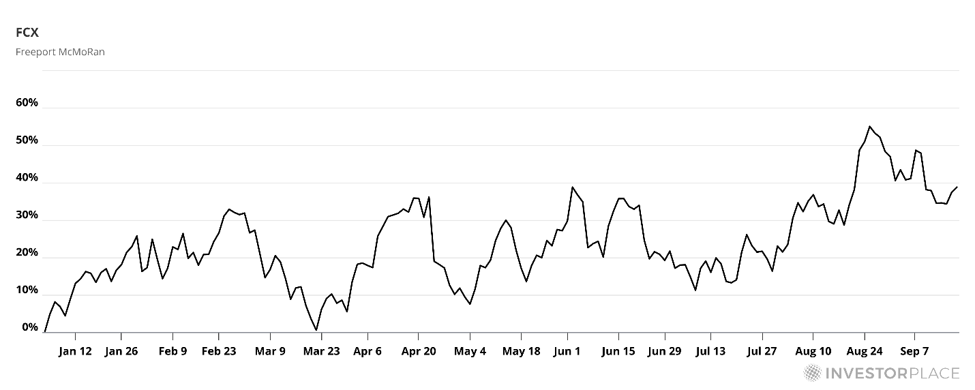
Earlier this month, three-month copper on the London Metal Exchange tagged a record near $14,700 a ton, capping its longest weekly winning streak since 1994. Jonathan’s favorite name in the space, Freeport-McMoRan (FCX), jumped more than 7% on the day and sits up almost 40% on the year.
The opportunity in copper comes courtesy of a simple, stubborn imbalance…
Demand is exploding – an AI data center uses roughly 10 times as much copper as a traditional one. But supply can’t respond – a new copper mine takes seven to ten years to build. On top of that, global mine output fell in the first half of the year, and Morgan Stanley now expects the first annual decline in mine supply since 2017.
But the piece Jonathan really likes isn’t the commodity story everyone can see. It’s the catalyst with a date on it:
I don’t just want to be long a strong commodity — I want a known catalyst with a date on it. Copper has one.
Washington already slapped a 50% tariff on semi-finished copper products back in 2025, but it left raw and refined copper untaxed. For now, at least. But Washington is currently considering a phased tax on refined copper: 15% in 2027, stepping up to 30% in 2028.
The market isn’t waiting. Roughly 200,000 tons of refined copper flooded into the U.S. in July alone – the largest monthly inflow on record – as buyers raced to beat that possible tax.
And this brings us to the specific opportunity Jonathan has flagged…
A tax on imported refined copper is a gift to the handful of companies that refine copper on American soil. And there’s barely anyone left to do it.
Jonathan points out that 16 primary copper smelters operated in the U.S. in 1976. Today, only two are operational. FCX runs one of them (its Miami smelter in Arizona); Rio Tinto (RIO) runs the other (Kennecott, in Utah). Put a tariff on finished metal, and you hand enormous pricing power to those two names.
Here’s Jonathan’s bottom line:
All any trader is ever doing is positioning in front of the biggest players in the room. Copper is flashing that exact signal right now.
And true to form, he didn’t just voice an opinion – he put a real, defined-risk version of the trade (a specific FCX options play) into his free portfolio, live on the show. Same discipline as the IWM call: know your level, define your risk, get positioned before the crowd.
Again, to join Jonathan for his Masters in Trading Live daily episodes, click here. These are the types of opportunities he profiles every day – and again, these videos are free.
Coming full circle
As I write here on Monday, the AI trade is up big. But the growing AI backlash isn’t going anywhere – Newsome’s executive order is just the latest proof.
Luke’s read is that the AI spending survives the noise, so this isn’t the moment to abandon the trade. And Jonathan showed two ways to stay in the game without white-knuckling every negative headline, which will be returning at some point.
Different time horizons, but the same discipline…
Know what you own, why, and decide where your line in the sand is before the volatility hits – not in the heat of a 600-point down day.
Do that, and it won’t much matter whether the next headline out of Washington (or Sacramento) is reassuring or alarming.
Have a good evening,
Jeff Remsburg
(Disclaimer: I own MSFT.)


