
Listen to the audio version of this article (generated by AI).
A quiet bull run with more juice… Brian Hunt’s “picks and shovels” … Tom Yeung on AI’s 100-day revolution… and Jonathan Rose’s catalyst playbook
As I write on Tuesday, the S&P 500 and the Nasdaq are both notching fresh all-time intraday highs. Even more impressively, this is happening as the 10-year Treasury yield hovers around 5.28%, near its highest level since 2002.
If these gains hold until the close, the financial media will trumpet this milestone and the market’s strength. But look under the hood, and you find an uneven story.
Over the past month, the S&P has gained just over 1% (in black), while the equal-weight version of the index, where every stock counts the same, has fallen more than 3% (in green).
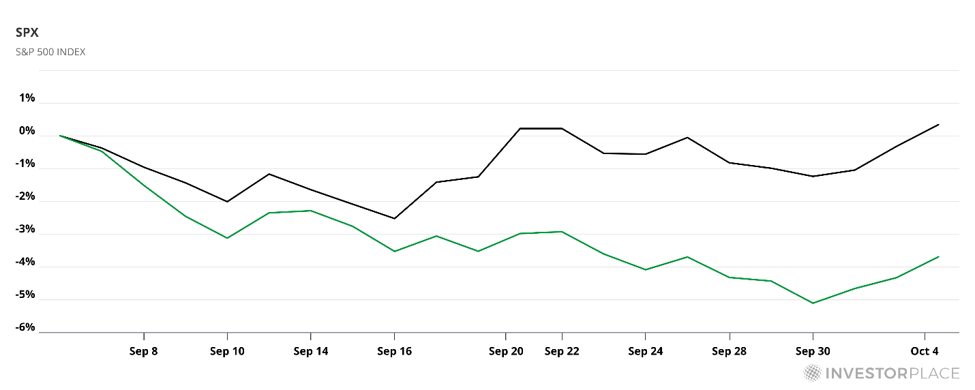
The truth is that a handful of mega-cap tech names are doing the heavy lifting. Strength is not uniform across the entire market.
That said, there is one sector that’s been roaring for a year and a half, and odds are you haven’t heard much about it.
It hasn’t commanded the spotlight like AI chipmakers or gold. It hasn’t sparked a social media frenzy. And yet, measured from its April 2025 low, it has more than doubled. The good news is that, if you’ve missed it, the evidence suggests this bull still has plenty of juice left in it.
I’m talking about biotech.
Today, let’s look at how to position for it.
A bull hiding in plain sight
While there are many ways to play biotech, let’s use the State Street SPDR S&P Biotech ETF (XBI) as our proxy for the sector. It’s the go-to benchmark for small- and mid-cap biotech stocks.
After President Donald Trump’s tariff announcements in April 2025, XBI plunged to $66 on fears of supply chain disruption, a freeze in capital markets, and massive cuts to Research & Development (R&D) spending. But as I write on Tuesday, it trades at roughly $151. That’s a gain of almost 130%.
What’s driving it?
Part of the answer is old-fashioned corporate desperation. Big Pharma faces a massive patent cliff. Between 2026 and 2030, an estimated $200 billion to $300 billion in annual revenue will be exposed to generic and biosimilar competition. Drug giants need new pipelines fast, and the quickest way to get one is to buy it. So, they’re buying.
Through early June, biotech deals totaled $106 billion across 201 transactions, according to PitchBook. At that pace, 2026 biopharma M&A could top $250 billion, second only to 2019.
Even more impressive is when this rally has happened…
As you know, in September the Fed raised rates for the first time in three years, and since then the 10-year Treasury yield has surged to 5.34%, its highest level since 2002. Rising rates are traditionally kryptonite for cash-hungry biotech companies. Yet the sector has held up, and then some.
The game-changer: AI
Dealmaking alone doesn’t explain why the biotech bull could have years left to run. For that, we need to look at what’s happening inside the labs.
Historically, drug development has been a brutal numbers game. Most drug candidates fail, and they fail expensively. But AI is beginning to change those odds.
A 2024 analysis in Drug Discovery Today found that AI-discovered molecules succeeded in Phase I clinical trials 80% to 90% of the time, versus a historical industry average of roughly 40% to 65%.
Phase I trials assess safety, not effectiveness, and Phase II success rates for AI drugs are around 40%, which is closer to the industry norm. But even so, if these early success rates hold, the odds of a drug candidate making it from start to finish would rise from 5%-10% to 9%-18%, nearly doubling the productivity of pharmaceutical R&D.
Think about what a doubling of R&D productivity means for an industry that spends hundreds of billions of dollars a year on research. That’s not an incremental improvement – that’s a new business model.
The technical level to watch
One more thing before we turn to our experts for specific ideas to consider…
XBI’s all-time high came in February 2021 at roughly $174, not far from where we sit today. From a technical perspective, that old peak matters. When a fund approaches a prior high, investors who bought near the top and have waited years to break even often sell as soon as they’re made whole. That creates “resistance,” or a ceiling of selling pressure.
But if/when XBI breaks decisively above its all-time high, that ceiling disappears. There’s no one left who’s underwater from the old peak, and technical traders often view that kind of “blue sky” breakout as fuel for a fresh leg higher.
As I write, XBI would need to climb about 15% to take out $174. That won’t happen today. But in biotech, a gap like that can close much faster than you might expect. A single wave of positive trial results, a big acquisition, or a shift in rate expectations can move the entire sector in a matter of weeks. As we’ve seen, this fund more than doubled in about 18 months.
So, we’re watching that level closely. And between now and then, we have some time to position ourselves, which dovetails into three of our experts, each offering a different way to ride this trend.
Brian Hunt: the “picks and shovels” of the healthcare boom
On Sept. 23, Senior Analyst Brian Hunt, editor of Money & Megatrends, highlighted a company that most investors have never heard of: Agilent Technologies (A).
It makes the lab instruments, software, and supplies that drugmakers and biotech firms use to analyze chemical and biological materials. When Brian wrote, the stock had just hit an all-time high.
Agilent kept climbing afterward. Last week, it notched another 52-week high, and it trades within about 7% of that level as I write on Tuesday.
It isn’t alone. Brian’s issue flagged a handful of Agilent’s peers in lab instruments, bioprocessing, and drug-development services, all of which were notching fresh highs.
For what’s driving this, Brian points to two tailwinds. The first is demographics. More than 10,000 Americans reach retirement age every day, and he notes that the number of Americans 80 and older is projected to roughly double by 2045.
The second is technology. Here’s Brian to explain:
Thanks to major advancements in genomic sequencing, AI-powered analytics, imaging technology, and preventative treatment, healthcare is becoming much better and more personalized. This is driving strong demand for all kinds of new tests, tools, and treatments.
After all, when a useful and important service you buy gets much better, you typically buy more of it.
That’s where companies like Agilent come in. They don’t need any single drug to succeed. They profit from the research itself, as Brian explains:
When drugmakers expand laboratory research, genomic analysis, testing programs, and manufacturing capacity, they require more analytical instruments, consumables and bioprocessing equipment – the “picks and shovels” supplied by companies like Agilent.
Overall, Brian believes the recent highs are just the beginning of this “healthcare megatrend that will generate large returns over the coming years.”
Brian’s full issue has more biotech tickers to consider, and you can get them – and his full analysis – for free. His Money & Megatrends issues deliver actionable insights loaded with stock ideas every day the market is open – all at no cost. You can sign up right here.
Tom Yeung: AI is already working, and Wall Street hasn’t noticed
Last week, Tom Yeung, lead analyst for our global macro expert Eric Fry in Fry’s Investment Report, made a similar case for biotech/healthcare.
He noted that, day to day, the progress is easy to miss. But step back, and the past 100 days “have revolutionized that industry… and barely anyone has noticed.”
He offered a few examples, including the first drug discovered and designed by generative AI. In earlier trials, it became the first drug to actually reverse lung damage in patients with a deadly lung disease, rather than just slowing it.
Tom’s overall take:
AI in medicine has reached a tipping point. Specialized models are now powerful enough not only to assist researchers and clinicians, but also to do the work for them.
The opportunity is that the market isn’t paying for any of this yet, offering a fantastic entry point for investors who spot it. On that note, Eric holds seven healthcare stocks in the Fry’s Investment Report portfolio.
Back to Tom:
We see this as an incredible investment opportunity. Whenever a fundamentally improving industry meets a sour mood, that’s where you’ll often find multibagger investments that seem totally obvious in retrospect…
Our portfolio’s seven healthcare companies trade for an average forward price-to-earnings ratio of 12.8X. That’s roughly the same ratio the market awards stocks like Tyson Foods Inc. (TSN) and Kimberly-Clark Corp. (KMB) – two firms in stagnating industries that are expected to see earnings decline this year.
One of those holdings shows how AI is already changing the game…
At its Capital Markets Day on Sept. 21, Novo Nordisk (NVO) showed that AI helped speed up the development of a new anti-obesity drug. The system tested 2,000 molecules and cut the time needed to identify a drug candidate by 50%.
Wall Street shrugged. Novo shares fell nearly 5% in Copenhagen that day, after management guided for revenue growth only in line with its peers through 2030. That’s exactly the “sour mood” Tom is talking about, and why he sees an opportunity.
Eric and Tom see NVO as a “buy” below $52. With shares around $37 as I write, you have plenty of room to get.
To discover the rest of their healthcare picks as a Fry’s Investment Report subscriber, click here to learn about joining them.
Jonathan Rose: trading the catalysts
For investors who want more torque, our trading expert Jonathan Rose, editor of Masters in Trading LIVE, is hunting for something different: the explosive, catalyst-driven moves that smaller biotech stocks are known for.
Consider Kodiak Sciences (KOD). On Sept. 28, this under-the-radar eye-disease company soared 178% in a single session. Its two experimental drugs had met their primary goals in a Phase III trial.
That’s a portfolio-changing move. But Jonathan says it’s not the most important number:
But here’s the number that matters more than the price move: volume exploded to 38.46 million shares against an average of roughly 701,000 traded before the move.
That’s not just a catalyst — it’s institutional participation showing up in real time.
And it’s the same dynamic I’m seeing in seven AI biotech names trading under $50 billion — each one small enough for real torque, but large enough to carry institutional attention.
We’re running long today, so I won’t dive into all the biotechs that Jonathan covered in yesterday’s free episode of Masters in Trading LIVE, but he walked through seven names, what confirms a real setup versus a trap, and what he’s watching around Wednesday’s Fed minutes.
By the way, if you’re concerned about whether the market is due for a pullback as it pushes deeper into new all-time-high territory, Jonathan notes:
Biotechs are not going to have that correlation to the overall NASDAQ like technology stocks, like AI stocks, like your hyperscalers.
It’s an interesting take – biotechs as a way to play both offense and defense. Here’s the free replay link again to yesterday’s episode if you want to investigate further.
And for more from Jonathan, he walks through market opportunities on his free Masters in Trading LIVE show every market day at 11 a.m. ET. He brings his viewers new trading ideas, flags potential entries and exits, and gives viewers specific tickers. Best of all, it’s 100% free. Just click here to sign up and you’ll receive reminder emails.
We’ll keep you updated on these trades. For now, keep your eye on XBI’s all-time high near $174. If/when we push through, it’s likely to accelerate the biotech bull that’s already roaring.
Have a good evening,
Jeff Remsburg
(Disclosure: I own XBI)


