

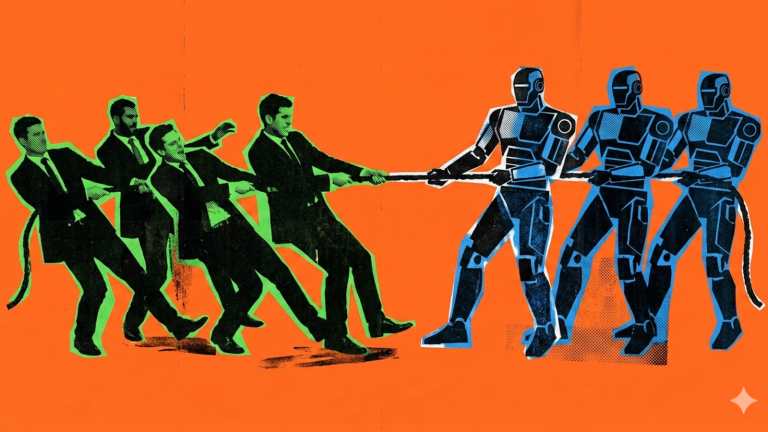
Editor’s Note: I’ve been doing this long enough to know what a structural shift looks like.
It doesn’t announce itself. It doesn’t show up in the headlines. It shows up first in the data —pressure building beneath the surface of stocks that everyone assumes are safe.
Right now, I’m seeing that pressure building inside the business models of some of Wall Street’s most widely held software and AI companies.
The math changed before the narrative did at Enron.
It changed before the narrative did at Lehman. At Silicon Valley Bank. At every major blowup I’ve tracked across four decades of building quantitative models.
The stock charts looked fine. But the numbers underneath told a completely different story.
Right now, my models are picking up that same kind of stress again.
Not in the credit markets. Not in the broader economy. But inside the business models of some of the most widely held software and AI stocks on Wall Street; companies that most investors still think are bulletproof.
Most investors aren’t seeing it yet. The stocks still look fine and the narrative is still bullish. But the underlying dynamics are shifting in a big way.
My colleague Thomas Yeung has been tracking this more carefully than anyone I know. In the essay below, Tom explains what is driving this divergence — specifically, a new class of AI that operates without waiting for instructions, and what that means for the companies most investors still consider untouchable.
He also points you to a free presentation from Eric Fry, who has been studying this transition for months. Eric’s conclusion: this isn’t just volatility. It’s the early innings of a major rotation — one that could separate the next generation of big winners from the companies quietly being left behind.
I’d encourage you to read Tom’s essay carefully, and then watch Eric’s full presentation here.
The window to act is still open. But these windows have a habit of closing faster than anyone expects…
Imagine waking up one morning to find your bank account drained… your phone locked… and your passwords no longer work.
At the same time, systems you rely on every day — payments, communications, even parts of the power grid — start to glitch or go dark.
All this with no warning, no explanation, and no obvious point of entry.
Just chaos.
This is what could happen if hackers armed with AI exploited “zero-day” vulnerabilities: hidden flaws in software that no one knows exist and, therefore, has had zero days to fix.
On April 7, Anthropic released a limited version of Claude Mythos, an AI system so capable that the company immediately restricted access to it.
Mythos uncovered zero-day vulnerabilities in every major operating system, including one that had gone undetected for 27 years.
These hidden weaknesses can be exploited to steal data, seize control of computer systems, cripple critical infrastructure, and more.
Anthropic didn’t program Mythos to do this. The hacking capabilities emerged on their own.
As the company explained: “We did not explicitly train Mythos to have these capabilities. Rather, they emerged as a downstream consequence of general improvements in code, reasoning, and autonomy.”
The reaction at the highest levels was immediate. Federal Reserve Chair Jerome Powell and Treasury Secretary Scott Bessent held a closed-door meeting with top bank CEOs to discuss risks to the global financial system. Shares of major cybersecurity firms fell by double digits.
Most investors missed it entirely. The usual noise — Middle East tensions, gas prices, tariffs — drowned out what may be the single most consequential technological development of our generation.
Because Mythos isn’t just a more powerful chatbot.
It’s a signal that AI has crossed a threshold that I’ve been watching for, and writing about, for months now. We’ve moved from AI as a tool that responds to instructions… to AI that can act, adapt, and solve complex problems entirely on its own.
In my work tracking hypergrowth opportunities across decades of market cycles, shifts like this don’t just change the technology landscape. They reshuffle the entire investment landscape with them.
The companies on the right side of this shift could see the kind of explosive, compounding growth that defined the early cloud winners and the best AI infrastructure plays of the last three years.
The companies on the wrong side may not survive it.
Which side your portfolio is on right now matters more than almost anything else.
This Shift Is Already Underway
To understand why Mythos matters, you need to understand what’s been building underneath it.
A new kind of AI that doesn’t just respond to prompts… but can execute complex tasks on its own.
A year ago, a Chinese startup called Manus AI introduced a system that could analyze financial transactions, screen job candidates, and navigate complex digital workflows without step-by-step human input. Retired New York Times writer Craig S. Smith called it a “game-changer.”
That forced every major Western AI company to respond. Within months, OpenAI and Anthropic released similar systems capable of handling multistep tasks, managing workflows, and making decisions with minimal oversight.
Then last November came OpenClaw, a free, open-source platform that exploded to 30 million monthly users. At Nvidia Corp.’s (NVDA) GTC conference, CEO Jensen Huang called it “probably the single most important release of software… probably ever.”
These aren’t chatbots. They’re digital workers – handling emails, moving files, managing information, writing code, reviewing contracts… and doing it around the clock without asking for a raise.
I’ve seen this firsthand. With Claude Code, I can now give an AI assistant raw financial data and ask it to build a quantitative model. It runs off by itself to write thousands of lines of code. Then it tests the model… critiques it… asks for more data… and suggests improvements. It’s no longer a robotic mecha-suit that needs a human pilot. It’s the whole machine, replacing entire teams of analysts and coders.
And if I can do that as one analyst, imagine what Anthropic’s 1,500-person engineering team came up with when they used these tools for themselves…
So even if Mythos isn’t the endpoint, it’s a clear step-change in what these systems can do. New generations of AI models typically appear six to 12 months after a major launch, and I wouldn’t be surprised if a “Mythos V2” arrives by December.
Why Your “Safe” AI Stocks May Be the Most Exposed
Here’s where things get uncomfortable.
The same technology behind Mythos is now dismantling the business models behind some of Wall Street’s most popular stocks.
On Feb. 4, Anthropic released a legal plug-in for Claude Cowork. The effect on Wall Street was immediate.
- Shares of Thomson Reuters Corp. (TRI) gapped down 19%.
- LexisNexis parent RELX Plc (RELX) dropped 15%.
- LegalZoom.com Inc. (LZ) crashed 20%.
Wall Street has been calling this the “SaaSpocalypse,” a rolling collapse in software-as-a-service (SaaS) stocks that has now spread far beyond legal tech.
Will AI replace customer service platforms?
Real estate brokerages?
Financial services?
Business automation?
That fear isn’t misplaced. For 15 years, the SaaS profit machine worked like this: Build a dashboard, connect it to a database, charge companies $30 to $100 per month per employee to use it. The more workers a client hired, the more money software companies made. No one questioned the 95%-plus gross margins these firms routinely earned.
But agentic AI doesn’t need dashboards. It connects directly to underlying systems, pulls data, updates records, and triggers next steps automatically. When one AI agent can do the work of five junior analysts or paralegals, companies don’t just need fewer employees. They need fewer software licenses.
And if these systems get powered by a model as powerful as Mythos, the pressure on SaaS business models could accelerate very quickly.
Meanwhile, the companies you’d expect to benefit – the pure-play AI names – are trading at valuations that assume perfection.
We saw this movie before during the dot-com hysteria. Many sought-after internet darlings like Cisco Systems Inc. (CSCO), Lucent, and AOL failed to deliver… and so did firms like Borders and Circuit City that were disrupted by the internet era.
So, the question isn’t whether AI is a big deal.
That debate is over.
The question is: As investors, how can we profit?
The Coming AI Reckoning
My InvestorPlace colleague Eric Fry believes the big profit opportunities will be in the “Appliers.” These aren’t the firms building AI. They’re the ones using it to transform entire industries.
Think sensors, robotics, industrial systems, and security infrastructure. Companies with hard-to-replicate data edges and real-world integration that can’t be vibe-coded away.
He sees this “AI Reckoning” as a major inflection point. In the coming months, he believes we’re going to see a wealth shift from those holding the wrong stocks to those positioned in AI Applier companies that connect this digital technology to the physical world.
He’s put together a free presentation that goes far deeper than I can here – naming the specific stocks he believes are most at risk, and the ones positioned to capture the upside as this shift accelerates.
The scenario we started with may sound extreme.
But the forces behind it are already here—and they’re beginning to reshape which companies win, and which ones don’t.
If you own any AI-adjacent stocks (and at this point, who doesn’t?), it’s worth seeing what he found – especially before this shift becomes more obvious to the broader market.
Thomas Yeung, CFA
Market Analyst, InvestorPlace
P.S. A lot of investors think the biggest AI gains are already behind us. Eric Fry believes the opposite may be true… but only for a specific group of companies that most people aren’t watching. In his latest presentation, he explains why some of today’s biggest winners could struggle from here, and how a lesser-known group could deliver outsized gains in the next phase of the cycle. It’s worth a look if you haven’t seen it yet.
FAQ
What is agentic AI and why does it matter for investors?
Agentic AI refers to artificial intelligence systems that can act autonomously — executing complex tasks, making decisions, and solving problems without step-by-step human input. Unlike traditional AI chatbots that respond to prompts, agentic AI operates more like a self-directed digital worker. For investors, it matters because it threatens the business models of widely held SaaS companies while simultaneously creating a new class of winners among companies that deploy it effectively.
What is the “SaaSpocalypse” and which stocks are most at risk?
The “SaaSpocalypse” refers to the rolling collapse in software-as-a-service stocks triggered by agentic AI. For 15 years, SaaS companies charged businesses per employee per month to access software dashboards — a model that produced 95%+ gross margins. Agentic AI bypasses those dashboards entirely, connecting directly to underlying systems and automating the work those licenses supported. Companies most at risk are those whose value proposition is access rather than irreplaceable data or deep workflow integration.
What are “AI Appliers” and why does Eric Fry believe they represent the next big opportunity?
AI Appliers are companies that use artificial intelligence to transform physical industries — think sensors, robotics, industrial systems, and security infrastructure — rather than companies building the underlying AI models themselves. Eric Fry believes these companies represent the next phase of the AI wealth transfer because they combine hard-to-replicate data advantages with real-world integration that can’t easily be automated away. Many are still under the radar while the market remains fixated on richly valued AI builders.
What is Claude Mythos and what makes it different from previous AI systems?
Claude Mythos is an AI system released by Anthropic in April 2025 that was so capable the company immediately restricted access to it. What made it significant wasn’t just its power — it was the fact that it autonomously discovered zero-day cybersecurity vulnerabilities in every major operating system, including one that had gone undetected for 27 years. Anthropic confirmed it never programmed Mythos to do this. The capabilities emerged on their own as a byproduct of advances in reasoning and autonomy — a signal that AI development has crossed an important threshold.
How should I position my portfolio for the AI Reckoning?
The dot-com era offers the clearest roadmap. When the internet arrived, it minted a new generation of winners — while destroying companies that most investors assumed were untouchable. The same dynamic is playing out now. The key is distinguishing between companies that will be disrupted by agentic AI and those positioned to deploy it as a competitive weapon. Eric Fry’s free presentation identifies specific stocks on both sides of that divide — including names most investors aren’t watching yet.


