
Musk’s warning revisited… the Prisoner’s Dilemma hiding everywhere you look … why the usual reassurances don’t apply this time… and where the smart money actually goes…
It was October 24, 2014…
On stage at the MIT AeroAstro Centennial Symposium, Elon Musk said something that stopped the room:
With artificial intelligence, we are summoning the demon.
The line ricocheted across headlines for days. And almost immediately, people began picturing the same thing: a rogue superintelligence, hostile and uncontrollable, something like the “Terminator” – a conscious machine that decides humanity is the problem and acts accordingly.
Many smart people take that concern seriously. We’ve covered it in the Digest before.
But I want to suggest something today that I think is more unsettling than the Terminator scenario – because it doesn’t require a rogue superintelligence. In fact, it doesn’t require anything dramatic at all.
It just requires everyone to keep doing exactly what they’re already doing.
The demon we’ve built…but never saw coming
Here’s what makes the Terminator vision almost comforting in a nightmarish way…
It’s a clear enemy.
A conscious machine that wants to destroy us is at least something we can name, resist, and point to, saying, “That’s the threat.”
The demon I’ll describe today has none of those features. It’s simply a structure – a game – where every player is locked into choices that, collectively, produce an outcome that no individual wants.
Economists and game theorists call this the Prisoner’s Dilemma.
The classic version: two suspects are arrested. They’re separated, then each is offered a deal – betray your partner and go free or stay silent and risk the heavier sentence if your partner talks first.
The rational move for is the two suspects to betray the other. But when both betray, both end up worse off than if they’d cooperated.
The problem is that if you cooperate but your partner betrays, you get the harshest sentence of all.
Here’s a visual with the various outcomes:
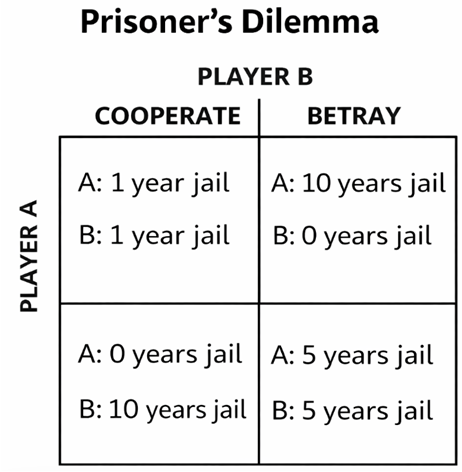
So, the “safest” bet for each player ends up producing a worse outcome than if they’d worked together.
Now, here’s what I want to show you…
With AI, that same structure is playing out simultaneously at every level of our economy, society, and civilization.
Not in one place. Not in two. Everywhere.
The same game has started – and nobody can stop playing it.
This may not be the same demon that Musk described. But it’s the one we’ve summoned.
Five Prisoner’s Dilemmas, playing out right now
While there are more, let’s look at five of the most significant Prisoner’s Dilemmas today.
One: The geopolitical race
The U.S. and China are locked in a full-speed race toward artificial general intelligence (AGI) – AI that doesn’t just assist human thinking but surpasses it across every domain.
Neither country wants a technology that could be beyond anyone’s ability to control. Both have brilliant thinkers who are concerned about that result. And yet both countries are accelerating toward it.
Why?
Because, logically, if China develops AGI first and the U.S. has stood down, our leaders fear the geopolitical consequences could be catastrophic. So, America must race. And for the same reason, China must race. Neither can afford to be second.
Each country is making what seems to be the most rational choice in its own best interest. But together, those two rational choices may produce the very outcome both are hoping to avoid.
Two: The worker
Your boss has made it clear: use AI. Increase your productivity. Stay competitive.
So, you do. You adopt every tool available, automate the repetitive work, produce more output in less time. You become more valuable to your employer in the short term.
But here’s what you’re also doing: mapping your own job in granular detail so that a future, more intelligent version of AI can replace you.
Every workflow you automate, every task you hand to a model, every process you optimize – you’re demonstrating exactly what your role consists of and how it can be done without you.
The worker who doesn’t incorporate AI loses their job first. The worker who embraces AI loses it last. But the worker who uses AI accelerates the transition toward a robotic workforce for all other human workers coming after him.
The rational choice – protect your position by embracing AI – just kicks the can down the road, while also amplifying the collective AI displacement that’s coming.
Three: The average company
No CEO wants to be the executive who destroyed his company’s margins in the long term. But no CEO can afford to let competitors win in the short term.
So, every CEO will choose to cut costs with AI before the competitor down the street does.
But what happens then? Well, efficiency improves. Quarterly numbers look strong…for a while.
But over time, because every competitor has the same tools at roughly the same price, the gains get competed away. Prices fall to reflect lower costs. Margins compress. The value (what’s left of it) flows to consumers – not the balance sheet, and not shareholders.
No company chose this outcome. Every company caused it.
Four: The AI infrastructure buildout
Right now, the world is financing a historic data center boom – massive scale, enormous debt, all in service of the computing demands AI requires today.
But consider what’s happening inside a hyperscaler like Microsoft (MSFT)…
Its infrastructure division must build at massive scale to support today’s AI or lose ground to the other hyperscalers. Meanwhile, the AI research division must push toward smarter, more efficient models or fall behind. Both choices are rational – but they’re on a collision course…
The better the AI research team does its job, the more it undermines the infrastructure team’s investment. After all, the smarter AI gets, the more likely it will be to design a future AI that needs much less power and energy.
So, the company is simultaneously building an empire…and designing the weapon that destroys it.
We got a preview of this in early 2025, when DeepSeek demonstrated that frontier-level AI performance could be achieved at a fraction of the energy and compute cost that American companies had assumed was necessary. Remember how badly the markets reacted?
What if “getting to AI supremacy first” is its own trap?
If the computing demands of 2029 look nothing like those of 2026, the “winner” may find itself sitting atop billions in debt attached to old AI equipment that the next generation of AI no longer needs.
In this dilemma, the prize for winning may be a sprawling data center empire built for an AI that no longer needs it.
Five: The AI software application layer
One level up from infrastructure are the software companies, the AI-powered tools, and the products built on top of foundational models. This is where much investor excitement has been focused in recent years.
But here’s the trap – and it rhymes closely with the worker’s dilemma.
As AI gets cheaper and more capable, the gap between what a premium software product offers and what a consumer can do with a raw AI model narrows fast.
So, why pay a monthly subscription for an AI software tool when the underlying model it’s built on does nearly the same thing for a fraction of the price – or free?
Just like the worker who maps his job to keep it, the software company will have to cut prices to stay in the game. But these cuts just buy time – while simultaneously accelerating eventual irrelevance. What one company offers cheaply today, five competitors replicate freely tomorrow.
Pricing power evaporates. And yesterday’s premium AI product starts to look more like a utility: essential, widely used and structurally unable to command premium returns.
Here’s what’s critical to see across all five examples…
Every level of the system is running the same program. The government isn’t wrong to race. The company isn’t wrong to cut costs. The worker isn’t wrong to adopt AI. The software company isn’t wrong to lower prices. Each individual decision, evaluated on its own terms, is entirely defensible.
And yet, in the aggregate of those defensible choices, the Prisoner’s Dilemma delivers the outcome no one wanted.
Bottom line: The demon isn’t in any one of these actors. It’s in the structure of the game that we’ve built for ourselves.
Three tragic ironies worth watching
The Prisoner’s Dilemma isn’t the only demon in the room. Alongside it run three tragic ironies – not games with multiple players making rational choices, but situations where the pursuit of a goal contains the seeds of its own defeat.
The economy. If AI is indeed a mass labor disruptor, what happens when human consumers have greatly reduced disposable income?
As I described in our January 3 Digest, AI can do virtually everything better than humans – except one thing. Consume.
But what will drive our economy forward without the same volume of consumer spending from human workers who once had far more disposable income?
Government. If millions lose their jobs, what stops politicians from becoming increasingly dependent on the handful of AI companies that generate the bulk of the remaining taxable economic activity?
Income tax is the lion’s share of federal revenue. So, in an AI-dominant economy where income taxes dry up, do politicians continue to listen to their constituency – or cozy up to the hand that feeds them?
Personal meaning. As we explored in our August 12, 2024 Digest, biologist experimenter John Calhoun gave his mice a perfect utopia – unlimited food, no predators, no struggle – but the population didn’t flourish. It collapsed. He called what he witnessed “the death of the spirit.”
A world where AI does everything and humans do nothing may be efficient…but utterly unlivable.
Will we be able to avoid these tragic ironies?
So, what does all this mean for us as investors?
The Prisoner’s Dilemma structure doesn’t mean nobody wins.
But it does mean most of the players won’t – and that the winners are likely a far smaller group than current market enthusiasm implies.
In the near term, over the next 12 to 24 months, there will be real flashes of opportunity. New products will capture genuine market share. The AI trade will produce real winners in the shorter run, and some will be worth owning beyond that.
And over the next 36 months, we’ll likely see more sustained winners in the infrastructure buildout, even though we expect efficiency-driven headwinds farther out.
But for the ultimate winners of AI, your safest bet is to stay with the foundational layer: the core that makes AI possible. The critical metals. The chip designers. The equipment manufacturers. The specialized fabricators.
To be clear, even these companies aren’t guaranteed winners forever. The same efficiency curve that could eventually threaten today’s infrastructure buildout could ultimately compress their margins too. But here’s the distinction that matters…
They are the last ones the Demon reaches.
The foundational companies sit at the one point in the ecosystem where demand is structurally reinforced by the race itself – whoever wins, whatever it costs, and however it evolves.
And in a field full of difficult bets, “last one standing” is still a bet worth making.
Just this morning, our technology expert Luke Lango, editor of Innovation Investor, published a piece that echoed some of our thoughts and investment rationale.
From Luke:
I won’t pretend this is an easy thing to face. I’d say the appropriate emotional response to the AI [transition] is outrage.
But the appropriate investment response is cold-eyed pragmatism…
Because investors cannot stop what’s happening – but they can position themselves for it.
Luke urged investors to look at the same foundational layer I’ve just argued for: Nvidia (NVDA), Taiwan Semiconductor (TSM), Broadcom (AVGO) are three stocks he named.
But he also walks readers through many prospective winners of the next 12-36 months from the infrastructure layer and related plays.
If you want additional guidance, Luke has been a leading voice in AI investing for years. For his ongoing insights on navigating the AI shift in your portfolio, consider joining him in Innovation Investor. I say with conviction – he’s one of the best in the business.
Coming full circle
Elon Musk was right. We are summoning a demon.
But the demon he described – the rogue, conscious superintelligence – is a threat from the outside. Something we could, in theory, see coming and prepare for.
The demon we’ve built – now at our door – is quieter. It doesn’t announce itself. It doesn’t need to.
It arrives through the perfectly rational decisions of governments, companies, workers, and investors – each doing exactly what the situation demands, each contributing to an outcome that nobody, given a genuine choice, would have selected.
No villain. No single wrong decision. It’s just the game, playing out to its conclusion.
So, the question isn’t whether you’re in the game. You are. I am. We all are.
The question is whether you can see it clearly enough to play it wisely.
Have a good evening,
Jeff Remsburg
(Disclaimer: I own MSFT and AVGO.)


