


Listen to the audio version of this article (generated by AI).
Editor’s Note: 🔊 On the go? You can now listen to today’s issue. Click the play button above.
Hello, Reader.
When the very first boxcar full of Campbell’s Condensed Tomato Soup left the company’s Camden, New Jersey, factory in 1898, it was riding atop rails built years earlier by the Philadelphia & Reading Railroad.
While the P&R had already gone bankrupt at that point, The Campbell’s Co. (CPB) went on to become a publicly traded staple worth tens of billions at its peak — with billions of cans sold and a presence in virtually every grocery store in America.
A savory reminder that yesterday’s failed builders often create the foundation for tomorrow’s success.
Every technological boom begins the same way.
A pioneer builds the “rails.” For a brief moment, investors applaud these visionaries.
But then optimistic vision collides with reality. Demand arrives slower than expected, and the builders struggle for survival.
Even as this pioneering group often fails, a follow-on group emerges and capitalizes on those failures. They don’t build the new technology. They use it.
By doing so, these enterprising companies build empires on the infrastructure some unfortunate “first mover” paid for.
And we’ve seen this exact movie in recent history… with the internet.
In the late 1990s, investors poured trillions into building the digital “rails” — telecom networks, fiber optics, and early hardware companies.
Many of those pioneers flamed out. Cisco Systems Inc. (CSCO), the poster child of internet infrastructure, lost roughly 85% of its value after the dot-com bubble burst… and took decades to fully recover.
But the companies that used that internet infrastructure?
They went on to dominate the global economy.
Amazon.com Inc. (AMZN) has surged more than 100,000% from its early days. Alphabet Inc. (GOOGL) has climbed tens of thousands of percent since its IPO.
The builders struggled. The appliers got rich.
And here’s the twist: Many of those same internet winners are now spending aggressively to build the next generation of technology — artificial intelligence.
Which raises a critical question: Will today’s AI builders ultimately follow the same path… while a new class of “AI Appliers” quietly captures the real upside?
In today’s Smart Money, we’ll show you exactly how that shift is already beginning to play out — including one under-the-radar “applier” we’re giving you free today…
It’s a company already using AI to boost efficiency, expand margins, and quietly pull ahead — with one key metric already surging more than 50% in just the past two years…
The Builders Built It… The Appliers Won
In the late 1800s and early 1900s, railroads were not just transportation. They were a transformational commercial platform. But by the early 1890s, America was neck-deep in rail capacity.
As a result, hundreds of railroads failed to turn a profit.
More than 1,500 railroad companies entered bankruptcy or receivership during the major railroad collapses of the 1870s, 1890s, and early 1900s. One of those early casualties was the Philadelphia & Reading Railroad – a titan of the 19th-century rail industry.
By 1890, the P&R ranked among the most valuable railroad companies on the New York Stock Exchange. But just three years later, it rolled off the rails into bankruptcy court and triggered the national economic depression known as the Panic of 1893.
More than 70 railroads followed the P&R into bankruptcy that year – representing roughly 25% of U.S. railroad mileage at the time.
But even though the P&R and hundreds of other track builders wiped out their shareholders, their expansive iron transportation networks reshaped American commerce. This allowed “second movers” to reach customers nationwide using the established rail networks.
The Campbell Soup Co., now The Campbell’s Co. (CPB), built its empire on the exact rail network the P&R painstakingly assembled over decades.
Campbell’s sat squarely inside the rail geography the P&R helped knit together. The company transported produce by rail from the Midwest to canning facilities in New Jersey, and then rolled boxcars of tomato and cream-of-celery soup across the country.
But the nationwide rail infrastructure was not simply a delivery platform for Campbell’s. It also acted as a catalyst for innovation. Because rail freight rates depended mostly on weight, the company had a major incentive to remove as much weight as possible from its cargo.
In 1897, Campbell’s chemist John Dorrance figured out how to make “condensed” soup by removing most of the water during production. That single innovation spared Campbell’s from transporting worthless “water weight” all over the country.
As a result, it dramatically reduced the effective cost of shipping soup nationwide.
If the rails had not already existed, Dorrance likely would never have bothered trying to condense Campbell’s soup.
Thus, a food empire was born. The invention of condensed soup turned Campbell’s from a small regional food company into an iconic national brand.
But here’s the part most investors miss…
The railroad companies didn’t disappear because their idea was wrong. They disappeared because they built too early, spent too much, and couldn’t capture the value of what they created.
The real fortunes were made by the companies that came next — the ones that used the rails, instead of paying to lay them.
And that same shift is already starting to happen again today…
Today’s AI Builders Are Laying the Same Rails
We know who the P&R companies will be: the hyperscalers building the AI infrastructure – the likes of Alphabet, Amazon, Meta Platforms Inc. (META), and Microsoft Corp. (MSFT) – that are now over-investing.
These are the same companies that once thrived as appliers during the internet boom.
Now, they’re taking on a very different role. They’re the ones building the rails.
The winners of the AI boom won’t be the builders.
They’ll be the Appliers.
These are the “second movers” — companies using AI to cut costs, boost productivity, and expand margins inside already-established businesses.
They don’t look exciting. But historically, they’ve been where the biggest gains are made.
One of the clearest examples is hiding in plain sight.
PayPal Holdings Inc. (PYPL) is a textbook Applier.
It’s embedding AI directly into its digital payments infrastructure. It’s putting AI to work in fraud prevention, transaction approvals, customer service, loan underwriting, and even internal functions like marketing and compliance.
This isn’t theoretical. Revenue per employee has surged more than 50% since 2022, a clear sign AI is already driving real efficiency gains.
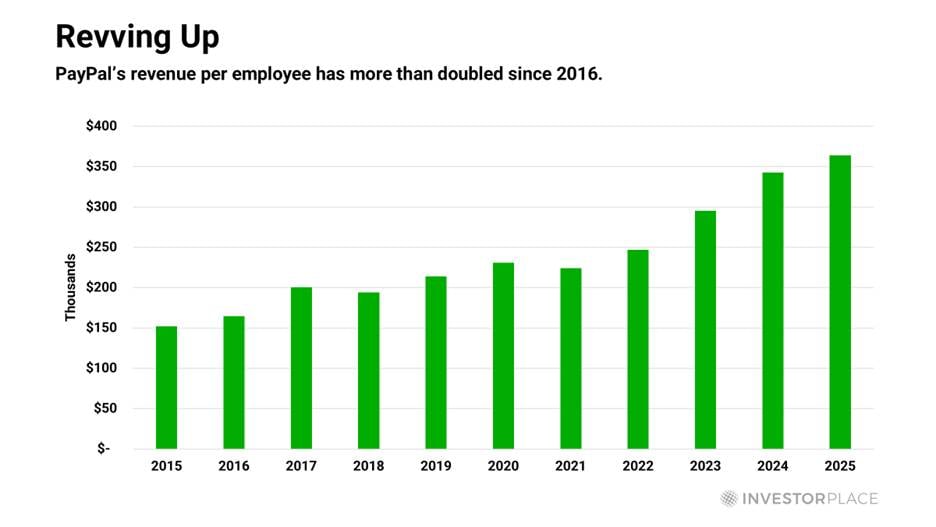
PayPal is also benefiting from AI’s expanding role in daily commerce. The company’s massive installed base of 435 million users positions it as a critical enabler of global digital commerce, much of which will be AI-influenced in the coming years.
At a recent investor conference, CEO Enrique Lores emphasized plans to accelerate AI-driven changes and serve customers in “new ways” — pointing to an expanding product lineup.
PayPal is riding the rails of already-built AI infrastructure, without risking its balance sheet to construct them.
And if history is any guide…
It’s companies like this, not the ones laying the rails, that stand to capture the biggest gains.
The Next Wave of AI Is Already Here
A new kind of disruptive technology is entering the scene — what I call “A-AI,” or autonomous AI.
This isn’t just AI that responds to prompts.
It’s AI that can act on its own — making decisions, executing tasks, and operating independently.
It has the potential to reshape entire industries — and early signs suggest it’s already putting pressure on some of the most widely held stocks in America.
Some of the market’s biggest winners today could quietly become tomorrow’s biggest disappointments.
Like every major technological shift, this will create winners… and losers.
And once again, the biggest winners are unlikely to be the ones building the technology. They’ll be the ones applying it.
In other words, you don’t want the P&R companies.
You want the Campbell’s.
In my brand-new special broadcast, I break down exactly how this shift is unfolding…
Which popular stocks may be at risk…
And which lesser-known “Appliers” are positioned to benefit.
I also reveal my No. 1 applier stock to buy before this technology takes off.
You can click here to watch it now.
Regards,
Eric Fry
P.S. Eric has seen multiple tech cycles—and knows where investors tend to get it wrong. His take on “AI Appliers” offers a grounded way to think about this boom. If you want to see how it could impact your portfolio, check out his latest free presentation while it’s still available.


