
Listen to the audio version of this article (generated by AI).
Luke’s Peak Watch update… why it’s still time to be cautious… Eric sells a 454% copper winner… Jonathan Rose and 33 surprises in Anthropic’s S-1
We’re on Day 2 of “the most important week of the year.”
That’s according to our technology expert Luke Lango, editor of Innovation Investor.
Let’s go straight to Luke’s Daily Notes from last Friday:
Microsoft (MSFT), Alphabet (GOOGL),and Amazon (AMZN) report [this] week, with the Fed’s Oct. 27–28 decision in the middle; October hike odds have fallen to about 9%. The midterms follow on Nov. 3.
For the hyperscalers, the questions are the ones the market asked [last] week: Is cloud growth accelerating? Are backlogs growing? Can they fund 2027 spending from their own cash flow?
Strong answers would also help settle the “capex growth slows” and “good news gets sold” signals on our Peak Watch Checklist.
If you’re unfamiliar with Luke’s reference to the Peak Watch Checklist, we covered it in our Oct. 21 Digest. Luke has developed a checklist to track 13 warning signals across the three stages of a boom’s turn to a bust: Froth, Cracks, and Confirmation.
Each signal gets one of four ratings: Clear (green), Watch (yellow), Flashing (orange), or Triggered (red). Each also comes with a specific tripwire – a concrete event that would flip it to red.
For “Froth,” those signals are “debt-funded capex,” “vendor financing,” and “record stock issuance.”
For “Cracks,” we have “capex growth slows,” “good news gets sold,” “revenue lags spending,” “pricing power erodes,” “AI credit spreads widen,” “capital raises fail,” and “the Fed tightens.”
Finally, for “Confirmation,” there’s “chip orders digest,” “capacity sits idle,” and “projects get canceled.”
As of Luke’s update yesterday, 7 of 13 signals were either yellow, orange, or red. Luke’s overall interpretation is that we’re currently “Late Cycle.”
This checklist points toward why this week is so important
The hyperscaler earnings could have a dramatic impact on “debt-funded capex” (as Meta (META) did last week, announcing the issuance of a new class of non-voting Class C common stock to fund its aggressive AI initiatives), “capex growth slows,” and “good news gets sold.”
And, of course, hyperscaler spending is the revenue for the chip, power, networking, and data center names that have driven the AI trade. So, if they signal a slowdown, it ripples through the whole complex.
At the same time, excessive hyperscaler spending is likely to alarm Wall Street. The fear is that they’re over-allocating capital into a historic, debt-fueled infrastructure bubble that will ultimately explode, with the fallout reflected on their balance sheets.
It’s a fine balance – which has Luke cautious but leaning bullish.
But there’s more to these next two weeks than the hyperscaler earnings
Back to Luke for what he’s watching, and his game plan:
We still need to see how the next two weeks play out. If hyperscaler earnings, the Fed, the midterms, and the Iran situation all resolve positively, AI stocks should bounce strongly off major support, and this will turn into the best buying opportunity of the whole cycle.
If all four resolve negatively, we could break major support, and this could be the start of a bigger, uglier unwind…
For now, patience is our ally, and we’re ready to react over the next two weeks, whichever way things go.
We’ll start getting answers tomorrow with the Fed’s rate decision, followed by Alphabet and Microsoft after the closing bell. We’ll report back.
And for more directly from Luke – including his updates on his Peak Watch List and which stocks he’ll be recommending if the next two weeks break the way he’s leaning – click here to learn about joining him in Innovation Investor.
Why waiting – instead of jumping in early – could be warranted this time
Now, a bullish investor might look at this setup and ask why anyone would sit on the sidelines. After all, the fundamentals of the AI trade still look strong.
Earnings across the chip and infrastructure names continue to beat expectations, and after the recent pullback, many of these stocks trade well below the valuations they commanded just a few months ago.
For example, as of yesterday’s close, AI king Nvidia (NVDA) was down 10% from its recent high, but some smaller AI infrastructure names have fared far worse. Coherent (COHR) dropped 35% since early October, and 48% if measured from its June peak (it’s rallying as I write here on Tuesday). To a traditional value investor, that looks like a sale.
It’s a reasonable argument. But it misses something about AI stocks that doesn’t show up in a price-to-earnings ratio.
In the latest issue of the AI Revolution Portfolio, the investment newsletter helmed by Louis Navellier, Eric Fry, and Luke, the team starts with Benjamin Graham’s famous “Mr. Market,” the moody business partner from The Intelligent Investor who offers to buy your stock at a fortune one day and sell to you for pennies the next.
Value investors like Warren Buffett have long used that idea to argue that falling prices mean better deals. But while that might work for traditional companies that own physical assets whose value holds in a downturn, AI is different.
From last week’s issue:
AI has a strange property where confidence is king…
Like a bank run, a loss of confidence in an AI trade can prove disastrous.
An example of what that looks like
Let’s circle back to Coherent. Itmakes the optical components, such as lasers and transceivers, that carry data at high speed between chips in AI data centers.
In August, it reported the best quarter in its history. Revenue hit a record $2.05 billion, up 34% from a year earlier, while adjusted earnings per share jumped 74% to $1.74. Data center revenue alone climbed 66%.
Management then guided for even higher revenue this quarter and said it expects to post its first $3 billion quarter by the end of its 2027 fiscal year. Analysts raised their revenue estimates for fiscal 2027 by 11%.
And yet, as I write on Tuesday, COHR trades almost 50% below its June high.
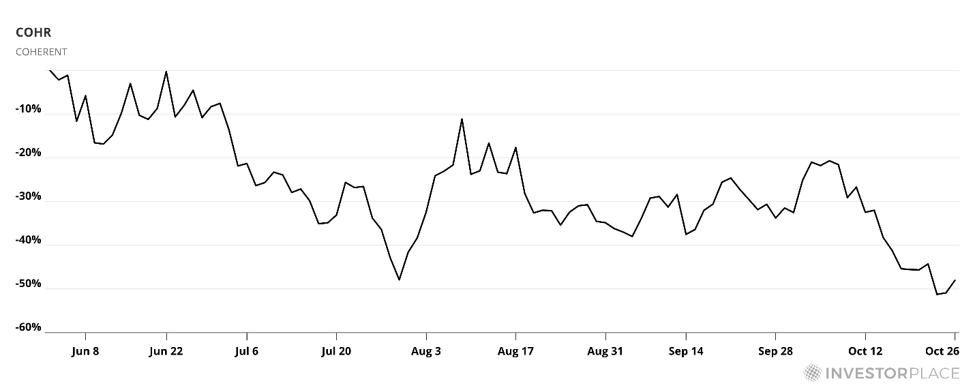
So, what changed?
Not the business – the sentiment surrounding the business.
Hot inflation reports have pushed Treasury yields higher… worries about the sustainability of AI spending have spread across the sector… and investors have started asking tougher questions, including why Coherent’s cash flow hasn’t kept pace with its booming revenue.
All this has changed one thing – confidence. And when confidence slips in the AI trade, even record earnings can’t hold a stock up.
Which brings us back to this week…
Coherent’s growth ultimately depends on how much the hyperscalers spend building out their data centers. The same is true for most of the AI infrastructure trade.
If Microsoft, Alphabet, and Amazon reaffirm their spending plans and show that spending is paying off in cloud growth, they give the market a reason to believe again. If they wobble, today’s “cheap” AI stocks could get a lot cheaper.
That’s why buying early isn’t necessarily safe – despite the lower valuations.
As for Coherent, it reports next Wednesday, Nov. 4. We’ll circle back.
Now, Coherent isn’t the only AI-linked investment whose fortunes hinge on hyperscaler spending. That brings us to a surprising move from Eric Fry…
Why a longtime copper bull just sold Freeport
Few analysts have been more bullish on copper for longer than Eric, our global macro expert and the editor of The Speculator.
Back in April, we featured Eric’s case for the metal here in the Digest. As he put it then, copper has always been the wiring of the world, but the world now demands more wiring than at any point in history.
So, it caught our attention last Friday when Eric told his subscribers to sell their remaining shares of Freeport-McMoRan (FCX), one of the world’s largest copper producers.
To be clear, this isn’t a case of a trade gone wrong. Eric first recommended Freeport in January 2020. He took profits on two-thirds of the position in 2021, and the final third has gained about 454% including dividends.
So why sell now? Here’s Eric:
Back then, AI was a production story… Today, AI is a demand story, and the market trades FCX like a data-center stock…
Although AI demand only accounts for a modest share of total copper demand, it accounts for a huge amount of the incremental demand that supports copper prices. Therefore, if that source of demand weakens, which recent trends suggest it might, the copper price could come under pressure.
That idea of weakening demand might raise an eyebrow. After all, we’ve reported many times here in the Digest on copper’s looming supply shortage.
But Eric notes that the International Copper Study Group has swung its 2026 forecast from a deficit to a surplus. And Comex warehouses hold 713,000 tonnes of copper, much of it stockpiled ahead of possible U.S. tariffs.
Meanwhile, Freeport’s earnings magnify every move in the metal. By the company’s own math, each 10-cent change in the copper price shifts its annual EBITDA (earnings before interest, taxes, depreciation and amortization) by about $390 million.
Finally, the cost of its Arizona mine expansion has climbed by about 30%, while the stock trades at roughly 35 times trailing earnings – not exactly a discount.
Eric’s conclusion:
Freeport remains a well-run company. But the reasons I bought it have mostly played out, and the reasons that remain depend on someone else’s capital spending.
That last line should sound familiar. As with Coherent, Freeport’s next leg depends on whether the hyperscalers keep spending and whether investors keep believing they will.
It’s one more reason this week’s earnings matter well beyond the cloud.
Before we move on from Eric, today is the last call to access his latest research in which he warns investors about AI Builders – like Coherent – that could fall 50% or more. He’s urging a rotation into AI Appliers – overlooked companies using increasingly cheap AI computing power to improve their businesses.
In his free research video, Eric gives away the name of one of his favorite AI Appliers and explains why next week’s elections will fuel the separation between these two corners of the market. But the video is coming down tonight, so this is last call – click here to watch it.
One last thing before we sign off today…
33 things hiding in Anthropic’s IPO filing
Yesterday, Anthropic, the company behind the Claude AI models, made its IPO paperwork public, filing its Form S-1 with the U.S. Securities and Exchange Commission (SEC). It runs hundreds of pages, and it reveals far more than the headline numbers.
Earlier today on Masters in Trading Live, our trading expert Jonathan Rose counted down the 33 things he believes every investor needs to know from it.
A few of them surprised me: an $80 billion “loss” that isn’t what it looks like… a single share of stock that controls more than half the vote… and one big AI name you’d expect to find in the filing that never shows up.
And Jonathan’s No. 1? It ties directly to the hyperscaler earnings we’re watching this week.
Click here to watch the free replay.
Have a good evening,
Jeff Remsburg
(Disclosure: I own MSFT, GOOGL, AMZN, COHR)


