
CoreWeave’s powerhouse earnings report… a $132.5B backlog and a new funding plan… where Luke’s AI levels stand… Louis’ presentation tomorrow… free stock recommendations from three of our experts
The most important read yet on how neoclouds are handling tighter capital markets…
That’s how our AI expert Luke Lango, editor of Innovation Investor, framed last night’s earnings from CoreWeave Corp. (CRWV) ahead of the report.
For any readers less familiar, neoclouds are newer cloud companies that rent out AI computing power, and CoreWeave is the best-known of them. Neoclouds have been at the forefront of concerns about the AI buildout because many have borrowed heavily to build their data centers.
Why does one company’s report carry this much weight? Because neoclouds are where the AI buildout meets the bill, and how easily they can fund themselves tells us whether the spending can keep growing at this pace.
So, what happened?
By nearly every measure, CoreWeave delivered. Third-quarter revenue jumped 168% to $3.66 billion, topping the $3.56 billion analysts expected. Backlog, the contracted revenue still to come, swelled to $132.5 billion. And CoreWeave raised its full-year revenue forecast to $13 billion to $13.3 billion, well above the roughly $12.9 billion Wall Street had predicted.
Here’s CEO Michael Intrator:
This was a breakout quarter for CoreWeave, with revenue increasing by more than $1 billion sequentially and adjusted operating margins reaching double digits a quarter ahead of plan.
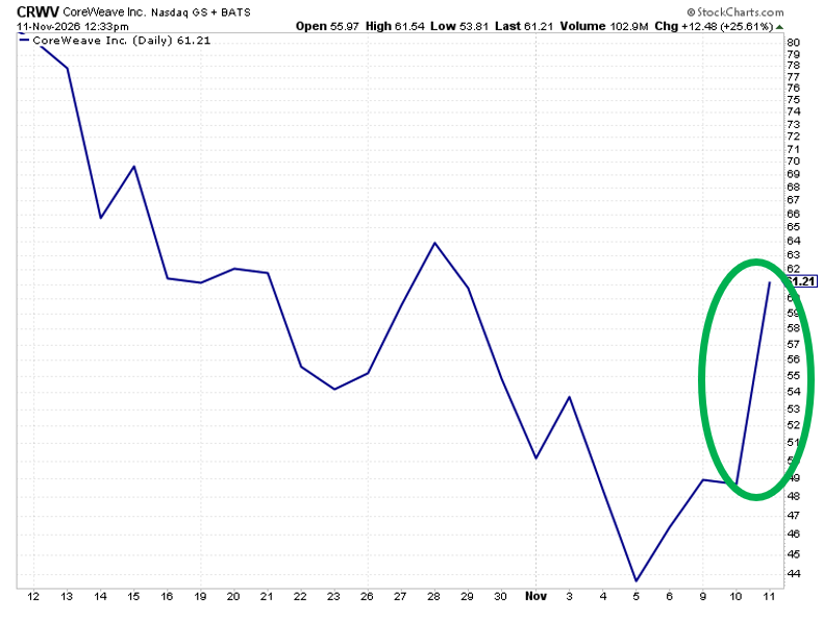
Investors, who had sent the stock down about 40% over the past month, noticed. As I write on Wednesday, CRWV is up 20%. Here’s a one-month chart showing the spike.
In navigating the recent drawdown in the AI trade, Luke told readers he was watching three things, starting with “whether credit spreads start to narrow alongside stocks” and “whether the neoclouds sound like they can keep raising money.”
The second is easier to answer than the first. We don’t yet have a clean read on credit spreads, but management’s message on funding was clear: it won’t tap the unsecured debt market at current rates. It will lean instead on financing backed by customer contracts and about $9 billion in customer prepayments and deposits, plus another delayed-draw term loan (a facility it can draw on in stages) expected in the coming weeks.
CoreWeave anticipates an investment-grade rating, with early talks pointing to a yield of 7% to 7.5%, roughly half of where its junk bonds trade. In other words, debt backed by customer contracts is far cheaper than the unsecured kind.
Still, not everyone is convinced. One analyst told Bloomberg Television that CoreWeave’s “interest expense is far higher than adjusted operating income,” calling it “a structurally challenged business.”
So, we’re not giving CoreWeave an “all clear,” but the financing worry has eased, at least for now.
For Luke’s third test, CoreWeave’s report just put it in play. So, let’s turn to the levels he’s watching.
The start of a real rebound or a dead-cat bounce?
Monday delivered the best day for AI stocks since August. The Nasdaq rose more than 2% and the Philadelphia Semiconductor Index (SOX) jumped more than 6% as Middle East tensions cooled and AI suppliers posted strong earnings.
However, Luke – normally one of our most enthusiastic voices on AI – wasn’t celebrating. Here he is from Monday’s Innovation Investor update:
As AI bulls with lots of AI stocks in our portfolios, we very much appreciate this rally. We welcome it. We’re happy about it.
But we also don’t think it means all that much. In our view, today is a classic oversold bounce that tells us absolutely nothing about what comes next for the AI trade, with technical and fundamental signals remaining mixed.
His reasoning is that the bounce didn’t repair any meaningful technical damage. The major AI benchmarks still sat below their 200-day moving averages (the average closing price over the past 200 trading days) as well as their July and October lows. And as of Monday, the forces behind the selloff hadn’t been fixed.
Luke says the AI selloff has been about three things: Washington, Wall Street, and supply chains forcing a slowdown in capital spending, or capex.
On Washington, the worry is scrutiny: Nvidia Corp. (NVDA) CEO Jensen Huang’s scandal, which includes a board investigation and a closed-door House briefing, is likely to prompt a closer look at AI spending. And last week’s election added another wrinkle, with voters backing data center restrictions in 40 of 41 ballot measures, according to Ballotpedia.
On Wall Street, the worry has been the cost of financing the buildout. Amazon.com Inc. (AMZN) saw its five-year credit default swap spread, the market’s price for insuring against default, climb to about 97 basis points from the low 70s a month ago, and Alphabet Inc. (GOOGL) and Oracle Corp. (ORCL) both saw theirs widen Monday.
And in the supply chain, companies including IREN Ltd. (IREN) and Applied Optoelectronics Inc. (AAOI) have said projects are getting delayed by shortages.
So, how did CoreWeave’s earnings impact these three overhangs, and what’s the result?
Last night gave us new information on all three of these overhangs, though not equally.
On Washington, CEO Michael Intrator said:
We do not anticipate any impact from the seismic regulatory shift that’s occurred.
On Wall Street, we just noted that CoreWeave said it won’t tap the unsecured debt market at current rates and expects a new investment-grade-rated loan at a yield of 7% to 7.5%, roughly half of where its junk bonds trade.
And on supply, CoreWeave says it’s still on track to have 1.85 gigawatts of active power, meaning capacity available to customers, by the end of the year. That matters because backlog only becomes revenue once data centers are powered on.
Overall, while not eliminating all the fear related to the AI trade, what we learned last night is certainly helping – and it’s impacting the key technical levels that Luke has been watching to determine his action plan.
Here’s a quick overview of Luke’s action plan:
Sell the bounce: If the VanEck Semiconductor ETF (SMH) is rejected at $504, or the SOX is rejected at its 50-week moving average (about 10,300 this week), Luke will trim some of the AI names he’s already downgraded to “Hold” because they’re most exposed to a data center slowdown.
Start buying back: If the SMH reclaims $504, the Invesco QQQ Trust (QQQ) (which tracks the Nasdaq 100) holds above its 200-day moving average near $681 and the SOX regains its 50-week average, Luke starts adding selectively.
Buy aggressively: A move above 11,684 on the SOX is his signal to get more aggressive.
As I write, SMH sits at $508, SOX clocks in at 10,610, and QQQ sits at 691. That puts all three above the “start buying back” levels that Luke has been watching. Now, we may not end the day here, but this is a good sign. We’ll bring you updated commentary and analysis from Luke as soon as it hits our desk.
Now, Luke’s levels are one way to navigate the uncertainty of not knowing what comes next. But legendary investor Louis Navellier, editor of Growth Investor, has another…
Louis’ dividing line
Over the last few days, as fear has gripped the market, Louis hasn’t moved to the sidelines like so many investors – but that doesn’t mean he’s been buying everything. As he put it in his Monday market update, “the key is owning the right stocks.”
Index performance can hide a lot, and the day after the election was a perfect example…
The Dow surged more than 1,500 points, or 3%, its best day since April 2025. Yet beneath that headline, the SOX index fell 3.3%, hitting a six-month low. A day later, the Nasdaq 100 plunged 6.4%, its worst day since March 2020.
Now, in the short term, fear can weigh on even the strongest stocks. But over the long term, the question that matters for your wealth is whether you own companies with real fundamental strength. That’s what Louis’ Stock Grader was built to measure, grading more than 6,000 stocks from A to F.
And Louis has developed a new way to put Stock Grader to work, one designed to help you find opportunities and avoid potential losers without having to predict where the market goes next.
He’s walking through it in a free presentation tomorrow, Thursday, Nov. 12, at 2 p.m. Eastern. And when you register here, you’ll get immediate access to test-drive Stock Grader yourself. You can enter the tickers you own or are considering and see exactly how Louis’ system sizes them up.
Finally, when you join tomorrow, Louis will share two free stock recommendations – one to buy, one to avoid.
Want some more free stock recommendations?
In August, we launched The Investor Place, a brand-new investing podcast featuring all our analysts. Each episode brings you fresh market insights, investing ideas, and candid conversations with some of the sharpest minds in the business.
Yesterday’s episode was a must-listen. It looks ahead to 2027 with Louis, Eric Fry (editor of Fry’s Investment Report), and Jonathan Rose (editor of Advanced Notice) each naming one sector they expect to do well next year, along with two stocks to play it. Louis also previews his free presentation tomorrow (here’s that registration link again).
And to catch all the new episodes of The Investor Place, you’ll find them – as well as the entire back-catalog – on InvestorPlace’s YouTube channel.
Wrapping up
Circling back to the AI trade and what comes next, we won’t wait long for the next data point…
Nebius Group (NBIS), another neocloud, reports tomorrow before the open, and its results will show whether CoreWeave’s story is unique or common across the group.
Then comes the big one. Nvidia reports after the close next Tuesday, Nov. 17. Beyond needing to report strong numbers and guidance, this time, the company also needs to give straight answers on the board’s investigation of CEO Jensen Huang.
But for today, the AI trade is celebrating a big win with CoreWeave. After a rough stretch for tech stocks, let’s enjoy it.
Have a good evening,
Jeff Remsburg
(Disclosure: I own SMH, AMZN, GOOGL)


