

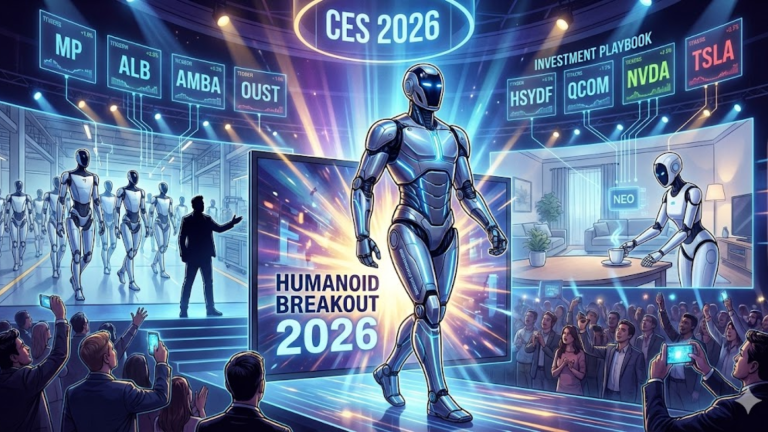
The Consumer Electronics Show (CES) feels like a big deal every year. But this year was different.
At CES 2026, the show floor overflowed with many high-tech curiosities, as usual – a soft-plastic composter, smart Legos, an ultrasonic chef’s knife, even a ring that records conversations with a tap. But for the first time in years, the vaporware haze lifted – revealing something concrete.
Until now, “robotics” at CES meant something akin to a little wheeled trash can that could follow you around while carrying a single beverage. It was a novelty; a toy.
Last week, the toys matured. They got jobs. And they are coming for ours.
For three years, we’ve been perfecting AI’s ‘brain’ – large language and generative models. Now we’re building its ‘body.’
If you thought ChatGPT was disruptive because it could write a workable marketing email, wait until you see what happens when physical AI can unload a shipping container for 16 hours straight without a coffee break.
Welcome to the Humanoid Breakout.
Here’s why this cycle represents genuine commercial traction – and where we see the highest-conviction opportunities.
Boston Dynamics’ Atlas Robot Enters Factory Production
The shift from science fiction to reality became undeniable last week – and one demo, in particular, made it palpable.
The inflection point came during Hyundai‘s keynote via Boston Dynamics‘ Atlas robot.
For years, Atlas was an engineering marvel – with no commercial purpose. The bot did backflips and parkour and danced to Motown.
But at CES 2026, Hyundai (which owns Boston Dynamics) put Atlas to work.
It unveiled the “Production Atlas”: fully electric, sleek, and remarkably quiet. But the real shock wasn’t a backflip; it was an unexciting demo of “parts sequencing.”
Hyundai showed Atlas walking into a disorganized staging area in a mock factory, identifying heavy car components with its new Google DeepMind-powered reasoning ‘brain,’ and precisely placing them onto an assembly line feeder.
The most telling moment was how it moved. When Atlas needed to turn around, it didn’t shuffle its feet like a human. Its torso spun 180 degrees while its legs stayed planted, then bent its knees backward to walk away. It was unnerving to watch – because it was a reminder that these things aren’t constrained by human biology. They are designed for pure efficiency.
Hyundai announced Atlas will be deployed to its Georgia Metaplant this year, moving from R&D project to capital equipment.
Tesla’s Optimus: Manufacturing Scale Meets Humanoid Robotics
If Atlas showed what’s technically possible, Tesla (TSLA) showed what’s commercially inevitable.
While Hyundai is polishing the ‘Ferrari’ of humanoids, Elon Musk is busy trying to build the ‘Model T.’
Tesla’s Optimus project has been easy to mock. Remember the person in the spandex suit dancing on stage? That seems like a lifetime ago.
In late 2025, that narrative shifted. Tesla began deploying Gen 3 Optimus bots inside its own Austin Gigafactory. They aren’t doing complex tasks yet, just moving boxes and sorting basic parts. But the bots are doing it all autonomously, powered by the same Full Self-Driving (FSD) neural nets that run Tesla cars.
Musk, never one to shy away from hyperbole, has doubled down in recent earnings calls. He has repeatedly stated that “Optimus will eventually be worth more than the car business and FSD combined.” That claim sounds bold – until you realize the total addressable market (TAM) for “manual labor” is basically infinite.
The beauty of the Tesla play is that it doesn’t need to find customers. Tesla is the customer. Musk needs thousands of these things just to keep his own factories running. And that internal demand provides a massive runway to perfect the technology before selling it to others.
Expect 2026 to bring the first true ‘fleet’ deployments inside Tesla – the moment when Optimus shifts from prototype to workforce.
1X NEO Brings Humanoid Robots Home at $20,000
Now, this story doesn’t end on factory floors. The next frontier is far closer to home.
Also launching this year is the NEO bot from robotics startup 1X. Unlike the industrial look of Atlas or Optimus, NEO is softer, lighter, and moves with an almost-human grace.
But the headline isn’t the design; it’s the price tag: $20,000, about the price of a mid-range used car.
It’s not cheap, but it’s not “industrial equipment” money. It’s a price point that upper-middle-class early adopters can rationalize for a machine that can supposedly fold laundry, load the dishwasher, and tidy up the house.
Whether NEO actually works as advertised in a chaotic home environment remains to be seen. But the psychological barrier has been breached. A humanoid robot is no longer something you see in a sci-fi movie; it’s something you can pre-order right now.
And this race for the home and factory has triggered a ‘land grab’ for the one thing these robots need to survive: spatial intelligence.
Mobileye Acquires Mentee as M&A Activity Accelerates
When a new sector is truly breaking out, you often see consolidation. The incumbents get nervous and buy the upstarts to acquire their talent and data.
We just got that signal. Mobileye (MBLY), the giant in automotive vision and Advanced Driver Assistance Systems (ADAS), just announced its acquisition of Mentee Robotics.
Why does a car sensor company want a bipedal robot? Because the challenge is the same: a self-driving car must interpret the world in real time to avoid collisions, just as a humanoid robot must do to navigate a living room. It’s all about “spatial intelligence” and navigating unstructured environments.
Mobileye realized its vision stack isn’t just for things with wheels; it’s for anything that moves autonomously. We see this as massive validation that the underlying technology for humanoids is maturing.
With the technology validated and the market starting to consolidate, the next phase is all about positioning – who profits as humanoids scale from demo units to deployment fleets.
11 Best Humanoid Robot Stocks Across the Supply Chain
We are witnessing the birth of a new hardware supercycle. The companies that supply the brains, muscles, and eyes for these machines are about to see demand explode.
Don’t just bet on the robot makers – that’s the low-margin end of the business. Own the bottlenecks instead.
Here is our roadmap for playing the Humanoid Breakout of 2026.

Rare Earth and Lithium Stocks Powering Robotics Growth
You can’t build a million robots without the magnetic materials that make their motors spin. And the supply chain for rare earths is severely constrained.
- MP Materials (MP): The premier Western play. If the Pentagon wants U.S.-made robots, they need MP’s California mine.
- Albemarle (ALB): These bots are battery-hungry. ALB is the blue-chip lithium volume leader.
Leaders of the Robotics Vision Stack
Of course, a robot that can’t see is just a very expensive paperweight.
- Ambarella (AMBA): This is our top pick for vision. Why? Latency. When a robot drops a glass, it can’t wait for a signal to go to the cloud and back to catch it. AMBA makes low-power AI chips that process vision on the edge instantly.
- Ouster (OUST): The “industrial” LiDAR leader. It isn’t chasing low-margin car deals; they are putting lasers on factory bots.
Critical Actuator and Motion Control Stocks
This is the most boring and profitable part of robotics: the gears that allow an arm to hold a 50lb box steady.
- Harmonic Drive Systems (HSYDF): The near-monopoly on high-precision “strain wave gears.” It’s virtually indispensable in precision robotics.
- Moog (MOG.A): For when the robots get bigger and need heavy-duty hydraulics and motion control.
The “Brains” & Connectivity
NVIDIA (NVDA) owns the training. But who owns the deployment?
- Qualcomm (QCOM): Our favorite new play for 2026. Its new “Dragonwing” chips are designed specifically for robots that need both 5G connectivity and on-device AI computing. If you have a fleet of 100 robots in a warehouse, they are talking to each other via Qualcomm.
- NVIDIA: An obvious choice. Every single robot is trained in NVIDIA’s “Isaac Sim” virtual gymnasium before it ever takes a real step.
Humanoid Robot Manufacturers and Top Automation Stocks
This is the high-risk, high-reward layer.
- Tesla: The only company with the manufacturing scale and internal demand to brute-force humanoid adoption.
- Symbotic (SYM): The less “sexy” yet highly effective play. The company is already automating Walmart‘s (WMT) supply chain with non-humanoid bots. It will integrate humanoids as the tech matures.
- PROCEPT BioRobotics (PRCT): The healthcare angle. While everyone watches factory bots, PRCT is quietly revolutionizing surgery with high-growth robotics.
Taken together, these trends mark more than a product cycle – they mark the start of a new industrial era. Robots are moving from the showroom to the supply chain. And for investors, that shift isn’t theoretical anymore – it’s investable.
The Final Word
The window to front-run this trend is closing fast.
The demos are done; the factory orders are being placed. It’s time to allocate accordingly.
The next wave of the AI Boom isn’t staying on a screen. Across factories, warehouses, and hospitals, intelligent machines are stepping into the real world – powered by the same rare-earth magnets and motion systems now being built on U.S. soil.
It’s the natural extension of the AI Capex Boom – and it’s where we see the next 10X opportunity taking shape.
Click here to discover the top plays in the coming AI-robotics surge.

