

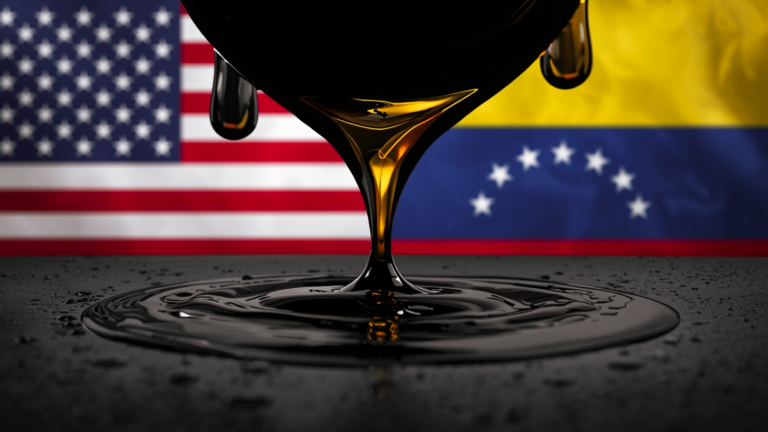
Welcome to 2026. By now, you’ve seen the footage. Blackhawks over Caracas, flashbangs at Miraflores, and Nicolás Maduro in zip ties, looking less like a transnational supervillain and more like some Joe Schmoe yanked out of bed at 3 a.m.
The official line from the briefing room is “Operation Ultimate Justice.” We’re told it was about narcoterrorism, liberation, and restoring the sacred flame of democracy to Bolívar’s cradle.
But let’s be real. You don’t send the 82nd Airborne to seize a head of state because you’re worried about traces of cocaine on banknotes. You do it because the geopolitical chessboard demands a violent rearrangement of the pieces.
This seizure is a geopolitical margin play. And more importantly, it is the loudest signal yet of a massive regime shift in how the world works – a shift where the invisible hand of the market is giving way to the very visible, very heavy hand of Pennsylvania Avenue.
Here is why this takedown marks the definitive end of the era where we could pretend politics and markets were separate spheres – and what that means for your portfolio.
Venezuela’s Heavy Crude Is the Real Prize
The reason U.S. boots are on the ground in Venezuela comes down to industrial chemistry and profit margins on the Texas Gulf Coast.
For 15 years, we’ve been told the U.S. is energy independent because of the shale revolution in the Permian Basin. That’s a half-truth that hides a costly logistical mismatch.
The U.S. pumps immense amounts of “light sweet” crude, comprising most of the 1.7 million barrels produced along the Gulf Coast daily. But the sprawling refinery complexes built there in the 1970s and ’80s – owned by Valero (VLO), Phillips 66 (PSX), and Exxon (XOM) – were designed to process ‘heavy sour’ crude: the opposite of what domestic wells produce.
When the U.S. began heavily sanctioning Venezuela, we cut off the premier source of that heavy sludge. Our refineries have been forced to import expensive replacements from Canada (which requires pipelines) or buy it from Russia (awkward, to say the least) or the Middle East (which means expensive shipping costs).
It created a ridiculous paradox: America, an oil superpower, couldn’t efficiently refine its own oil, while the perfect commodity source sat just across the Caribbean, locked behind a political wall.
Last week, the White House kicked down that wall.
In truth, the ‘narcoterrorism’ indictment was just a legal sledgehammer – the means, not the motive. The real objective is to unlock 300 billion barrels of the exact chemical grade of crude required to make the U.S. refining complex run at peak profitability. It’s about securing the feedstock that allows Valero to turn a barrel of sludge into diesel and jet fuel at maximum margin.
Geopolitically, it’s a bonus that we also seized the collateral for about $12 billion in Chinese loans and kicked Rosneft out of the Western Hemisphere. But make no mistake: this operation was underwritten by the ghosts of industrial capacity.
Market Fallout From the Venezuela Oil Shock
Now, let’s talk about what Maduro’s seizure – and potential U.S. occupation – means for markets, because the fallout will be massive.
The Crude Reality: Short-Term Pop, Long-Term Drop
In the next 48 to 72 hours, expect Brent and WTI to jump $5 to $8. This is the “chaos premium.” There will be fears of colectivos blowing up pipelines or loyalist generals torching infrastructure on their way out, which is why insurance rates on tankers in the Caribbean just tripled.
But fade that rally.
If the U.S. military can secure the oil fields in the Orinoco Belt (a big “if,” but that’s the mission), the medium-term outlook is overwhelmingly bearish for global oil prices. Venezuela currently pumps less than 1 million barrels a day. With U.S. capital and expertise, that could hit 2.5 million within 18 months.
The world is already awash in supply. Dumping another 2 million barrels onto the global market daily puts a titanium ceiling over oil prices. We are looking at a long-term future of $60 to $65 oil – great for consumers and terrible for petrostates that aren’t us.
Gulf Coast Refiners Are the Biggest Winners
The cleanest trade on this entire operation is the U.S. refining sector.
If you own Valero, Phillips 66, or Marathon Petroleum (MPC), you just won the lottery.
Their input costs (heavy crude) are about to collapse relative to the price of the finished product (gasoline and diesel). Their “crack spreads” – the profit margin on refining – will blow out to historic highs. They are finally getting the feedstock they were built for, delivered cheaply from across a U.S.-controlled Caribbean Sea.
Chevron is likely the first mover here. It’s the only major U.S. player that never really left Venezuela. It kept a foot in the door, operating under special licenses even during the darkest days of Maduro’s governance.
Chevron is now the de facto operating arm of the U.S.’ reentry into Venezuelan energy. It has the maps, the geology data, and the personnel on the ground. While other major players are negotiating entry with the new transitional government, Chevron will already be pumping.
Who Loses When Venezuelan Oil Returns
If Gulf Coast refiners can get cheap Venezuelan heavy crude via tanker, they don’t need expensive Canadian heavy crude shipped via rail or controversial pipelines. This is a direct shot across the bow of Canadian oil sands producers like Suncor (SU).
Furthermore, if global oil prices stabilize lower because of Venezuelan supply, high-cost U.S. shale producers in the Permian – those who need $75 oil to break even – will feel the squeeze.
Venezuela Signals a New Era of State-Driven Markets
If you are just trading the oil pop, you are missing the forest for the burning trees. The Venezuela raid is a microcosm of a much larger, more significant dynamic that will define investing for the next decade.
We are witnessing the definitive end of the neoliberal consensus: the idea that the government sets the rules, then steps back to let the market play.
That era is dead. We are now in the era of the Imperial Executive.
The White House is no longer just a regulator. It is an active, aggressive participant in every facet of economic life. Maduro’s seizure is just the most kinetic example of a mindset that views everything – from foreign borders to corporate boardrooms – as terrain for executive action.
Consider the pattern over the last few years leading up to this moment:
- Trade: The White House is fundamentally managing trade flows, deciding which industries thrive based on “national security” imperatives that change with the political winds.
- Domestic Industry: We’ve seen the government taking direct equity stakes in critical companies, from semiconductor manufacturers to green energy firms, blurring the line between public interest and private profit. The State is now the ultimate venture capitalist.
- Foreign Policy as Economic Policy: America is using the Treasury Department as a weapon, the dollar as ammunition, and, now, the Marines to execute hostile corporate takeovers of sovereign nations.
Venezuela is the thesis statement of this new regime: There is no such thing as a “private market” separate from state power.
The Final Word
The White House has decided the invisible hand is too slow, too inefficient, and too unreliable to secure American interests. So, it’s donning brass knuckles instead.
What does this mean for you as an investor?
It means the old models of fundamental analysis – discounted cash flows, P/E ratios, competitive moats – are secondary to politics.
You cannot model a company’s future cash flows without first modeling its relationship with Pennsylvania Avenue.
- Is the company’s supply chain aligned with White House foreign policy? (If it runs through China, sell. If it runs through the new U.S.-occupied Venezuela, buy.)
- Is the industry considered strategically vital enough to receive massive state subsidies or protectionist tariffs?
- Is the CEO on the right email chains with the Commerce Department?
In this new world, alpha isn’t generated by finding an undervalued asset in a free market but by correctly anticipating where Washington’s eye will land next.
If the White House decides it wants heavy crude, it will kick down a door in Caracas to get it. If it wants chips, it will flood the zone with subsidies. And if it wants control, it will legislate competitors out of existence.
The State is armed. It’s hungry. And it’s not asking permission.
The best trade right now isn’t growth or value. It’s alignment.


