


Editor’s Note: At InvestorPlace, we have a wide range of perspectives and styles. We don’t all trade the same way – and that’s a good thing. One of us may spot something the rest of us missed, opening our eyes to something that we – or the market – have overlooked.
In fact, that’s what my colleague Jonathan Rose has done. He looks at the market through a different lens than I do, and he has an idea I think every investor should hear. He believes AI isn’t just changing how businesses operate – it’s changing how people work, how money moves and how policy decisions get made.
What stood out to me here is how clearly he explains what may be coming next – and why Wall Street might be underestimating it.
Jonathan recently hosted a free presentation called The Profit Surge Event, where he walked through how he’s trading this setup – and shared a few names he’s watching now.
Click here to watch the full replay.
Now, I’ll turn it over to Jonathan…
*****************
2025 was supposed to be the year AI took over everything.
Every major AI champion – from Sam Altman to Elon Musk – was predicting rapid job replacement, superhuman productivity, and AGI just around the corner.
Markets bought into the narrative. AI stocks surged, hyperscalers absorbed more share, and capital crowded into the trade.
To be clear, there were real opportunities. Over the past six months, I’ve helped my members capture double- and triple-digit gains in both marquee AI names and smaller, overlooked players tied to the build-out.
But here’s the reality: AI’s moment hasn’t unfolded the way most people expected.
We haven’t seen robots running the economy or machines suddenly replacing every job. What we are seeing, however, are the early signs of something far more important – a structural shift that will reshape work, income, and capital allocation well beyond this hype cycle.
And this shift is moving faster than markets, policymakers, or most investors realize.
So in this report, let’s move past the headlines and focus on where the real opportunity is forming.
Specifically, I’ll show you:
- How AI is already reshaping the labor market – and why the impact is appearing faster than most investors expect.
- Why the Federal Reserve’s traditional tools don’t work the same way in an AI-driven economy.
- How a new layer of digital money and payment infrastructure is emerging – and why the companies behind it remain badly mispriced.
If you want to understand where the next wave of asymmetric upside is coming from, keep reading.
The Labor Market Is Already Showing Signs of Structural Stress
Over the past year alone, some of the largest companies in the world have already started acting on it:
- Amazon.com Inc. (AMZN) cut 14,000 corporate roles – its largest layoff ever.
- Verizon Communications Inc. (VZ) eliminated more than 13,000 jobs, citing modernization and automation.
- IBM Corp. (IBM) is slashing back-office roles and freezing hiring wherever AI can handle repetitive tasks.
And those are just the headlines.
More than 4,200 companies have announced layoffs or hiring freezes this year as AI becomes embedded in daily operations.
The International Labour Organization warns that clerical and cognitive jobs are highly exposed to generative AI. And research from the Federal Reserve Bank of St. Louis links higher AI exposure to rising unemployment risk.
The chart below shows that the most AI-exposed occupations have seen the sharpest unemployment increases since 2022:
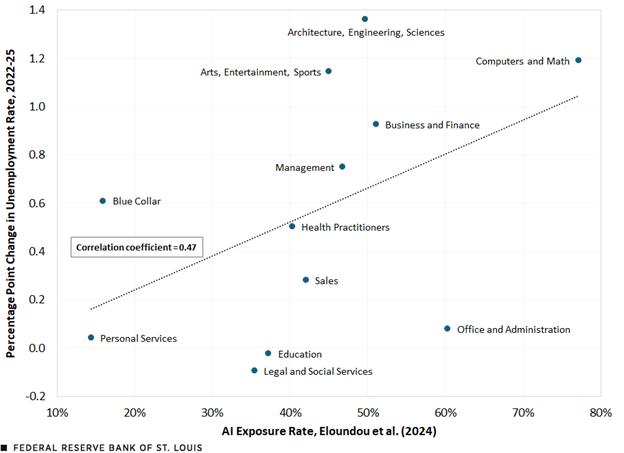
In other words, the disruption isn’t theoretical. It’s already happening.
AI won’t remove humans from the economy entirely. Its real impact is forcing a reorganization of how work, income, and productivity function. Workforce retraining, automation support, and income stabilization will become central pillars of the next economic phase.
And that creates a powerful, underappreciated macro trend – one that markets have not fully priced in yet.
I’ve already helped readers profit from early stages of the AI build-out, from high-profile AI software names to critical supply-side players fueling the infrastructure behind it.
What matters now is understanding what comes next – because this shift doesn’t stop with labor.
It changes how monetary policy works… and how money itself moves through the system.
The Fed’s Tools Don’t Work for This Problem
The Federal Reserve operates under a simple mandate: maximum employment and price stability.
Cheaper money through Fed rate cuts encourages businesses to borrow, invest, expand, and hire.
At least, that’s how it used to work.
That framework assumes companies need more people to grow. In an economy increasingly shaped by AI and automation, that assumption is breaking down.
If the Fed cuts rates again, it will absolutely make life easier for businesses. But instead of fueling job creation, cheap capital now accelerates investment in automation.
Every dollar of lower-cost financing makes AI systems, robotics, and software-driven scale more attractive than hiring. Instead of hiring, companies invest in data centers, robotics, and automated systems.
Rate cuts can still support markets. They can boost earnings, strengthen balance sheets, and lift asset prices. What they can’t do is reverse a structural shift in how work gets done.
The labor disruption showing up in 2025 data is only the early phase.
Retraining and productivity gains will matter. But the transition will be uneven – and job displacement will remain a growing pressure.
And that’s where the next, less-discussed force enters the picture – one that’s reshaping how income is delivered and how money moves through the economy.
This shift isn’t limited to labor. Money itself is going digital.
Around the world, physical cash and slow payment systems are being replaced by fully digital money rails that move value instantly. That transition is quietly reshaping how income is paid, how support is delivered, and how economies function in an AI-driven world.
At the center of this new monetary architecture are central bank digital currencies, or CBDCs – digital versions of national currencies designed to move in real time.
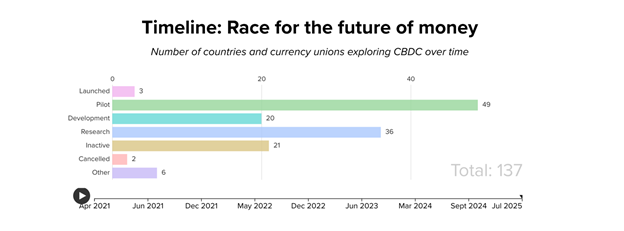
More than 130 countries are already exploring or piloting CBDCs. Institutions like the International Monetary Fund are actively pushing tokenization and real-time settlement standards.
The same infrastructure is taking shape in the United States.
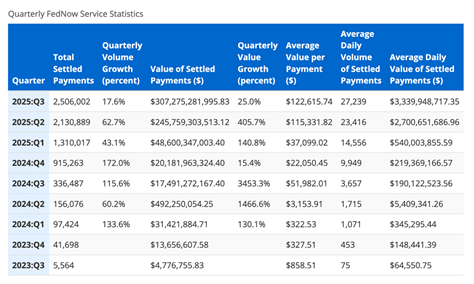
In 2023, the Federal Reserve launched FedNow, a 24/7 instant-payment network that allows banks to send and settle money in real time. It isn’t a CBDC, but it is the digital plumbing the U.S. financial system will increasingly run on — the foundation for instant, fully digital money movement.
And it isn’t just governments building these rails.
While official CBDC proposals face political resistance, private-sector platforms – including Visa, Mastercard, and PayPal – already operate digital payment networks at massive scale.
The digital infrastructure needed for large-scale, real-time income distribution already exists – even if the public conversation hasn’t caught up yet.
As AI accelerates job disruption, it’s becoming clear that monetary policy alone can’t stabilize the system.
One likely response is fiscal – using digital infrastructure to deliver income support directly. That support could take many forms, from wage stabilization and automation offsets to emergency payments or baseline income programs. The labels may differ, but the mechanism is the same.
As those payments move across digital rails, money flows will concentrate in the companies that operate them.
These rails include payment networks, instant-settlement systems, and digital wallets – the infrastructure that will carry the next generation of money movement.
What most investors haven’t priced in yet is how valuable that infrastructure becomes when income itself goes digital.
Who Benefits From This Shift?
Large payment networks like Visa Inc. (V), Mastercard Inc. (MA), and PayPal Holdings Inc. (PYPL) are obvious beneficiaries. But digital-first platforms are positioned for even larger landgrabs.
Coinbase Global Inc. (COIN) sits at the center of U.S. digital-dollar infrastructure. Through its stablecoin, USDC, Coinbase participates across the full stack – payment flows, reserves, settlement, custody, and institutional access.
In practice, stablecoins already function as the private-sector version of a digital dollar. They’re doing the job long before official government solutions arrive.
If future income support is delivered digitally – and those payments flow through private platforms – the companies issuing and moving digital dollars become structural winners. Coinbase is one of the clearest examples.
All of this sits inside a global payments ecosystem worth roughly $2.4 trillion today, projected by McKinsey to reach $3.1 trillion by 2028 – before accounting for any digital income-support flows. Add recurring digital payouts, and the opportunity grows significantly.
Why You Need to Act Now
System-level shifts don’t announce themselves. They appear first in data, then in capital flows, and finally in prices.
Right now, we have labor disruption, a central bank with limited tools, and global digital money rails expanding rapidly. Yet the companies enabling this convergence remain undervalued relative to the role they’re poised to play.
That disconnect creates a rare opportunity to position early in what could be one of the most important macro shifts of the coming decade. The market just hasn’t connected the dots yet.
The real edge comes from knowing how to turn a structural thesis into a disciplined trade – with defined risk, asymmetric upside, and a framework that holds up through volatility.
That’s exactly why I recently hosted The Profit Surge Event… joined by my colleagues at InvestorPlace: Louis Navellier, Eric Fry, and Luke Lango.
In it, I walk through how to identify these hidden infrastructure plays and apply a simple trading framework that has historically amplified strong stock ideas into outsized gains. And Louis, Eric, and Luke share their highest-conviction names.
I’m reopening access to The Profit Surge Event, along with a free report featuring their three high-conviction stock ideas positioned for this shift.
You can watch the replay right now and see how to position for what’s coming next.
Remember, the creative trader wins.

Jonathan Rose,
Founder, Masters in Trading


