
Listen to the audio version of this article (generated by AI).
In the summer of 1919, then-Lieutenant Colonel Dwight D. Eisenhower set out on a journey from Washington, DC, to San Francisco.
Today, you could make that trip in about 45 hours of driving time, or about 4-5 days depending on how much you chose to drive each day.
But Eisenhower wasn’t driving on modern highways. He was part of a military convoy attempting to cross the country on roads that were not always worthy of the name.
Vehicles frequently broke down; the convoy broke and repaired dozens of wooden bridges and reported that nearly all roadways were unpaved from Illinois through Nevada.
The trip took 56 days and left a lasting impression on the young officer.
It’s no surprise then that when Eisenhower became President, he championed the effort to build the Interstate Highway System.
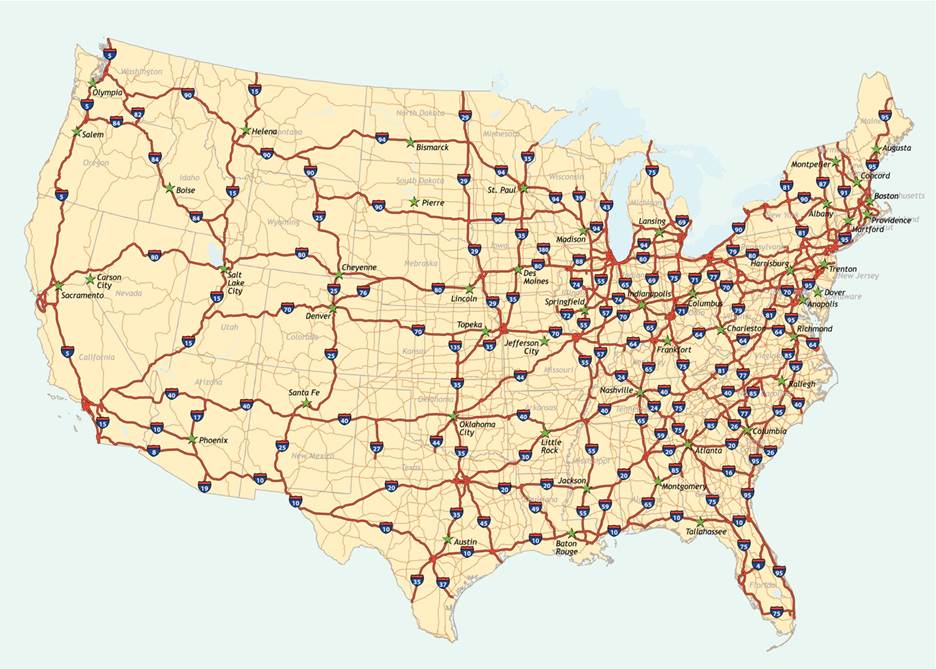
That infrastructure buildout changed America.
As it continued, goods began moving across the country faster and more efficiently. Businesses started reaching customers hundreds or even thousands of miles away. Entire industries grew around the new network of roads.
Seventy years after Eisenhower signed the Federal-Aid Highway Act of 1956, the Interstate Highway System has generated more than $6 in economic activity for every dollar spent on its construction, according to the American Society of Civil Engineers.
And a huge chunk of that wealth didn’t go to the companies building the highways.
Major freight haulers and companies such as FedEx (FDX) and UPS (UPS) have been huge beneficiaries of the ease of travel.
Many major businesses generate substantial revenue by locating their operations along highways. It could be McDonald’s (MCD), Waffle House, or Cracker Barrel. And if you’ve made a major cross-country road trip, maybe you’ve stayed in a Motel 6 or Holiday Inn.
None of these companies built the infrastructure – but they capitalized on it, building huge businesses.
And we’re seeing something similar happening in America today.
The Next Great AI Companies
Companies like Microsoft (MSFT), Amazon (AMZN), Alphabet (GOOG) and Meta (META) have spent billions on AI infrastructure. They’ve built enormous data centers, bought countless computer chips and worked to secure enough electricity to run it all.
Wall Street traders have rewarded these companies with extraordinary market gains.
But are we forgetting the lessons about who grows rich from infrastructure buildouts? What if the next great fortunes are going to come from the companies that figure out how to use it to their best advantage?
Those are the companies Eric Fry is looking for. And he has a great history of finding them.
Eric is an expert global macro investor – that means he follows the world’s biggest trends and then homes in on the few companies best positioned to profit from them.
And he has seen this type of opportunity before.
Back in 2000, investors were pouring billions into the companies building the internet.
Telecommunications companies were laying millions of miles of fiber-optic cable. Technology stocks were soaring. And Wall Street couldn’t get enough of the companies making it all possible.
But while companies like Cisco and Corning were soaring, Eric recognized something most investors were missing. Many of the companies building the internet were borrowing enormous sums to build infrastructure that was rapidly becoming cheaper to use.
That’s when Eric started to look elsewhere.
One of the companies he found was Humana (HUM).
Yes, the health insurance company.
Its stock had fallen 59% from its previous high. But behind the scenes, Humana was using the internet to streamline claims processing, reduce administrative costs and improve its business.
Wall Street was largely ignoring it, but Eric wasn’t.
He recommended Humana to his readers. Over the next five years, the stock gained more than 350% and eventually rose roughly 4,000%.

Meanwhile, Cisco (CSCO), one of the great infrastructure stocks of the internet boom, collapsed nearly 90%.
Eric didn’t predict the end of the internet. But he did recognize that the next great winners might not be the companies everyone was watching.
And now he believes history is about to repeat itself with AI.
In fact, Eric believes we’re at a turning point in the AI boom.
He calls it “The Separation Phase.”
It’s when the companies that built the infrastructure begin to lose their advantage… and a new group of winners emerges.
Eric calls these companies “AI Appliers.”
They’re not necessarily technology companies. In fact, some of them operate in industries you’d never associate with artificial intelligence.
But they’re using AI to transform their businesses, cut costs and potentially generate extraordinary profits.
And Eric believes some of these overlooked companies could double in value over the next 12 months.
More importantly, he believes the shift could begin as soon as November 4 – the morning after the midterm elections.
That’s why he’s just recorded an urgent new presentation explaining what he sees coming, why some of America’s most popular AI stocks could be vulnerable, and where he believes investors should look instead.
He’ll also reveal how his Apogee system is identifying these opportunities — and give you the name and ticker symbol of one AI Applier he’s recommending right now.
Click here to watch Eric’s AI briefing — and discover the next generation of potential AI winners.
Enjoy your weekend
Luis Hernandez
Editor in Chief, InvestorPlace

