
Natural gas has its best day in four years… an arctic blast across the country… why the opportunity is much bigger… Eric Fry’s top stock… how to catch a free replay of “Prediction” 2026
As I write Wednesday afternoon, stocks are rallying sharply after President Trump announced he and NATO Secretary General Mark Rutte have “formed the framework of a future deal with respect to Greenland.”
The relief comes from Trump saying that as a result of this negotiation, he would no longer impose the punitive tariffs on European countries that were set to begin February 1.
As I write, details about the framework agreement remain unclear. But the announcement marks a stunning reversal in the ongoing controversy over Trump’s efforts to acquire Greenland for the U.S.
In yesterday’s Digest, we dove into Trump’s interest in taking control of the Danish territory. His recent statements had amped up global geopolitical fears, with Trump threatening 10% tariffs starting next month – escalating to 25% in June – on eight NATO countries that had increased their military presence in Greenland.
That uncertainty triggered yesterday’s selloff, the worst day for stocks since October 10. But earlier today, during his speech at the World Economic Forum in Davos, Trump said:
I don’t have to use force. I don’t want to use force. I won’t use force.
That comment sparked an initial relief rally. Then came this afternoon’s announcement of a “framework” deal, sending stocks even higher.
We’ll keep tracking this story as it develops. But for now, markets are happy again.
And there’s one market in particular that’s very happy…
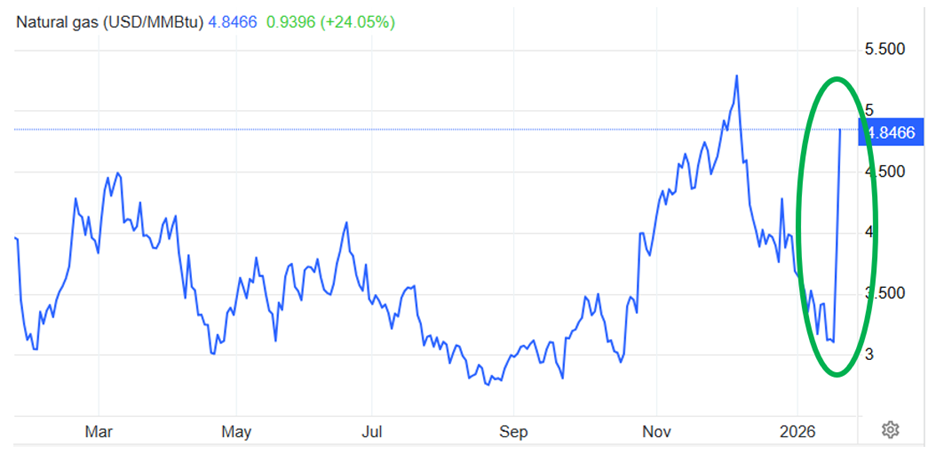
Natural gas prices are surging on the back of cold weather gripping much of the country
I don’t use “surging” lightly.
Look at what’s happening on this one-year chart for the price of natural gas.
Source: Trading Economics
Here’s CNBC from yesterday:
Prices surged 25%, or 78 cents, to $3.89 per million British thermal units by 10 a.m. ET, putting natural gas futures on pace for the best day in four years.
Prices are up another 20% here on Wednesday.
Legendary investor Louis Navellier flagged this in yesterday’s Growth Investor Flash Alert podcast:
Natural gas prices are up quite a bit because it’s cold in the Northeast and Midwest, and that cold has extended into the South, affecting places like Atlanta.
So, because we have big metro areas cold right now and the cold may persist for a while, natural gas prices are up.
“Cold” doesn’t quite describe it – it’s really cold.
According to the National Weather Service, wind chills could hit -50 degrees Fahrenheit across the Upper Midwest and Northern Plains. By Sunday, that sub-zero weather system is expected to expand into the Ohio Valley, then the Northeast.
But according to Eric Fry, this short-term weather-driven spike in natural gas prices is just the beginning of a much bigger story
In his 2026 forecast for Fry’s Investment Report, Eric – our macro investing expert – highlighted several structural tailwinds that should keep natural gas prices elevated, and natural gas stocks climbing, throughout the year.
Here’s Eric:
The United States has become the world’s largest LNG exporter.
LNG plants along the Gulf Coast now absorb more than 14% of total U.S. natural gas production, and ship it to destinations in Europe and Asia.
Once an LNG facility starts up, its demand does not fluctuate with seasonal weather conditions. It pulls gas like a vacuum cleaner, nonstop, year-round, as long as a hefty price differential exists between pricey European gas and cheap U.S. gas.
Add in surging demand from AI data centers – which could boost demand for natural gas by 20% to 45% over the next five years – and you have a recipe for sustained higher prices.
So, how do you play it?
For an easy one-click option, check out XOP, State Street’s SPDR S&P Oil & Gas Exploration & Production ETF. It holds a handful of oil/gas heavyweights, including Exxon (XOM), Occidental (OXY), and ConocoPhillips (COP).
If you’re looking for a more concentrated bet, one of Eric’s top picks is Devon Energy Corp. (DVN), one of the leading producers in the Delaware Basin.
For years, Devon’s natural gas has been “stranded” – trapped by insufficient pipeline capacity. But two major pipeline projects are changing that equation. The Matterhorn Express came online earlier this year, and the Blackcomb Pipeline will enter service in the second half of 2025.
Together, these pipelines give Devon direct access to premium Gulf Coast pricing and to the booming LNG export terminals.
Despite these improving fundamentals, Devon trades at less than nine times forward earnings – barely half the valuation of the average natural gas stock.
As Eric puts it:
When investors stop pricing Devon as a stranded-gas problem and start pricing it as a beneficiary of a higher-floor natural-gas regime, the stock will merit a meaningfully higher multiple.
It looks like investors are beginning to make this pricing adjustment. As you can see below, DVN is up 10% over the last nine days while the S&P has fallen 1%.
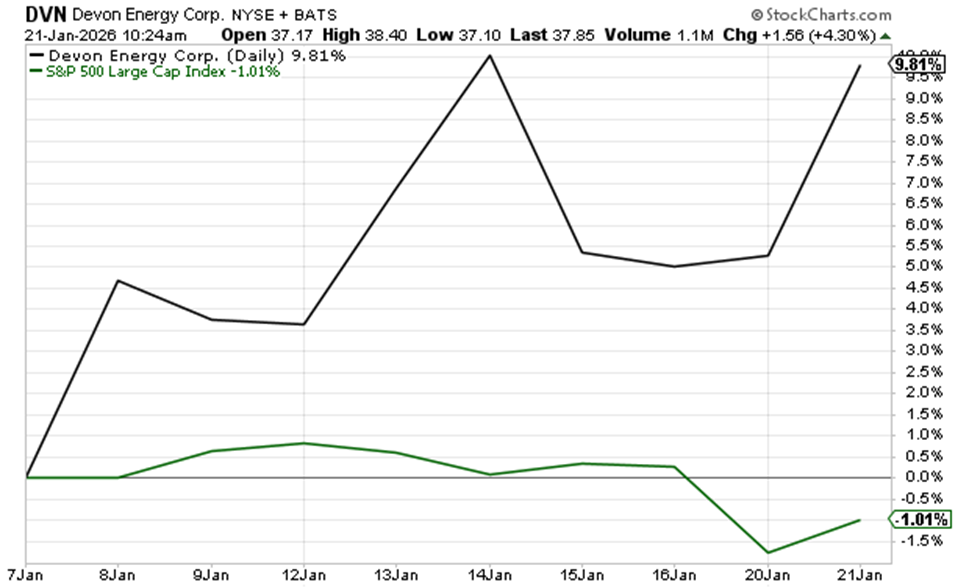
Eric says that Devon is a “Buy” below $45.00.
To keep up with all of Eric’s latest natural gas research and updates on DVN, click here to learn about joining him in Fry’s Investment Report.
Meanwhile, Luke Lango says 2026 could be the breakout year for space stocks
Let’s turn to space.
According to our hypergrowth investing expert Luke Lango of Innovation Investor, three major catalysts are converging to create what he calls a “rare and bullish setup” for space stocks in 2026.
First, there’s the White House Space Executive Order signed in mid-December, titled “Ensuring American Space Superiority.”
It sets hard deadlines: a crewed Moon landing by 2028, a commercial pathway to replace the International Space Station by 2030, and a mandate to shift government contracts toward “commercial-first” procurement.
Here’s Luke on why this matters:
This is important because the fastest way to create winners is to change how contracts are awarded.
When Washington shifts from cost-plus, bespoke contracting to commercial-first, fixed-price models, a different set of companies starts to win.
Second, there’s the emergence of what Luke calls “Space AI” – the idea of orbital data centers.
It sounds absurd until you realize that Nvidia (NVDA) is already profiling startups pursuing space-based data centers. Alphabet (GOOGL) is partnering with Planet Labs (PL) on “Project Suncatcher” to launch space-based Google AI data centers by 2027. And Tesla (TSLA) CEO Elon Musk has talked about using SpaceX to provide orbital computing for his AI company, xAI.
Back to Luke:
We are witnessing the birth of Space AI, the next multi-trillion-dollar hardware supercycle.
The ‘AI Power Wall’ on Earth is forcing hyperscalers to look toward orbital data centers for inference and radiation-hardened edge computing.
Third, there’s the potential SpaceX IPO in 2026 – which could raise $25 billion-plus and value the company above $1 trillion.
Luke believes this event would “re-rate the entire space sector overnight,” much like Tesla’s success legitimized the broader EV industry.
What’s the portfolio action step?
Luke highlights Rocket Lab (RKLB) as a top opportunity.
The company just landed an $805 million contract in December to deliver 18 missile warning satellites – its largest deal yet, nearly 50% larger than its entire 2024 revenue.
By the way, a huge “congratulations” to Luke’s Early Stage Investor subscribers. After getting into RKLB back in June 2022, they’re up 1,002% as I write on Wednesday.
Luke also points to Planet Labs (PL), which secured a $260 million contract from Germany in July 2025 and saw its contract backlog surge 245% year over year. The stock is up over 477% over the last 52 weeks.
Luke’s bottom line:
If you’re looking for a way to keep playing AI upside while everyone fights over the same data center trades… space is a natural new hunting ground.
For Luke’s complete analysis of the Space AI opportunity – including the small company he believes sits at the center of this trillion-dollar disruption – click here to watch his latest briefing.
Finally, if you missed Keith Kaplan’s “Prediction” event yesterday, the replay is available now for a limited time
Yesterday morning, TradeSmith CEO Keith Kaplan hosted Prediction 2026, where he unveiled the company’s breakthrough Seasonality tool.
This next-gen trading tool is anchored in a simple but powerful insight: thousands of stocks show historically reliable windows – specific times of year when they tend to rise. Keith calls them “green days.”
TradeSmith’s software identifies these patterns with remarkable precision across roughly 5,000 stocks – down to the exact day.
Take Target (TGT). Over the past 15 years, between June 22 and July 21, the stock has risen an average of 5.2%, climbing 100% of the time. In 2025, it gained 10.3% during that window.
These aren’t one-off patterns. In an 18-year backtest, TradeSmith’s seasonal trading system generated 857% total growth – that’s more than double the S&P 500’s return over the same period.
During yesterday’s event, Keith walked through how the system works, why these patterns persist, and – most important – why January 28 is a critical date to watch as new seasonal windows are likely to be opening up.
Click here for all these details and to see the Seasonality tool in action.
We’ll keep you updated on all these stories here in the Digest.
Have a good evening,
Jeff Remsburg


